
Managing online reviews has become essential for any business that depends on local search visibility and customer trust, but choosing the right tool to do it isn't straightforward.
Here's our breakdown of the best online review tools in 2026, with hands-on impressions, real pricing, and verified user feedback.
Best online review tools at a glance
No time to go through the full list? Here’s a quick overview.
| Software | Starting price | Free trial available? |
| LocalImpact | $19/month | Yes |
| Reputation.com | $80/location/month | No |
| Reviewshake | $29/month | Yes |
| Broadly | $799/month | No |
| Podium | Custom pricing | No |
| Birdeye | Custom pricing | No |
| Grade.us | $124/month | Yes |
| NiceJob | $75/month | Yes |
| GatherUp | $99/month | Yes |
| ReviewTrackers | $89/location/month | No |
| TrueReview | $49/month | Yes |
How we chose these tools
We logged 150+ hours testing each platform, including hands-on use of dashboards, review request flows, and reporting features. Our evaluation focused on the criteria that matter most to the businesses actually using these tools day to day:
- Ease of setup and use: How quickly a non-technical owner or small team can get the platform running without dedicated support, and how intuitive day-to-day workflows feel once everything's configured.
- Review generation capabilities: The strength of automated request flows over SMS, email, and QR code, plus the ability to time invites around real customer touchpoints.
- Multi-platform monitoring: How many review sources each tool tracks (Google, Facebook, Yelp, and industry-specific platforms) and how well it consolidates everything into one inbox.
- Reporting and analytics: Depth of sentiment analysis, trend reporting, and competitor benchmarking, plus how easy it is to share insights with stakeholders.
- Integrations: Direct connectors to CRMs, field service software, and other tools businesses already rely on, so review data flows automatically.
- Pricing transparency and value: Whether starting prices are published, what add-ons cost, and how much businesses actually pay once contracts and overages are factored in.
1. LocalImpact
LocalImpact is built for owner-operators and agencies who need to collect, monitor, respond to, and showcase reviews without the cost or complexity of an enterprise platform.
Setup is fast: connecting Google and Facebook profiles, customizing a review request, and embedding a widget on a website takes just a few minutes.
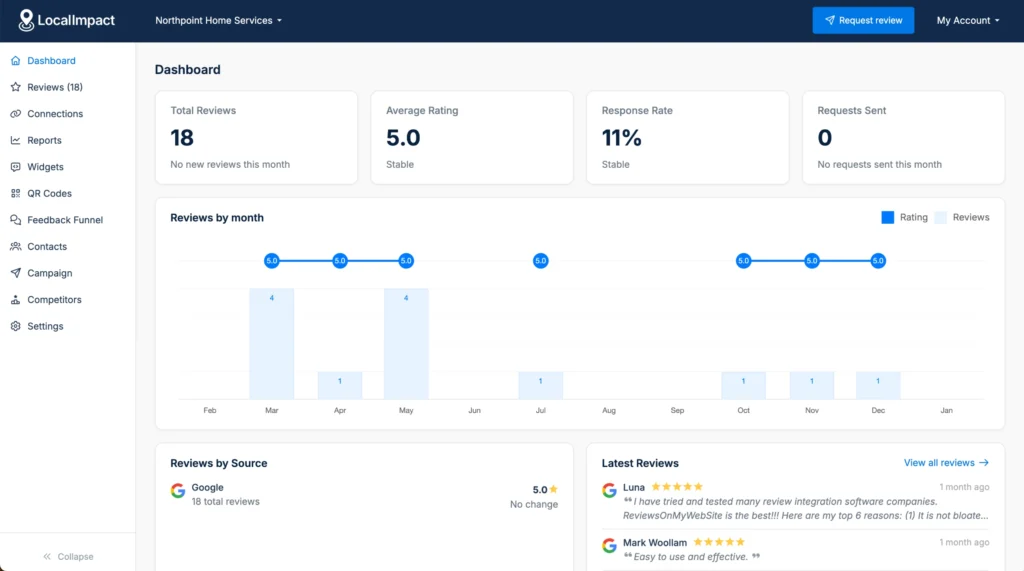
LocalImpact covers the full review management workflow at an accessible price point. You get automated SMS and email review requests, AI-generated replies, and a customizable widget builder with 8+ layout options.
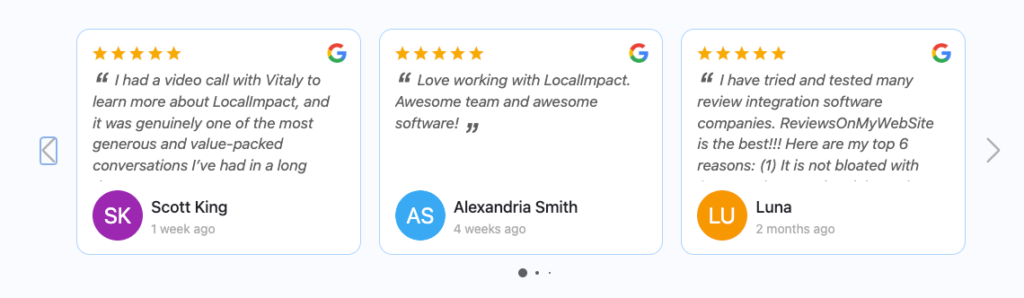
Social sharing and a white-label dashboard for agencies round out the feature set. Integrations include Jobber, Housecall Pro, HubSpot, QuickBooks, and Zapier.
Key features
- Automated review requests: Send invitations by SMS, email, QR code, or shareable staff link, with automated follow-ups that re-engage customers who didn't respond the first time.
- AI review replies: Generate context-aware responses to reviews in seconds, with one-click tone and length adjustments to keep replies aligned with your brand voice.
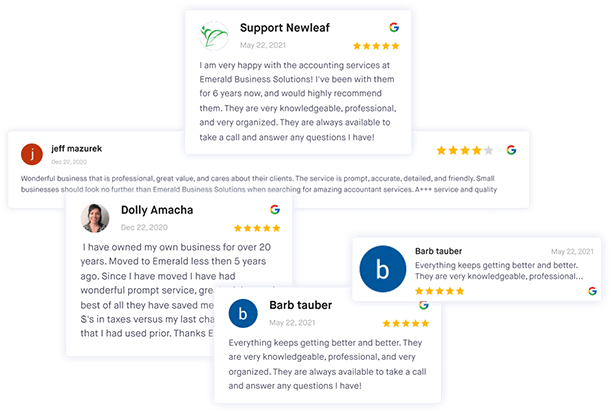
- Review widget: Embed reviews on any website using copy-and-paste code, with eight layout options (list, slider, carousel, grid, masonry, flash, rating badge) and full styling control.
- Feedback funnel: Route happy customers toward public review sites and capture negative feedback privately, so you can address issues before they become public reviews.
- Social sharing: Turn standout reviews into branded social media graphics with customizable templates, fonts, and colors, ready to publish without design work.
- White-label agency dashboard: Resell reputation management under your own brand with a custom logo, favicon, and domain, plus multi-client management from a single account.
What users say
Users consistently highlight how easy LocalImpact is to set up and the strength of its support team.
"The platform is extremely easy to set up and integrate with my existing website. The dashboard is simple to navigate, and the automation tools save me time collecting and displaying reviews.
Customer support is quick to respond and always helpful."
Pricing
LocalImpact offers a 14-day free trial with no credit card required.
Paid plans include:
- Growth ($49/month)
- Pro ($99/month)
- Agency ($149/month)
Get more online reviews for your business
Monitor, manage, and get more online reviews for your business with LocalImpact.
2. Reputation.com
Reputation positions itself as a reputation performance engine built for the AI era, and that framing matches what we saw inside the platform.
Reviews, listings, surveys, social, and competitive benchmarking all sit under one roof, with an AI layer (Reputation IQ) that lets you query feedback data in plain English instead of building reports.
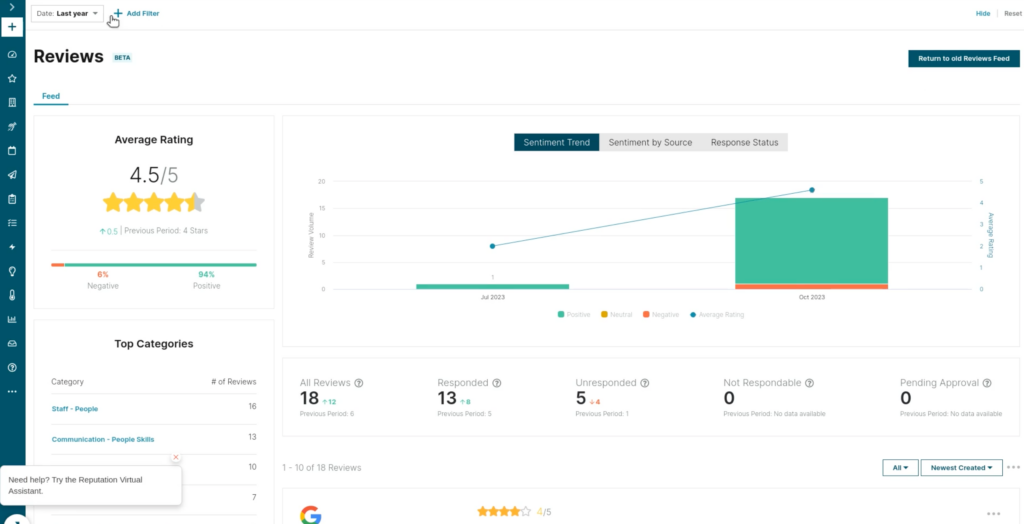
The depth is the draw for enterprises and the friction for everyone else.
Multi-location brands with regional managers, franchise leaders, and CX teams benefit from the role-aware insights and routing workflows, while smaller operators often find themselves paying for capabilities they don't have the team to use.
Key features
- Reputation IQ: Ask plain-English questions about your feedback data and get role-aware answers without building reports or exporting dashboards.
- Reviews and Review Booster: Automate SMS and email review requests, centralize responses across sources, and generate AI-assisted replies tuned to your brand voice.
- Listings and local SEO: Keep business listings accurate across major directories and improve visibility in both traditional and AI-driven search results.
- Surveys: Collect private feedback alongside public reviews, then route survey responses into operational workflows for follow-up.
- Insights and Journey Insight: Unify signals across reviews, surveys, and listings into one performance layer, and map sentiment across the full customer lifecycle.
- Actions: Convert recurring negative feedback into routed tickets with ownership, SLAs, and escalation tracking.
- RepScore: Track overall brand health through a single metric built from nine reputation factors, updated in real time.
Pros & cons
Pros
- Role-aware permissions and dashboards that work for hierarchical multi-location structures
- Strong industry-specific configuration for verticals like automotive, healthcare, and care & living
- Closes the loop between insight and action through tickets and assigned ownership
Cons
- Implementation typically takes around two months, with onboarding load on internal teams
- Reporting and social media analytics can feel less polished than the core review workflows
- The UI can feel dense for non-marketing users like branch managers
What we like
Reputation IQ is the standout. Being able to type "How are we performing compared to last quarter in the Southeast region?" and getting a usable answer with the right data attached is meaningfully faster than building a custom report.
And the fact that it's trained on your hierarchy and naming conventions means the answers actually fit the structure of your business.
What users say
Users consistently call out the value of consolidating reviews, surveys, and social into one place across many locations.
"Reputation really keeps everything organized and in one place. The reviews, the metrics, and all the social media integrations allow me to schedule easily across platforms."
A common piece of feedback centers on reporting depth and customization.
"I think the reporting is a bit clunky. You can filter by year and template status, but it takes a few tries to kinda get that down, and I've had to retry associates on it."
Pricing
Reputation doesn’t offer a free trial. Plans are priced per location, per month, with optional add-ons and managed services available.
Paid plans include:
- Rep Core ($80/location/month)
- Rep Core + Pulse ($115/location/month)
- Rep Core + Surveys ($150/location/month)
3. Reviewshake
Reviewshake positions itself as a best-in-class reputation management solution built specifically for SMBs and resellers, with a clear focus on online reviews rather than the broader customer experience suites.
Going through the platform, we found the dashboard organized around four core jobs: generating reviews, monitoring and responding to them, showcasing them as social proof, and analyzing performance.
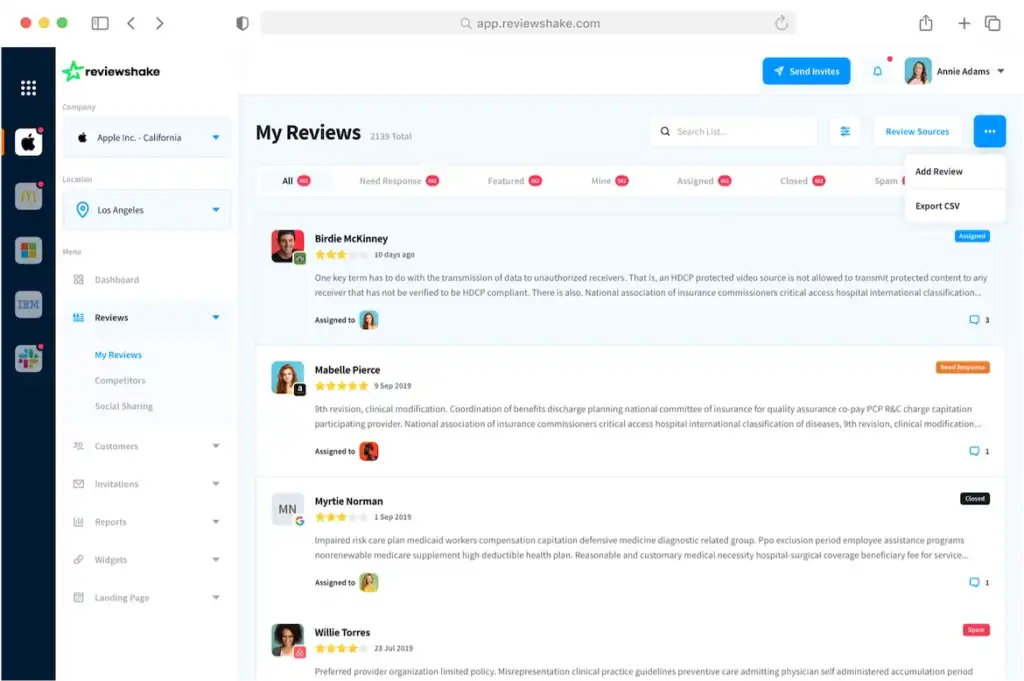
The AI layer is where Reviewshake leans in hardest.
Reply suggestions adapt to brand voice, sentiment analysis surfaces trends across your own reviews and your competitors', and adaptive campaign optimization tweaks review request workflows in real time based on engagement data.
Key features
- Automated multi-channel review campaigns: Send branded review invites via SMS, email, or QR codes with smart timing rules and automated follow-up reminders proven to lift conversions.
- AI-powered reply suggestions: Generate on-brand responses to reviews automatically, with sentiment-aware tone adjustments to keep replies professional and consistent.
- Centralized review inbox: Monitor reviews from across the major review sites in one dashboard, with real-time alerts for new or negative feedback.
- Customizable review widgets: Embed carousels, grids, or pop-ups on your website that update automatically as new reviews come in, with branded styling controls.
- Google Business Profile highlights: Pin top reviews and keywords directly to your Google Business Profile to improve local visibility.
- Sentiment analysis and competitor benchmarking: Track tone, keywords, and trends across your reviews and your competitors' to spot patterns worth acting on.
Pros & cons
Pros
- Clear, SMB-focused product without the bloat of broader customer experience suites
- Strong AI capabilities across replies, sentiment analysis, and campaign optimization
- White-label option built for agencies reselling under their own brand
- Multi-location support for businesses or clients with multiple branches
Cons
- Landing page and widget customization options can feel limited for users wanting deep branding control
- New campaign workflow can feel less straightforward the first time through
- Personalization options on review invitations (merge fields, department-level tags) could go deeper
What we like
The adaptive campaign optimization is a small but useful detail.
Most review tools let you set up an invite sequence and walk away, but Reviewshake actually watches campaign performance in real time and surfaces suggestions for improving engagement. This means you're not stuck running a low-performing flow for months before you realize it.
What users say
Users consistently call out Reviewshake's ease of use and the responsiveness of the support team.
"My favorite part would have to be the level of customer service I have received from the team. They are very knowledgeable and attentive.
I typically receive a response within 30 - 60 minutes, if not sooner. The system is pretty easy to use and it seems to work!"
A common piece of feedback centers on widget formatting and customization depth.
"Would like to see better formatting of the widgets."
Pricing
Reviewshake offers a free trial you can use to test out the software. Paid plans include:
- Starter ($29/month)
- Growth ($59/month)
- Ultimate ($99/month)
4. Broadly
Broadly has evolved from a review request tool into an "AI workforce" platform for local service businesses, with a stack of AI employees handling reception, reputation management, social media, and sales tasks.
Going through the platform, the reputation management piece sits inside a much broader stack: phone calls, web chat, SMS, social DMs, and review requests all flow into one shared inbox, with AI generating responses across the board.
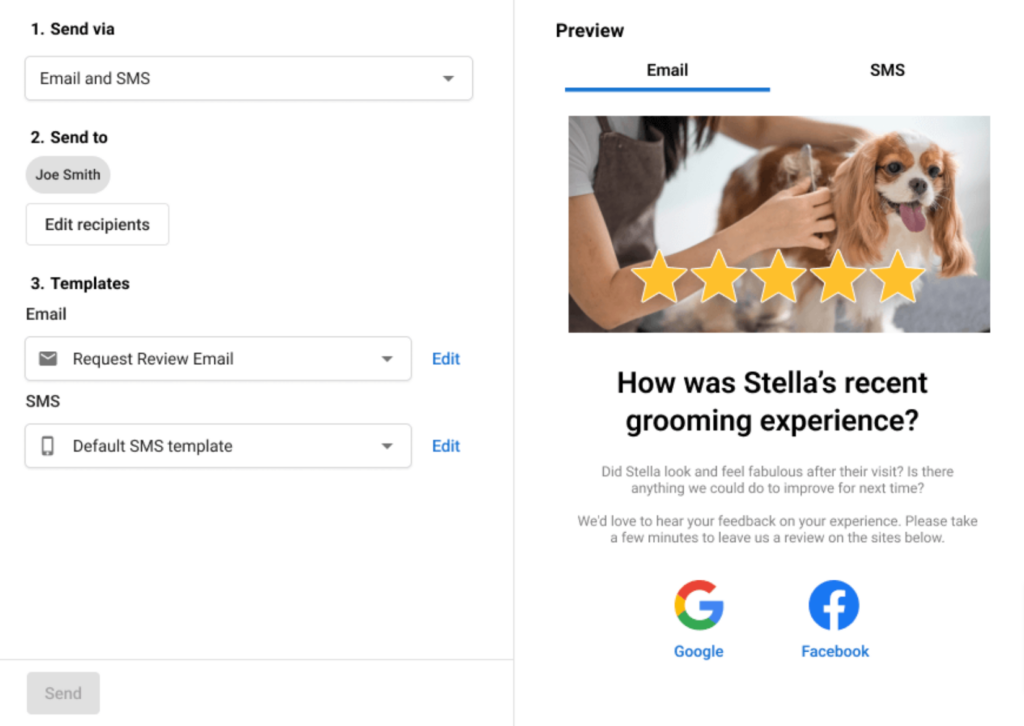
The depth works well for trades like home services, automotive, dental, and law firms where the same business owner is juggling reviews, missed calls, and lead capture.
For businesses that just want a focused review tool, the broader feature set means paying for capabilities you may not use.
Key features
- AI Reputation Specialist: Automatically generates on-brand responses to reviews and handles review request workflows so feedback collection runs in the background.
- Automated review requests: Send invitations via SMS or email after a job or appointment, with integrations into field service tools like Jobber, ServiceTitan, ShopMonkey, and Clio to trigger requests at the right moment.
- Unified inbox: Consolidate phone calls, SMS, WhatsApp, web chat, Facebook, Instagram, and email into one shared feed with full conversation history.
- AI-powered Web Chat: Engage website visitors instantly, capture lead contact information, and continue conversations over SMS to convert more leads.
- NPS surveys and customer feedback: Collect private feedback alongside public reviews to catch issues early and identify likely repeat customers.
- Local SEO and listings management: Keep business information consistent across major directories and track local search rankings through a grid view.
Pros & cons
Pros
- Strong fit for local service trades, with workflows that match how those businesses operate
- AI features baked across reception, reputation, and lead capture rather than gated as add-ons
- Shared inbox consolidates messaging channels that would otherwise live in separate apps
Cons
- Connecting multiple Google Business Profile locations requires separate accounts, which adds cost for multi-location businesses
- Contract terms and cancellation policies have drawn criticism from some users
- Customer service quality has become more inconsistent based on recent feedback
What we like
Broadly's AI Reputation Specialist is one of the more useful AI implementations in this category.
Instead of just suggesting reply text for a human to edit, it generates on-brand responses that match the sentiment of each incoming review and can post them automatically.
What users say
Users consistently highlight how easy Broadly is to use and how it drives review volume without manual effort.
"Broadly is easy to use, you don't need to be tech-savvy to send reviews, respond to web chats from customers or request payments."
A common piece of feedback centers on multi-location handling and customer service consistency.
"Their software does not allow you to connect multiple GoogeMyBusiness stores under one account, you need separate accounts which end up costing more money."
Pricing
Broadly is priced at $799/month.
5. Podium
Podium has positioned itself as an AI-native communications platform rather than a pure review management tool, with "Jerry" the AI Employee at the center of the product.
Going through the platform, the review piece is one slice of a broader stack that includes phones, SMS, web chat, payments, and an AI agent that can respond to leads, schedule appointments, and reply to Google reviews within minutes.
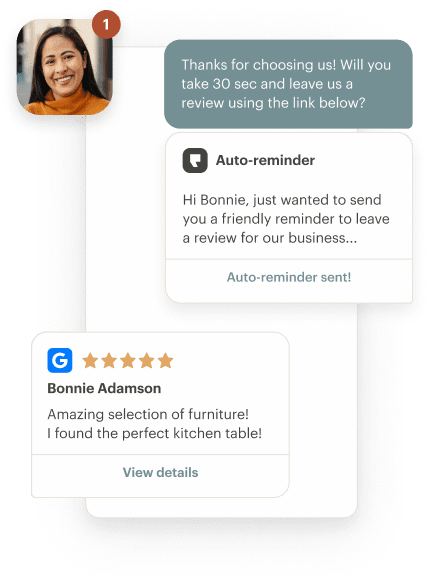
The depth makes Podium a strong fit for verticals like auto dealerships, HVAC, medspas, and home services where speed-to-lead directly drives revenue.
For businesses that only need review collection, the broader suite (and the price tag attached to it) might be an overkill.
Key features
- AI Reputation Specialist: Automatically generates personalized, on-brand review request invites and responses, with customizable tone and engagement style.
- Review automations: Trigger review invites by SMS or email after a job or transaction, with automated reminders to keep response rates high.
- All-in-one inbox: Consolidate reviews, SMS, web chat, social DMs, and phone calls into a single feed with internal notes and conversation assignment.
- Podium AI Employee ("Jerry"): Engage leads within two minutes, answer questions based on your inventory and policies, book appointments, and send promotions across SMS, web chat, and phone.
- Phones and call summaries: Use the built-in phone system with call recording, AI-generated call summaries, and call routing to capture every inbound conversation.
- Text-to-pay and payments: Send payment links via SMS and process customer payments inside the same thread as your conversations.
Pros & cons
Pros
- AI Employee genuinely handles after-hours engagement and routine inquiries, freeing staff time
- Strong industry tailoring for auto, HVAC, medspa, dental, and retail verticals
- Call recording and AI call summaries reduce time spent on coaching and dispute resolution
- Unified inbox consolidates channels that would otherwise live in separate apps
Cons
- Pricing is significantly higher than most competitors, with starting plans out of reach for many small businesses
- Annual contracts and auto-renewal terms have generated repeated user complaints
- Bulk messaging caps can feel tight for businesses running monthly campaigns
- Some advanced features (like AI Employee customization) require additional configuration and support
What we like
The call recording paired with AI-generated transcripts and summaries is one of Podium's most genuinely useful features.
Being able to scrub through a summary instead of replaying a five-minute call makes coaching, dispute resolution, and surfacing missed follow-ups noticeably faster, particularly for service businesses where what was promised on a phone call has real revenue implications.
What users say
Users consistently call out how Podium centralizes communication and improves response times.
"What I appreciate most about Podium is how it brings order to what would otherwise be a scattered communication setup. Earlier, we had to keep track of calls, emails, and messages across different platforms, and it honestly got messy during peak hours.
With Podium, everything lands in one place, so it's easier to stay on top of conversations without missing anything important."
A common piece of feedback centers on pricing and contract terms for smaller operations.
"One downside I've noticed with Podium is the pricing can feel a bit heavy, especially if you're not using every feature regularly. For smaller teams or tighter budgets, the cost combined with contract commitments can make you think twice."
Pricing
Podium doesn’t display its pricing publicly. You’ll need to reach out to the company’s sales team to get a quote.
Get more online reviews for your business
Monitor, manage, and get more online reviews for your business with LocalImpact.
6. Birdeye
Birdeye has rebuilt itself around AI agents, with the platform positioned as the agentic marketing layer for multi-location brands.
Going through the platform, the review piece sits alongside Listings AI, Social AI, Search AI (for AI search visibility on ChatGPT, Perplexity, and Google), Insights AI, and Messaging AI, all configurable with brand voice, custom triggers, and location-level rules.
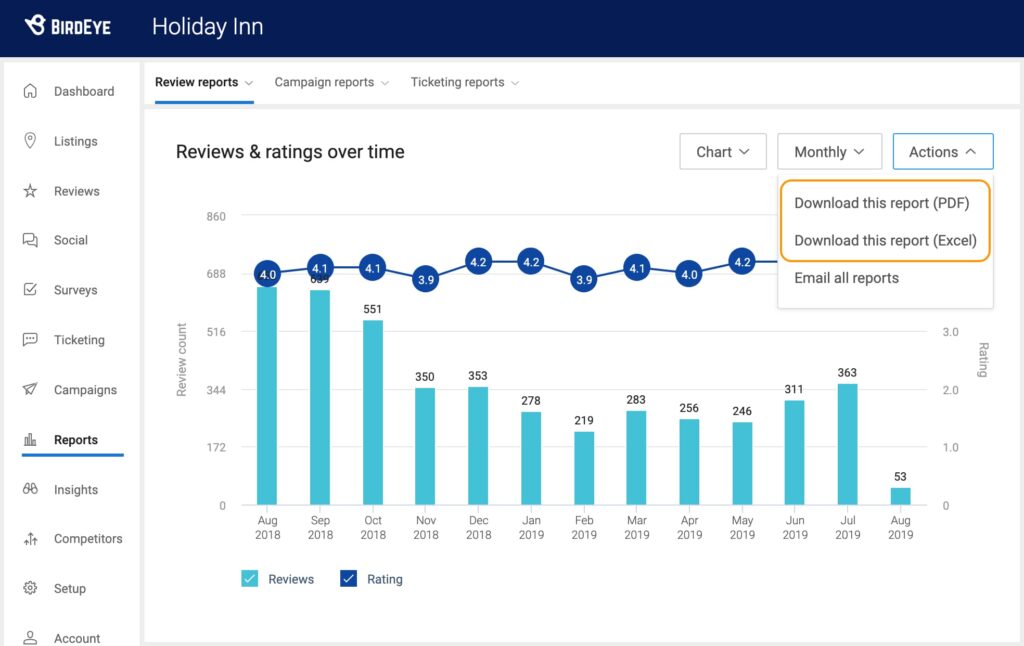
The depth makes Birdeye a strong fit for enterprise customers managing hundreds of locations across verticals like healthcare, dental, real estate, and self-storage.
For smaller operations that just need review collection and response, the platform's breadth (and pricing tied to it) is far beyond what's required.
Key features
- Review Generation Agent: Runs A/B tests across subject lines, templates, sites, and channels to send review requests at the optimal time and through the highest-performing source.
- Review Response Agent: Interprets sentiment, urgency, and images in reviews to generate personalized, on-brand replies in your tone, scalable across hundreds of locations.
- Review monitoring across 200+ sites: Track reviews from hundreds of leading review platforms in a single dashboard with location-level filtering.
- Birdeye Score and Insights AI: Combine sentiment, reputation, and listing data into a single brand health metric, with industry benchmarking, location comparisons, and AI-driven recommendations for what to fix.
- Competitive benchmarking: Monitor competitor reviews and ratings across all locations to identify gaps and refine local marketing strategy.
- Multi-location controls: Role-based access, tiered approvals, and location-level reporting purpose-built for enterprise brands.
Pros & cons
Pros
- Robust multi-location capabilities with location-level reporting, approvals, and role-based access
- Strong AI layer across reviews, social, listings, and insights, with industry-specific tuning
- Enterprise-ready compliance and security (SSO, audit logging, HIPAA, SOC 2, GDPR)
- Deep integration library with EHRs, CRMs, property management platforms, and industry-specific tools
Cons
- Pricing can feel high for smaller teams, and adding new tools or modules often comes with significant cost increases
- The platform's depth means a real learning curve, with some features and settings buried for new users
- Several useful capabilities (surveys, insights, benchmarking, ticketing) sit behind premium plan tiers
- Integrations occasionally break without clear notification, which can interrupt review request flows
What we like
The Birdeye Score is one of the more thoughtful additions in the space. Instead of leaving teams to interpret reviews, listings, and sentiment data separately, it rolls those signals into a single brand health metric you can benchmark across locations and against industry norms.
For a multi-location brand trying to identify which sites are underperforming and why, that consolidation removes a layer of analysis work that would otherwise live in a spreadsheet.
What users say
Users consistently highlight Birdeye's centralization across reviews, messaging, and location-level data.
"I've been using Birdeye for about 2 years, and the biggest value is having reviews, customer messages, and location-level feedback all in one place. The dashboard is easy to check daily, and it saves a lot of time compared to jumping between different review sites."
A common piece of feedback centers on the learning curve and pricing pressure when adding new tools.
"With each new tool comes a heavy price request. We've been customers for 6 years now and there was no cooperation or meeting in the middle when it came to pricing for a tool that we had interest in."
Pricing
Birdeye doesn’t share its pricing publicly. You’ll need to reach out to the company’s sales team to get a quote.
7. Grade.us
Grade.us is built specifically for agencies and SEOs who want to offer review management as a service under their own brand.
The entire experience can be white-labeled (custom domain, dashboard branding, email from-address, reporting), with agency pricing structured around per-seat costs across 10+, 100+, and enterprise tiers.
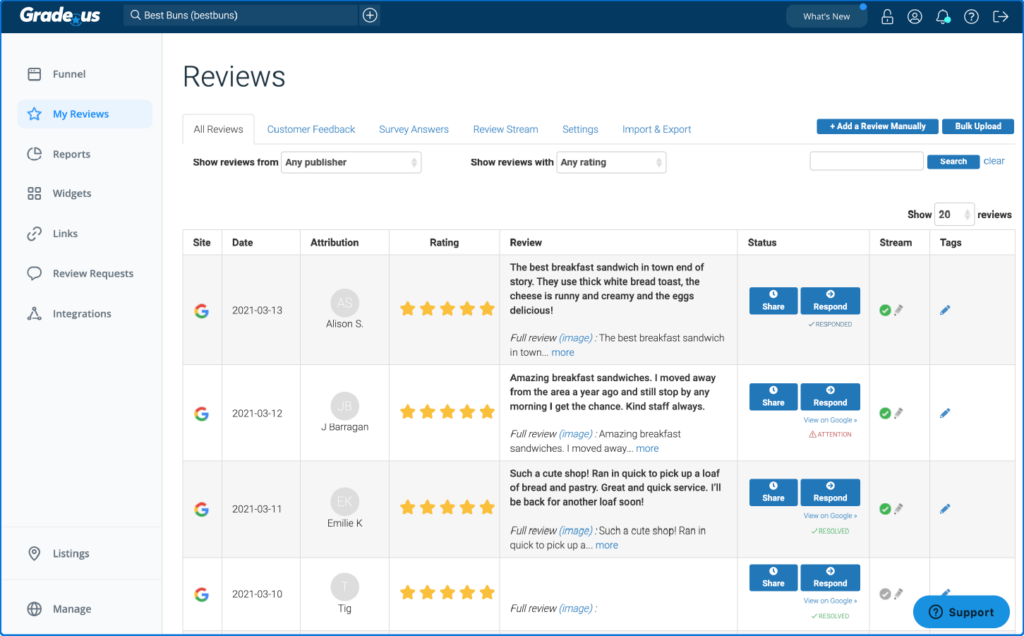
The product is focused rather than broad, with no AI workforce, no payments, no web chat. What it does well is the agency-resale workflow: fast client onboarding, automated review funnel landing pages, monitoring across 100+ industry-specific review sites, and white-labeled reporting that agencies can send to clients on autopilot.
Key features
- Review funnel landing pages: Customizable, segmented landing pages that route happy customers to public review sites and surface dissatisfied customers privately through internal feedback forms.
- Email and SMS review request drip campaigns: Multi-step automated sequences with full control over subject lines, from-address, reply-to, send timing, and unlimited follow-ups.
- White-label everything: Fully branded dashboard, custom domain, white-label email notifications, and client reporting with no Grade.us branding visible to clients.
- Multi-site review monitoring: Track reviews across Google, Facebook, Yelp, and over 100 industry-specific sites including Healthgrades, TripAdvisor, Zillow, Avvo, and dozens more.
- Review widgets and social sharing: Embed schema-friendly review widgets on client websites and automate sharing 5-star reviews to Facebook for ongoing social proof.
- Scheduled white-label reporting: Automate weekly or monthly portfolio reports across single or multiple locations, delivered to multiple stakeholders from a branded email address.
Pros & cons
Pros
- Genuinely deep white-label capabilities, well beyond what most platforms offer
- Built for agency workflows with fast client onboarding (often under 10 minutes per location)
- Strong agency pricing structure with per-seat costs that scale down as you add clients
- Customer support is consistently called out as responsive and high-quality
Cons
- Focused on review management only, with no payments, web chat, or messaging features
- Pricing has climbed in recent years, which has made it harder for some agencies to pass costs along
- Reporting analytics felt thin to some users until a recent redesign
- Limited integration library compared to broader marketing platforms
What we like
The level of white-label flexibility goes further than most platforms in the space.
Beyond the obvious dashboard branding, agencies get a custom domain, white-labeled email sender addresses, branded reporting, and even the option (on higher tiers) to swap the favicon.
What users say
Agencies consistently call out Grade.us for the ease of onboarding new clients and the quality of support.
"Very easy to use and set up new clients. The onboarding process is less than 10 minutes per client. And the customer support has been great. The few times I've had questions/issues they team has been quick to respond and resolve everything."
A common piece of feedback centers on pricing increases over time.
"Far too expensive. Doubled in price while I was using it. Hard to pass those costs on to my clients."
Pricing
Grade.us offers the following pricing plans:
- Small Business ($124/month for one location)
- Multi Location ($75/month/location)
- Agency (custom pricing)
8. NiceJob
NiceJob takes a deliberately focused approach: review generation, social proof, referrals, and reputation marketing for small home service businesses, without the broader AI workforce, payments, or unified inbox features.
Going through the platform, the experience is built around "set-and-forget" automation, with a clean integration into field service tools like Jobber, Housecall Pro, ServiceTitan, JobTread, and QuickBooks.
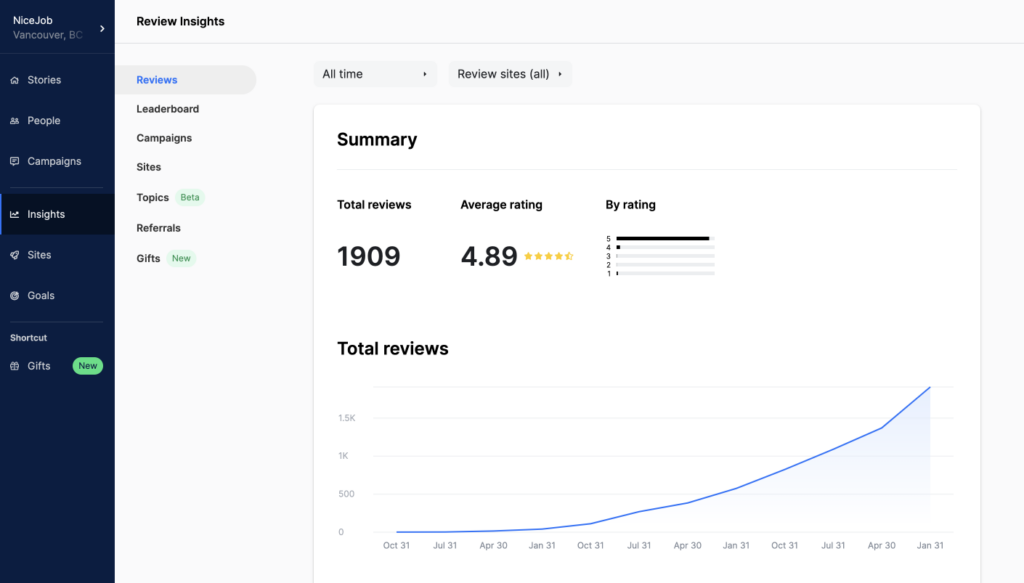
The pricing is also notably more accessible than the enterprise-focused platforms in this space.
For a single-location service business that just wants more Google reviews and a simple social proof widget on the website, NiceJob hits the brief without forcing you into features you won't use.
Key features
- Automated review request campaigns: Trigger an SMS plus three-email sequence the moment a job is marked complete in your CRM, with customizable timing and messaging.
- AI Review Replies (Pro plan): Auto-generate on-brand responses to reviews with adjustable tone, length, and rules (e.g., only auto-reply to reviews 3 stars and above).
- Social Proof widgets: Embed review carousels, trust badges, and microsite widgets on your website to showcase real reviews and recent customer activity.
- Social media auto-sharing: Automatically publish the best new reviews to Facebook and other channels with branded post styling to keep social profiles active without manual effort.
- Referrals and Repeats programs: Built-in referral campaigns and re-engagement workflows to turn happy customers into a repeat revenue source.
- Insights and team leaderboards: Track which team members drive the most positive reviews, monitor campaign performance, and benchmark against competitors (Pro plan).
Pros & cons
Pros
- Tight integrations with field service software like Jobber, Housecall Pro, ServiceTitan, and JobTread
- Genuinely simple onboarding, with most users up and running in 15 to 20 minutes
- No contracts and month-to-month billing, which is rare among enterprise-focused competitors
- Strong, attentive customer support consistently called out by users
Cons
- Limited customization on the website widgets (number of reviews shown, styling, fonts)
- Multi-location handling can feel clunky compared to platforms purpose-built for enterprise
- Integration library is narrower than broader marketing platforms, with workarounds via Zapier
- AI Review Replies sit behind the Pro plan, which adds cost for longtime customers used to the base plan
What we like
The auto-share to Facebook is one of those features that does a lot of work in the background. Most home service businesses can't justify a dedicated social media manager, but they still need to keep their Facebook page from going stale.
NiceJob handles this by turning every new 5-star review into a branded social post automatically, which keeps the profile active and feeds local SEO without anyone touching the page.
What users say
Users consistently highlight how NiceJob removes the burden of manually chasing reviews while still delivering volume.
"It does a tremendous job automating review requests from our customers and is hassle-free for our business. I love how easily it integrates with Housecall Pro and automatically invites customers to leave reviews right when their job is finished."
A common piece of feedback centers on website widget customization limits.
"I don't like the widgets and aspects that interact with the website to show reviews. I'd like more customization in terms of the number of reviews displayed, style, font, color, etc."
Pricing
NiceJob offers a 14-day free trial that does not require a credit card.
Paid plans include:
- Reviews ($75/month)
- Pro ($125/month)
- Sites add-on ($99/month + $199 setup fee)
9. GatherUp
GatherUp organizes its platform around a three-stage framework: listen, understand, engage.
Going through the platform, the structure is reflected in how features are grouped: review and feedback collection through email and SMS on the listening side, AI-powered insights and NPS reporting on the understanding side, and SmartReply, AutoReply, and review widgets on the engagement side.
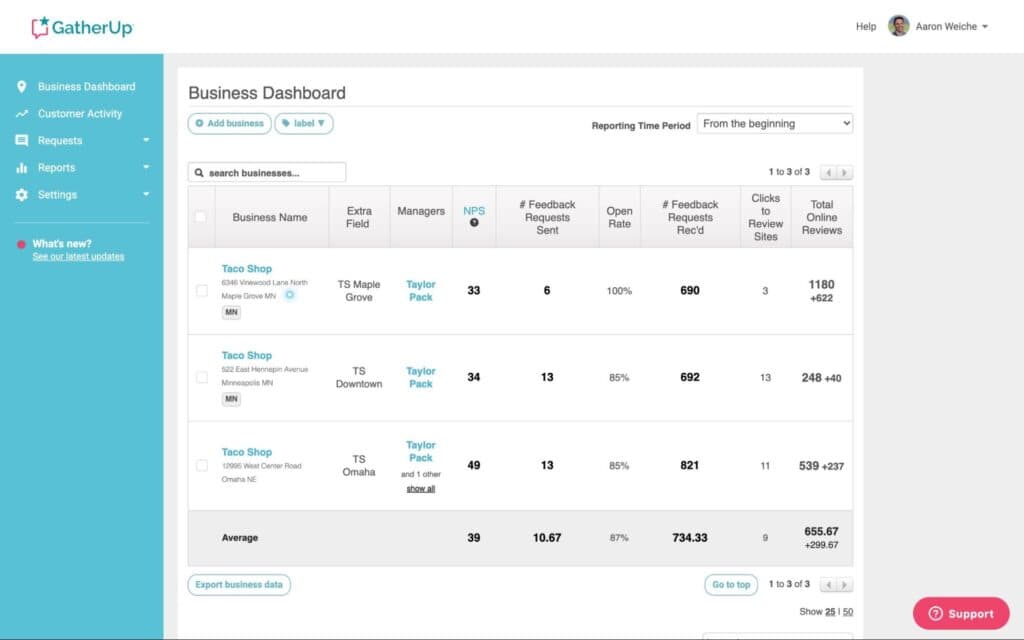
The platform leans heavily on NPS scoring and structured customer feedback in a way most competitors don't, which makes it particularly useful for businesses that want to act on feedback rather than just collect star ratings.
Recent additions include a Review Defense tool that detects, disputes, and defends against fake reviews across locations.
Key features
- Email and SMS review request automation: Set up triggered review requests with reminders, branded landing pages, and customizable timing across multi-location accounts.
- Multi-site review monitoring: Track reviews across 100+ review sites, including Google Q&A, Facebook, Yelp, Glassdoor, OpenTable, and Indeed.
- SmartReply, AutoReply, and Suggested Replies: AI-generated review responses that match sentiment and tone, with options for fully automated positive replies and human-approved replies for negative feedback.
- AI Smart Insights and Auto-Tagging: Surface the top 10 themes across customer feedback automatically and apply custom tags to first- and third-party reviews based on keywords.
- NPS surveys and performance reporting: Built-in Net Promoter Score collection with real-time performance reports summarizing NPS metrics, survey responses, and review volume per location.
- Review Defense: Detect and dispute suspicious reviews (bot attacks, competitor fraud, review bombing) with the TrueReview certification badge to signal authentic feedback to customers.
Pros & cons
Pros
- Built specifically for agencies and multi-location operators, with strong white-label capabilities
- Heavier focus on customer feedback insights (NPS, sentiment analysis, smart tagging) than most competitors in this space
- Customer support and onboarding consistently called out as exceptional by users
- Review Defense is a differentiated feature that addresses fake reviews proactively rather than reactively
Cons
- Pricing can feel high for businesses managing many locations
- Review display widgets feel dated compared to more modern competitors
- Reviewer drop-off in the funnel happens occasionally, with some reviews stuck in GatherUp without being published externally
- Some customization options are limited, particularly around campaign pausing and template controls
What we like
The Review Defense product is one of GatherUp's most distinctive additions. Most competitors handle fake reviews reactively by flagging them after they've already damaged rankings and trust.
GatherUp's approach detects suspicious activity (review bombing, competitor fraud, AI-generated review pods) as it happens and triggers automated disputes, which is genuinely useful for multi-location operators where one bad actor can affect dozens of profiles before anyone notices.
What users say
Users consistently highlight GatherUp's customer support and the depth of the platform for review management.
"GatherUp is an extremely useful SEO tool that I would highly recommend. Their reputation management services have become a staple for our business. Our clients love the portal and the ability to manage their reviews from one spot."
A common piece of feedback centers on pricing relative to value, particularly at scale.
"The product is expensive for what it provides, especially when you have a lot of locations."
Pricing
GatherUp offers a 14-day free trial. Paid plans include:
- Single location ($99/month)
- Multi-location ($60/month per location)
- Agency (custom pricing)
10. ReviewTrackers
ReviewTrackers leans into the "voice of customer" angle harder than most platforms in this space, positioning the product as a customer experience analytics tool first and a review management tool second.
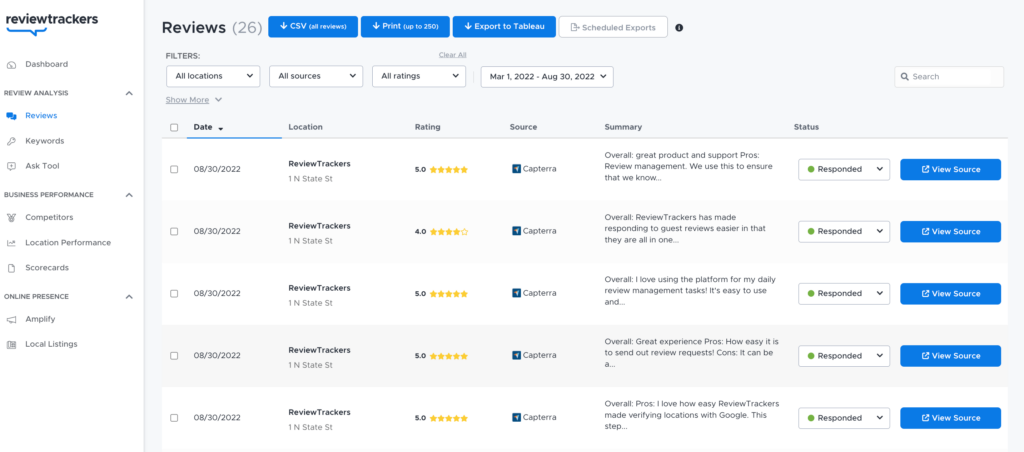
Going through the platform, the core capabilities are organized around acquisition and retention business goals, with features like customer experience analytics, competitor analysis, local SEO, and listing management feeding into both.
Key features
- Multi-source review aggregation: Pull reviews from top directories into a single dashboard with filtering by location, rating, source, and response status.
- Automated review request campaigns: Trigger email and SMS review requests through direct integrations with CRMs and POS systems, with personalized templates and reminder workflows.
- Smart Response and AI-generated replies: Auto-generate on-brand responses to reviews using customizable templates that match sentiment and tone.
- Competitive analysis and benchmarking: Automatically track competitors' review velocity, ratings, and customer sentiment to identify gaps and build local SEO strategies.
- Customer experience analytics: Surface trends, sentiment patterns, and operational issues across locations with automatic tagging and reporting designed for executive-level visibility.
- Local listings management and social monitoring: Keep business information consistent across directories and monitor social media mentions in a single workflow, with a native Hootsuite integration for combined social plus reviews.
Pros & cons
Pros
- Genuine focus on customer experience analytics and operational insights, beyond just review collection
- Strong competitive analysis tools that surface where rivals outperform you and where they're vulnerable
- Aggregation across multiple locations is consistently called out as easy to navigate
- Customer support gets repeated praise across user reviews, including named account managers
Cons
- Direct responses on platforms like Yelp and TripAdvisor aren't always supported from within the dashboard
- Notifications for disconnected review sites can be erratic, requiring manual checks
- Some users find the breadth of buttons and options overwhelming during initial onboarding
- Pricing can feel high for smaller operations, particularly when compared to simpler tools
What we like
The competitor analysis depth is one of ReviewTrackers' real differentiators.
ReviewTrackers automatically tracks rival review velocity, sentiment trends, and online rank against your own locations, then highlights areas where competitors excel and areas where they're losing ground.
What users say
Users consistently highlight ReviewTrackers' ability to centralize multi-source review data and the responsiveness of customer support.
"The aggregation feature is great. I can easily see reviews all in one place and don't have to worry about collecting it from individual sources. Additionally, they make it very easy to respond to Google reviews and help us with quick response times."
A common piece of feedback centers on direct response capabilities for certain platforms.
"The only thing I wish we could revise is the ability to respond to Yelp and Trip Advisor within the platform."
Pricing
Pricing starts at $89/location/month.
Get more online reviews for your business
Monitor, manage, and get more online reviews for your business with LocalImpact.
11. TrueReview
TrueReview takes a focused, automation-first approach to review management, with the platform built around getting more Google (and other site) reviews through SMS and email campaigns with minimal setup.
The experience is genuinely simple: connect a review site, set up a campaign, and let smart drip sequences handle the follow-ups while AI handles the responses on the back end.
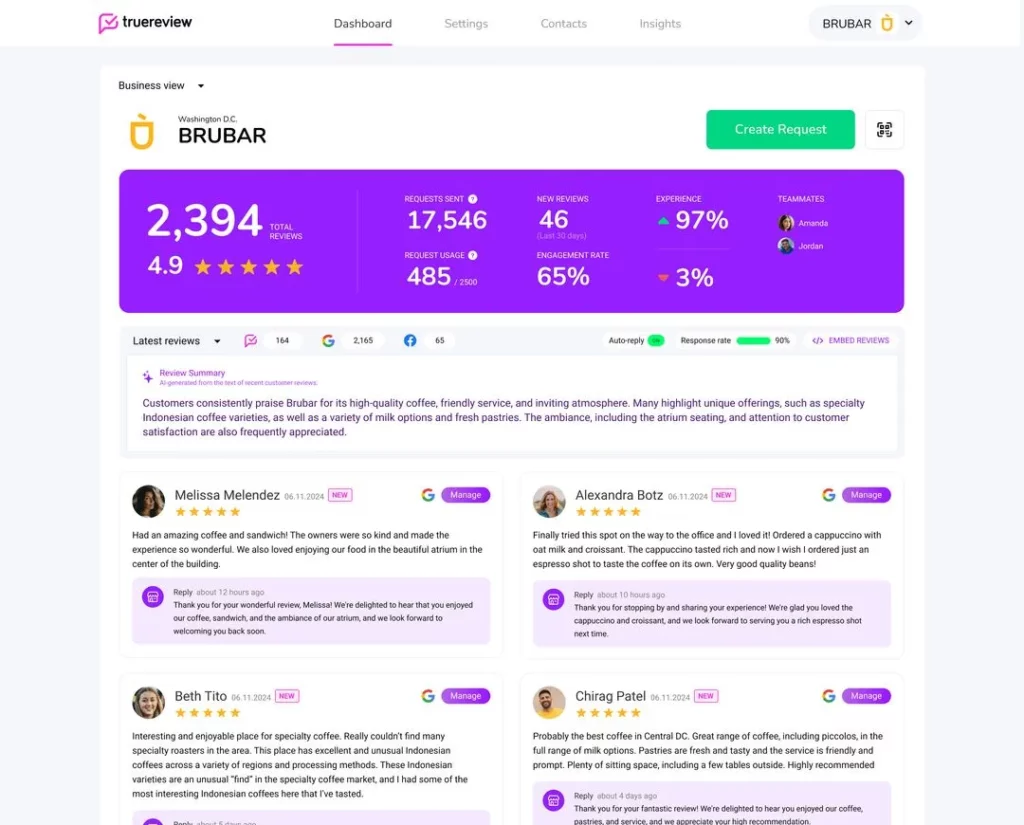
What stands out is how much capability TrueReview packs in at a meaningfully lower price point than the enterprise-focused platforms.
Features like AI auto-replies, Review Radar (which monitors for Google policy violations), AI review tagging, and a Social Review Post Generator come standard in the higher tiers, while the entry-level plan is approachable for solo operators and small businesses.
Key features
- SMS and email review request campaigns: Send personalized requests via SMS, email, or QR codes with multi-step drip sequences that track customer interaction and automate follow-ups.
- AI Review Response Generator: Generate human-like responses to reviews based on the reviewer's name, rating, and message content, with selectable tone (professional, friendly, grateful, direct) and automatic language detection.
- Automated Review Replies: Auto-reply to Google and TrueReview reviews using AI-generated responses or pre-written templates, with rule-based controls (e.g., only auto-reply to 4-5 star reviews) and customizable send delays.
- Review Radar policy violation monitoring: AI-powered scanning of incoming Google reviews for potential policy violations (bullying, hate speech, fake content, spam), with category-specific reporting guidance to improve removal odds.
- AI review tagging and filtering: Automatically categorize reviews by themes, sentiment, or services, then filter to surface trends, add internal notes, and track team mentions.
- Embedded review widgets: Display reviews from Google, Facebook, and 20+ other sites on your website with customizable layouts, dark/light mode, and slider or pagination styles.
Pros & cons
Pros
- Genuinely simple setup and clean user interface, with most users up and running quickly
- AI features (response generator, auto-replies, tagging, Review Radar) feel modern and well-executed
- Customer support consistently praised across user reviews, with direct access to the team
Cons
- Lower-tier plans support only one location, which limits use for multi-location operators
- White-label options aren't built into the platform for agency resellers
- Integration library is narrower than larger competitors, though Zapier helps bridge most gaps
What we like
Review Radar is one of the more thoughtful additions in the space. Most review platforms either ignore fake or policy-violating reviews or rely on browser-automation bots that violate Google's terms of service.
TrueReview's approach is more principled: the AI flags potential violations, recommends the correct reporting category (a major factor in whether Google actually removes the review), and routes the report through your own Google profile rather than submitting it programmatically.
What users say
Users consistently highlight how TrueReview simplifies what used to be a manual, time-consuming process.
"TrueReview is an outstanding software tool that expertly bridges the gap between reputation management and efficient customer engagement.
Its integration with Zapier stands out as a particularly innovative feature, allowing for seamless connectivity with numerous apps and services, enhancing operational efficiency. The automated review requests function is a game-changer."
A common piece of feedback centers on pricing tiers and multi-location support.
"The pricing tiers are not as friendly for really small businesses and the segmentation to review negative reviews is difficult to navigate."
Pricing
TrueReview offers a 14-day free trial with up to 250 review requests, no credit card required.
Paid plans include:
- Starter ($49/month)
- Small Business ($99/month)
- Premium ($299/month)
How to choose the right online review tool for you
Picking the right review tool comes down to matching your specific situation to the platform's strengths. Here's what to weigh as you compare options:
- Business size and structure: Single-location operators usually do best with affordable, focused tools, while multi-location brands need rollup reporting and location-level permissions. Be honest about which side of that line you're on, since the price gap between tiers is significant.
- Workflow integrations: If you run a service business on a field service CRM, integration matters enormously. Tools that fire review requests automatically at job completion will consistently outperform tools that require manual exports or batch uploads.
- Pricing transparency and contract terms: Some platforms publish flat monthly pricing, while others require sales conversations and annual commitments. If predictable budgeting matters or you want flexibility to switch, prioritize tools that publish their pricing openly.
- Feature scope beyond reviews: Some businesses genuinely benefit from bundling reviews with messaging, listings, and payments, while others end up paying for capabilities they never touch. Map what you actually need before paying for an all-in-one suite.
- Reseller versus end-user use case: Agencies should evaluate platforms designed specifically for reselling, with white-label dashboards, multi-client management, and per-seat pricing. End-user businesses should generally skip these and pick a tool designed for their direct use.
The right tool is the one that solves your specific reputation challenge without forcing you to pay for capabilities you'll never use or learn workflows your team won't adopt.
Take advantage of free trials wherever they're offered to test how the platform actually feels in your day-to-day.