
Choosing the right review collection software can feel overwhelming when every vendor promises the same thing.
We spent over 300 hours testing platforms, comparing features, and digging through real user feedback so you can skip the demo carousel.
Here are the nine review collection tools that actually earn their keep in 2026, along with what they cost, who they fit, and where they fall short.
Best review collection software at a glance
| Software | Starting price | Free trial available |
| LocalImpact | $19/month | Yes |
| ReviewTrackers | $89/location/month | No |
| Broadly | $799/month | No |
| Reviewshake | $29/month | Yes |
| Reputation | $80/location/month | No |
| NiceJob | $75/month | Yes |
| Birdeye | Custom pricing | No |
| Grade.us | $99/month | Yes |
| TrueReview | $49/month | Yes |
How we chose these tools
After more than 300 hours of hands-on testing across dozens of platforms, we narrowed the field using six criteria that matter most for businesses focused on collecting more reviews:
- Ease of setup: Getting from signup to your first review request should take minutes, not days. We timed every platform from account creation through sending the first request.
- Request automation: Manual review chasing kills consistency. We looked for SMS and email automation, follow-up sequences, CRM integrations, and the ability to trigger requests from real business events like completed jobs or paid invoices.
- Review site coverage: Google reviews matter most for local search, but Facebook, Yelp, and industry-specific sites pull weight in many verticals. We checked how many sources each platform supports natively and how clean the integrations feel.
- Negative feedback handling: Good tools give unhappy customers a private path before they reach for the public star rating. We evaluated feedback funnels, alert speed, and how each platform routes negative responses.
- Display and sharing tools: Reviews you collect should work for you in marketing. We assessed website widgets, social sharing, and SEO-friendly review pages.
1. LocalImpact
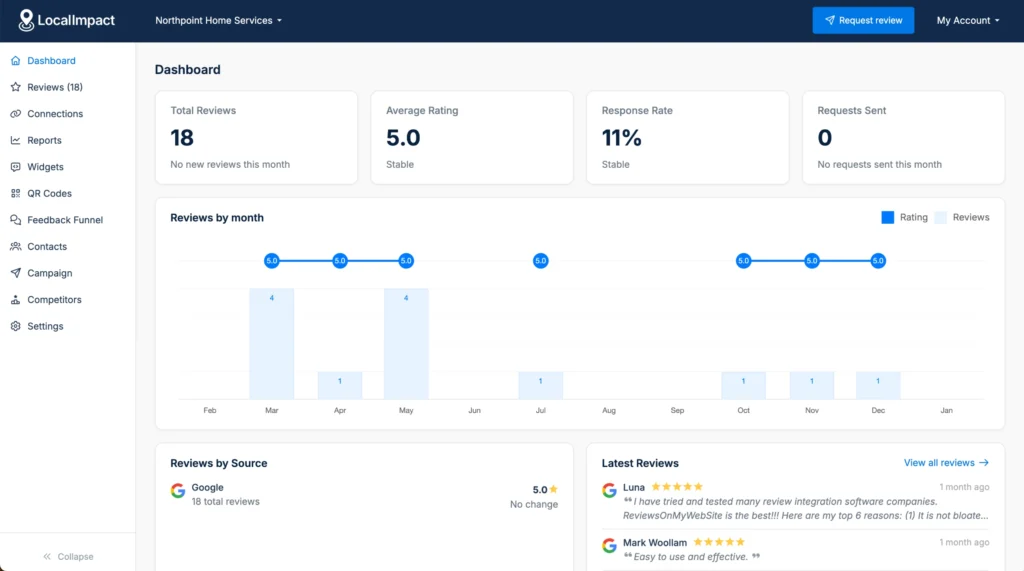
LocalImpact is a review collection and reputation management platform built for local businesses, multi-location operators, and the marketing agencies serving them.
It covers the full workflow from sending requests to displaying reviews on a website, all from a single dashboard.
Key features
- Automated review requests: Send review requests via email and SMS, with follow-up reminders that stop automatically once a review is posted.
- Multi-site review aggregation: Pull reviews from Google, Facebook, Yelp, and 30+ other platforms into a single dashboard for monitoring and response.
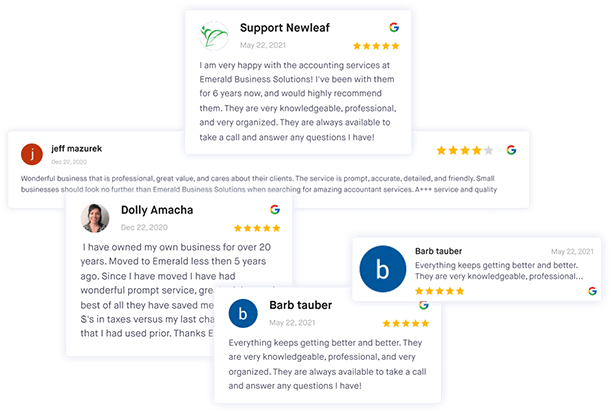
- Website review widgets: Display real customer reviews directly on your site with a customizable review widget that matches your brand.
- AI-assisted responses: Generate personalized review replies using AI and save hours of your time every month.
- White-label option: Agencies can use the white-label option to rebrand the platform under their own name and resell review management as a service.
What users say
Users consistently call out how easy LocalImpact is to set up and how well it works for small businesses that want review management without a steep price tag.
“The platform is extremely easy to set up and integrate with my existing website. The dashboard is simple to navigate, and the automation tools save me time collecting and displaying reviews.
Customer support is quick to respond and always helpful.”
Pricing
LocalImpact offers a 14-day free trial with no credit card required, so you can test the platform fully before committing.
Paid plans include:
- Growth ($49/month)
- Pro ($99/month)
- Agency ($149/month)
Collect reviews on autopilot
Monitor, manage, and get more online reviews for your business with LocalImpact.
2. ReviewTrackers
ReviewTrackers is a reputation management platform we tested across multi-location use cases, where it shines brightest.
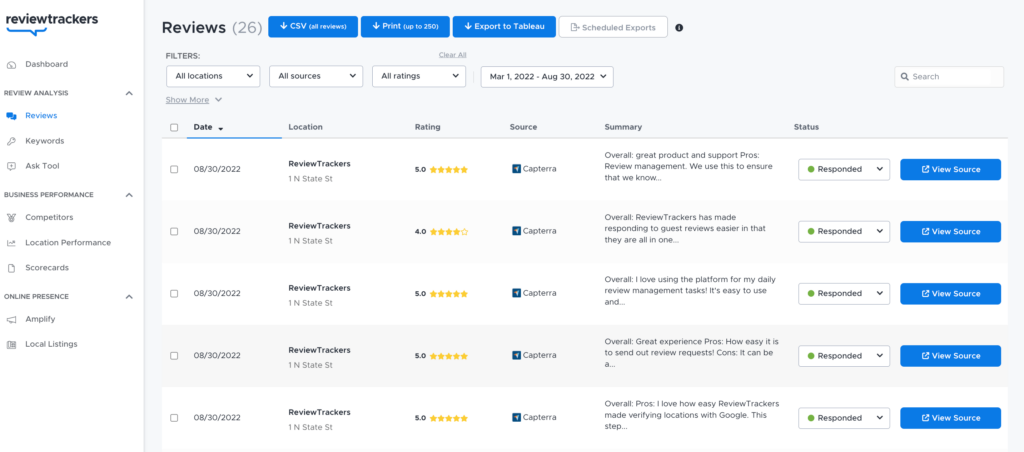
The product centralizes reviews from dozens of sources and layers analytics on top to surface trends, sentiment patterns, and competitor benchmarks.
Key features
- Review aggregation from dozens of sites: Pull customer reviews from Google, Facebook, TripAdvisor, Yelp, and other review platforms into one feed.
- Smart response with AI: Draft responses to reviews using AI that adapts tone based on rating and sentiment.
- Trending topics analysis: Use machine learning to identify themes across review text, with word clouds and sentiment scoring.
- Multi-location dashboards: Compare performance across locations with side-by-side scorecards and customizable filters.
- SMS and email request campaigns: Trigger review invitations from existing customer data with templates and follow-up sequences.
- Competitor benchmarking: Track competitor ratings and review velocity to see how your locations stack up locally.
Pros & cons
Pros
- Powerful analytics that go beyond basic monitoring.
- Solid integrations with Google Business Profile and major review sources.
- Multi-location reporting is well organized and easy to export.
Cons
- Pricing scales quickly with locations, which can stretch budgets for mid-sized brands.
- The interface includes a lot of buttons and views that can overwhelm new users at first.
- Some review notifications can lag behind real-time, especially from Yelp.
What we like
The trending topics text analytics is the standout. Most review platforms stop at sentiment scoring, but ReviewTrackers actually surfaces the specific terms and themes driving feedback, which makes operational improvements a lot easier to prioritize.
What users say
Users praise how ReviewTrackers consolidates review data across locations and helps teams respond faster, especially when running multi-location operations.
“The aggregation feature is great. I can easily see reviews all in one place and don’t have to worry about collecting it from individual sources. Additionally, they make it very easy to respond to Google reviews and help us with quick response times.”
A common note from reviewers is that the interface takes some getting used to before it feels intuitive.
“The only thing that caught me off guard when I started using it would be the sheer amount of buttons visible that could possibly overwhelm a new user. This does however get easier and easier as time goes by.”
Pricing
Pricing starts at $89/location/month.
3. Broadly
Broadly is a customer engagement platform we evaluated specifically for service businesses like HVAC operators, electricians, landscapers, and similar local trades.
Review collection sits at the center, but it ships alongside web chat, a shared inbox, payment tools, and SMS marketing.
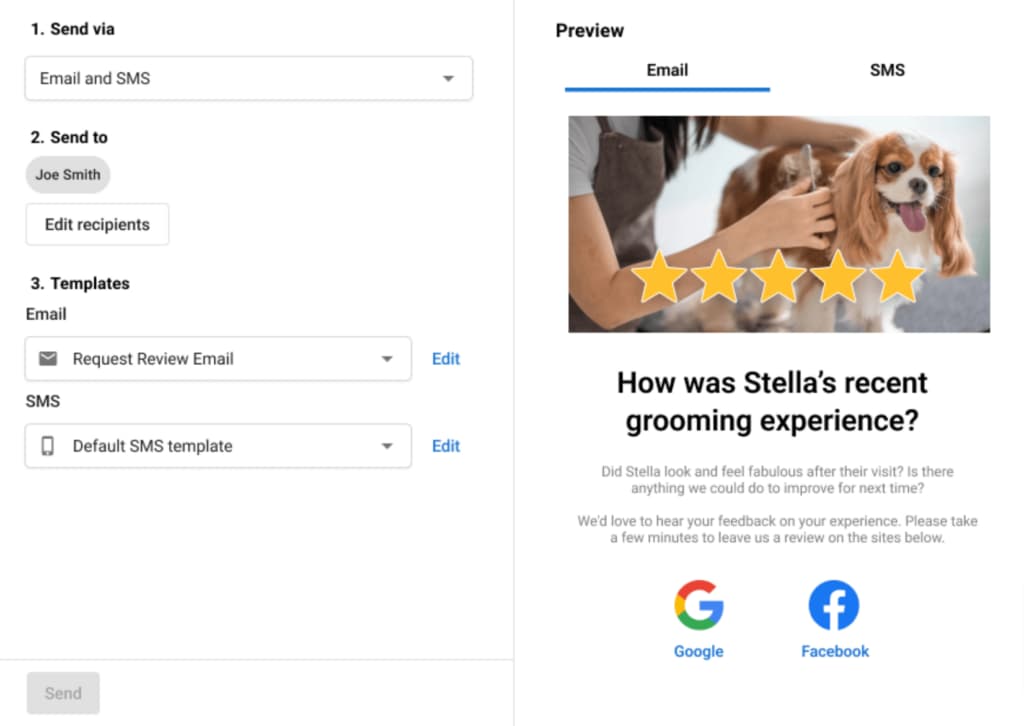
Texting is where Broadly leans hardest. The platform pushes review requests via SMS by default and lets you have one-to-one private conversations with customers after a job, which works well for resolving issues before they end up in public reviews.
Key features
- Text-first review requests: Send review invitations via SMS to drive higher response rates than email alone.
- Shared team inbox: Consolidate leads and customer messages from Google, Facebook, Instagram, web chat, and contact forms into one view.
- Web chat widget: Capture leads directly from your website with a chat widget that flows into the same inbox.
- Mobile invoicing and payments: Send invoices and accept payments by text, which doubles as a natural trigger for review requests.
- Email and SMS campaigns: Run promotional or retention campaigns from a template library or build your own.
- AI Receptionist: Higher-tier plans answer chats, social messages, and inbound calls with an AI agent that can book appointments.
Pros & cons
Pros
- Text-based review requests reliably drive better response rates than email-only tools.
- Shared inbox keeps all customer touchpoints in one place.
- Well-suited for home service workflows with mobile invoicing and post-job follow-up.
- Active product development with new AI features rolling out steadily.
Cons
- Some users report wanting more automation for routine touchpoints like appointment reminders.
- Contract terms have been a source of friction for businesses that expected month-to-month flexibility.
- Higher-tier features get expensive once you add the AI Receptionist modules.
What we like
The post-review private messaging flow is a genuinely useful safety net. You can reach a customer one-on-one right after a review lands, which often turns a vent-and-move-on moment into a fixable conversation.
What users say
Broadly earns strong reviews from service business owners who appreciate the text-first approach and the support team’s responsiveness.
“Communication and texting has been great for us to connect with customers. One to one private message to my customers after they review, and the ability to fix a problem before it becomes too late.”
Some users have noted that they want more automated touchpoints built into the platform.
“Not enough auto features. I wish it auto-sent out appointment reminders, etc.”
Pricing
Broadly is priced at $799/month.
4. Reviewshake
Reviewshake is a review management platform that we put through its paces with agency use cases in mind.
The product monitors reviews from dozens of the most popular review sites and ships with a strong white-label layer that lets agencies rebrand the entire dashboard for clients.
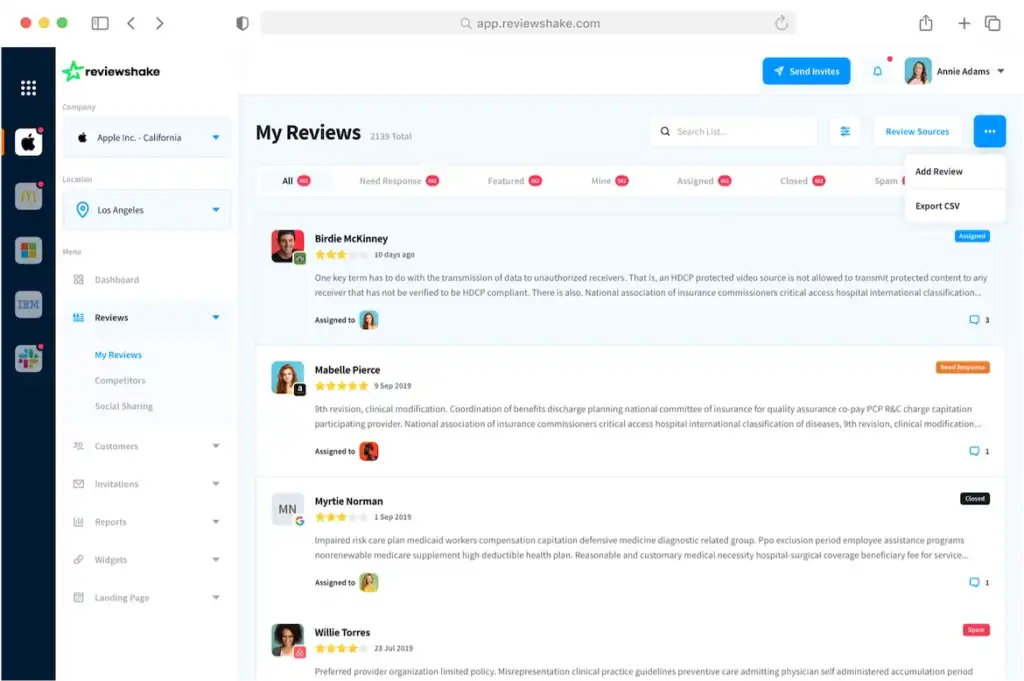
Beyond the white-label angle, Reviewshake handles the full review collection loop with SMS, email, and QR code workflows. The platform also automates social sharing of positive reviews and offers a feedback funnel for routing negative feedback privately.
Key features
- White-label dashboard: Rebrand the entire platform under your agency name and offer review management as a packaged service.
- SMS, email, and QR code requests: Trigger review invitations through multiple channels, including printable QR codes for in-person use.
- Extensive review site monitoring: Track reviews across Google, Yelp, Facebook, and dozens of industry-specific platforms.
- Automated social sharing: Push positive reviews to social media platforms to recycle social proof.
- Drip review campaigns: Run multi-step email and SMS sequences that stop sending once a review is posted.
- AI response suggestions: Generate response drafts to keep tone consistent across high review volumes.
Pros & cons
Pros
- Strong white-label functionality designed specifically for agencies.
- Onboarding is well-paced and not overwhelming for new users.
- Active feature development and a roadmap shaped by user feedback.
Cons
- Native integrations are limited, so Zapier handles many connections.
- Widget customization is less flexible than some newer tools on the market.
What we like
The drip review request campaigns are well thought out. Reminders escalate intelligently and stop automatically once a review is captured, which keeps the experience from feeling pushy to customers.
What users say
Reviewshake earns strong reviews from agencies and small business operators who value the all-in-one dashboard and the white-label option.
“It’s a very easy to use platform, we can access all our customer feedback in one place, we can easily ‘show off’ our good reviews on our website and across socials.”
One thing reviewers point out is that some integrations rely on Zapier rather than native connections.
“Some downsides would include the need to use Zapier instead of having internal integration functionality to bring customer data in without the need for additional software.”
Pricing
Reviewshake offers a free trial you can use to test out the software. Paid plans include:
- Starter ($29/month)
- Growth ($59/month)
- Ultimate ($99/month)
Collect reviews on autopilot
Monitor, manage, and get more online reviews for your business with LocalImpact.
5. Reputation
Reputation (formerly Reputation.com) is the enterprise-tier option we evaluated for multi-location brands and large organizations.
The platform pulls customer ratings from Google, Facebook, and dozens of other channels, then layers sentiment analysis, surveys, and the proprietary Reputation Score on top.
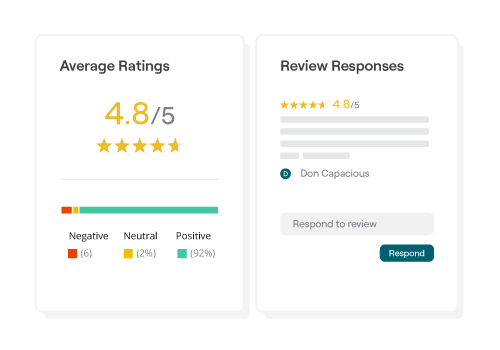
This is not a tool we would point a single-location business toward. The platform is built for organizations with hundreds of locations, dedicated reputation teams, and the budget to support both.
Key features
- Centralized review aggregation: Consolidate ratings and reviews from Google, Facebook, Yelp, and industry-specific sites into one platform.
- Reputation Score analytics: Get a proprietary composite score that combines review volume, sentiment, and competitive context.
- Real-time review monitoring: Receive instant alerts on new reviews with sentiment classification baked in.
- Customer surveys: Run NPS, CSAT, and custom surveys to capture sentiment beyond public review channels.
- Business listings management: Sync business information across hundreds of directories to support local SEO.
- Direct response from dashboard: Reply to reviews across sources without leaving the platform.
Pros & cons
Pros
- Deep analytics tailored for enterprise reporting needs.
- Centralized control across hundreds of locations from a single dashboard.
- Real-time alerts and sentiment tagging built into the review feed.
- Strong survey functionality alongside review monitoring.
Cons
- Pricing is geared toward enterprises and starts well above what most small businesses can justify.
- Social media management is less developed than the core review functionality.
- Reports can occasionally lag, which slows down navigation between review filters.
What we like
Reputation Score is genuinely useful for executive-level reporting. Boiling review performance down to a single composite number that includes competitive context makes it much easier to brief stakeholders who do not want to dig into the underlying data.
What users say
Users at larger organizations consistently praise the platform’s ability to centralize feedback and streamline review responses across many locations.
“Reputation centralizes users or customers ratings and reviews, all collected from different platforms like Facebook, Google, among others. The app has a real time review monitoring system, which systematically offers analytical report trends and sentiments.”
Some users mention they would like to see stronger social media management features built into the platform.
“Reputation lacks brilliant social media presence and management, where it needs a dedicated scheduling and management option.”
Pricing
Reputation does not offer a free trial. Plans are priced per location, per month, with optional add-ons and managed services available.
Paid plans include:
- Rep Core ($80/location/month)
- Rep Core + Pulse ($115/location/month)
- Rep Core + Surveys ($150/location/month)
6. NiceJob
NiceJob is a reputation marketing platform for home service businesses, contractors, and other field-based operators.
The product’s strength is automation tied to existing CRM or field service tools so that review requests fire automatically when a job is marked complete.
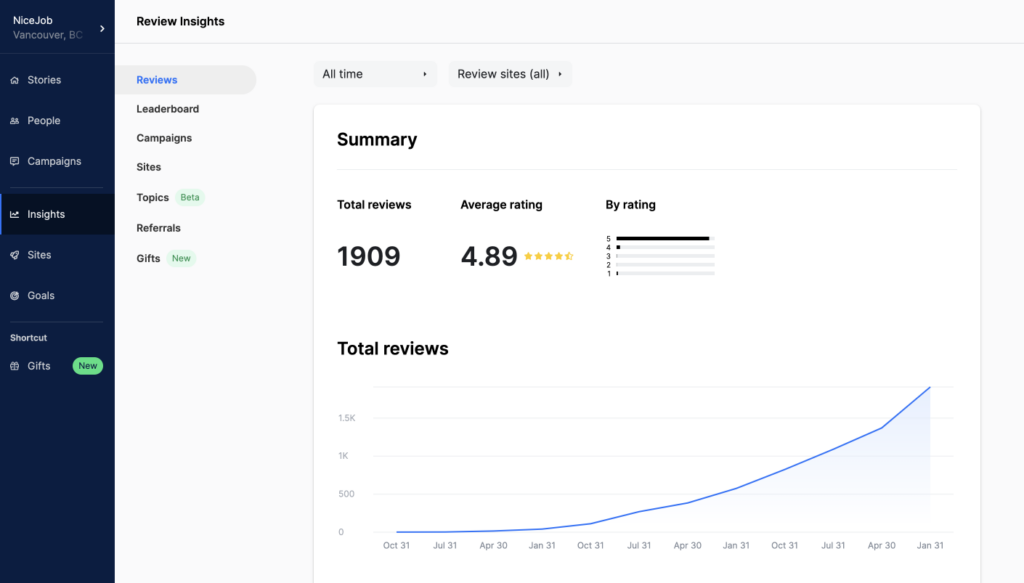
The platform also handles social proof and SEO content. Positive reviews can be auto-published to social media, embedded as testimonials on a site, and used to populate review-rich content that supports local rankings.
Key features
- CRM-triggered review requests: Send invites automatically when a job is closed in tools like Jobber, ServiceTitan, or Housecall Pro.
- SMS plus email request sequences: Hit customers first by text, then follow up by email if no response comes back.
- Reviews widget for websites: Showcase verified reviews directly on your site to build trust with new visitors.
- Auto-share to social media: Push glowing reviews to Facebook and other platforms without manual posting.
- Stories and Get Repeats: Convert past customers into repeat business through follow-up campaigns that reference earlier work.
- SEO-friendly review pages: Generate company landing pages designed to surface reviews in search.
Pros & cons
Pros
- Best-in-class CRM integrations for home service tools.
- Onboarding is fast and most users are sending requests within the first day.
- Strong automation that runs in the background without daily attention.
- Responsive support team that helps with integration setup.
Cons
- Widget customization is limited compared to design-focused tools.
- The SEO landing page generator does not always rank as well as a custom-built page.
- Bulk customer uploads can feel clunky if you don’t have a CRM connected.
What we like
Automation that fires on real business events is what we keep coming back to. Tying a review request directly to a closed job in your CRM removes the discipline problem that kills most review programs.
What users say
Users frequently call out the hands-off automation and the meaningful jump in review volume they see after switching.
“I really like the automation in NiceJob. It’s synced with our CRM and is pretty much hands-off. Review invites are sent out automatically when a work order is completed in our CRM, which is great.”
On the downside, reviewers mention that the on-site widget could use more design flexibility.
“I don’t like the widgets and aspects that interact with the website to show reviews. I’d like more customization in terms of the number of reviews displayed, style, font, color, etc.”
Pricing
NiceJob offers a 14-day free trial that does not require a credit card.
Paid plans include:
- Reviews ($75/month)
- Pro ($125/month)
- Sites add-on ($99/month + $199 setup fee)
7. Birdeye
Birdeye is a customer experience platform we evaluated across multi-location and enterprise use cases.
Review collection is one module among many that includes listings management, social media tools, messaging, surveys, and AI-driven response automation.
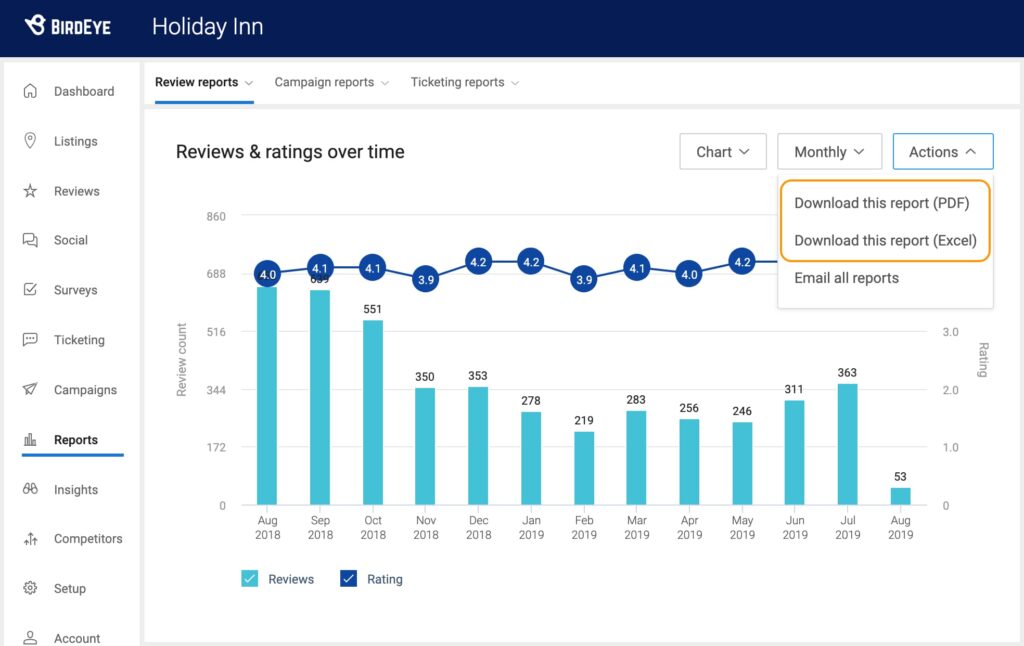
Birdeye sits squarely in the all-in-one camp. We found the platform best suited to brands that want one vendor handling reputation, listings, social, and customer messaging rather than stitching together separate point tools.
Key features
- Automated review requests: Send SMS and email review invitations triggered by customer events or scheduled batches.
- AI response generation: Draft review replies with AI assistance tuned to your brand tone.
- Multi-location dashboard: Manage reviews, listings, and customer feedback across hundreds of locations from a unified view.
- Listings management: Sync business data across major directories to keep NAP information consistent.
- Internal notes on reviews: Add internal tags and notes to reviews for team-level coordination on responses.
- Surveys and insights: Run satisfaction surveys and surface trends with sentiment scoring and topic detection.
Pros & cons
Pros
- Genuinely comprehensive platform that covers reviews, listings, social, and messaging.
- Strong AI features for response drafting and trend detection.
- Onboarding support is hands-on, with named specialists guiding setup.
- Well-suited for enterprise rollouts across many locations.
Cons
- The learning curve reflects the breadth of the platform, which takes time for new users to absorb.
- Contracts typically run annually rather than month-to-month.
What we like
The internal notes feature on reviews is a small detail that pays off across a multi-location team. It lets managers tag specifics for staff training without having to clutter the customer-facing response.
What users say
Users with multi-location operations consistently praise Birdeye’s centralization and the AI tools that save time on responses.
“What I like best about Birdeye is how efficiently it centralizes reviews and customer feedback across multiple businesses. The automation around review requests has saved our team time while increasing review volume.”
Reviewers mention that the platform’s breadth comes with a learning curve.
“The learning curve is more a reflection of how robust the platform is, not the support we received.”
Pricing
Birdeye doesn’t share its pricing publicly. You’ll need to reach out to the company’s sales team to get a quote.
8. Grade.us
Grade.us is a review management platform we evaluated with agency users in mind. Pricing is structured per seat or per location with a three-seat minimum, which makes the math work for agencies serving multiple clients rather than single-location businesses.
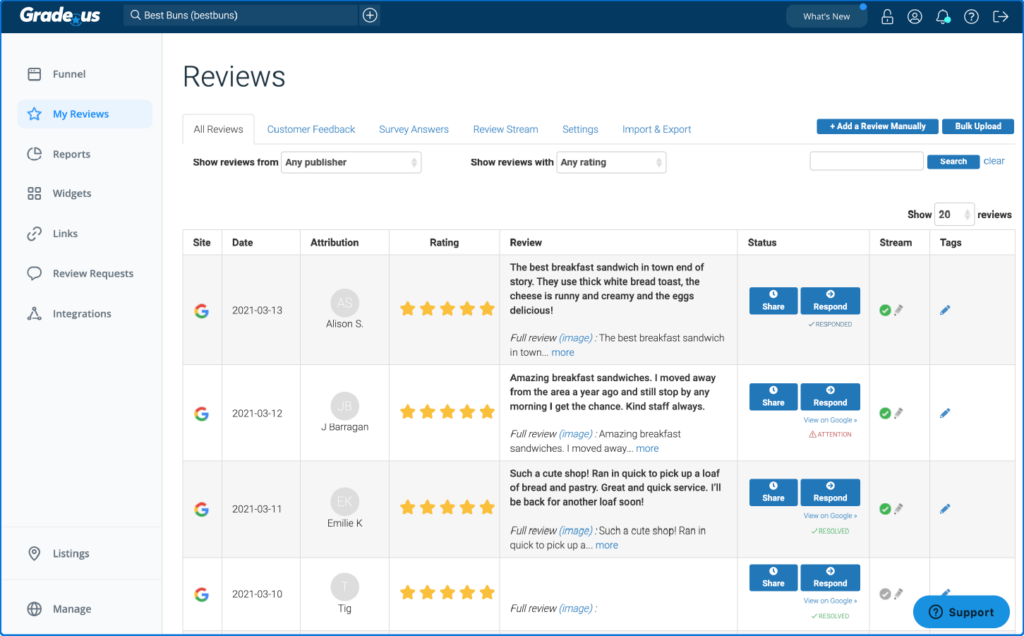
The platform automates review solicitation across Google, Facebook, and industry-specific sites, monitors what gets said about each brand, and turns positive reviews into SEO-friendly web and social content.
Agencies can use it as a packaged offering for their clients.
Key features
- Multi-channel review requests: Send invitations via email and SMS, with a customer-friendly funnel that routes to the right review site.
- Review monitoring across the web: Track new reviews from Google, Facebook, and dozens of industry-specific platforms.
- Reputation funnel: Direct unhappy customers to a private feedback channel before they post publicly.
- SEO-friendly review widgets: Publish reviews to client websites with schema-marked widgets that support search visibility.
- Auto-share to social: Push high-rated reviews to social channels automatically to amplify positive feedback.
- Agency dashboard: Manage multiple clients under one login with per-client reporting and access controls.
Pros & cons
Pros
- Seat-based pricing fits agency economics cleanly.
- Active and consistently praised support team.
- Solid automation for review solicitation and follow-up.
- Review widgets that publish reviews directly to client websites with auto-updating content.
Cons
- Dashboard navigation has a learning curve and the layout is not always intuitive.
- Some users report that texted review links occasionally do not render properly on mobile.
- Phone support has been scaled back, so urgent issues route through email or chat.
What we like
Reviews flowing automatically to a client’s website is a small touch that makes Grade.us easy to defend to agency clients. The displayed reviews update on their own, which removes a routine maintenance task from the agency’s plate.
What users say
Agency users especially praise the pricing structure, support quality, and the ability to manage review collection at scale.
“The support is consistently excellent. Pricing is designed to allow agencies to make a decent profit on a modest amount of needed attention. I have used other products. The team that put this together really care about doing it right.”
A frequent piece of feedback is that the dashboard layout takes time to learn.
“The learning curve was a little steeper than I had hoped. The dashboard requires memorization of where and what the tabs do rather than being obviously intuitive.”
Pricing
Grade.us offers a 14-day free trial with no credit card required.
Paid plans include:
- Small Business ($99/month)
- Multi Location ($60/month per location)
- Agency (custom pricing)
Collect reviews on autopilot
Monitor, manage, and get more online reviews for your business with LocalImpact.
9. TrueReview
TrueReview is a focused review collection tool we tested with single-location use cases. The product sticks closely to its core job of inviting customers to leave reviews, with SMS and email outreach, follow-ups, and AI-powered response suggestions.
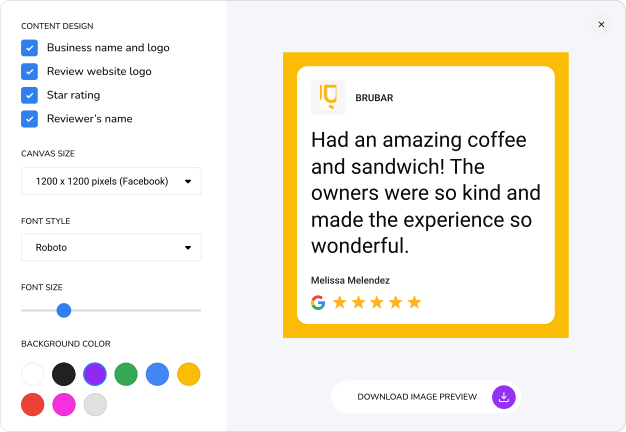
What stands out is how quickly TrueReview gets out of the way. Setup takes minutes, the interface is uncluttered, and you can start sending requests almost immediately without wading through configuration options you do not need.
Key features
- SMS and email review requests: Send personalized review invitations through both channels with automatic follow-ups.
- AI review reply suggestions: Generate draft responses to Google reviews in seconds with editable AI-written replies.
- Negative feedback funnel: Catch unhappy customers with a private feedback form before they post a public review.
- Custom links and QR codes: Create custom review links for any site and generate QR codes for in-person review collection.
- Social review post generator: Turn top reviews into branded visual posts ready for social media.
- Zapier and API integrations: Connect TrueReview to CRMs, POS systems, and other tools to trigger requests automatically.
Pros & cons
Pros
- Genuinely easy setup that gets you to your first review request quickly.
- Strong customer support team that is responsive across plan tiers.
- Lower entry price than most platforms with comparable functionality.
- AI response generator that saves real time on routine replies.
Cons
- Native integrations are limited, so many connections rely on Zapier.
- Branding customization on review requests is restricted on the lower-tier plans.
- Higher-tier multi-location features require the Premium plan.
What we like
The social review post generator is a smart bonus. Turning a strong review into a branded visual ready for Instagram or Facebook in a couple of clicks is something most platforms don’t offer at this price.
What users say
TrueReview’s reviews highlight how easy the platform is to use and how attentive the support team is.
“We love using TrueReview because it’s so easy to set up and customize your campaigns. Then you can track the requests and follow up with the clients. So easy!”
Reviewers occasionally call out that they want more flexibility around branding and customization.
“I wish there was more customization of the requests and that I could remove the TrueReview branding and include my company’s.”
Pricing
TrueReview offers a 14-day free trial with up to 250 review requests, no credit card required.
Paid plans include:
- Starter ($49/month)
- Small Business ($99/month)
- Premium ($299/month)
How to choose the right review collection software for you
The right tool depends on your business size, your budget, and how much extra functionality you actually want bundled in with review collection. Here’s how to narrow the field:
- Match the tool to your business size: A solo operator doesn’t need an enterprise platform with sentiment dashboards across hundreds of locations. Look for tools sized to your operation so you’re not paying for capacity you’ll never use.
- Decide if you want all-in-one or focused: Some platforms bundle reviews with web chat, listings, surveys, and social management. Others stick to review collection and do it well. Decide which side of that line you want before comparing prices, because the bundled options are often two to ten times more expensive.
- Prioritize your existing integrations: If your customer data lives in a specific CRM or field service tool, check that the review platform integrates natively. Zapier workarounds can work, but they add a moving part you’ll eventually have to maintain.
- Test the request experience as a customer: The biggest driver of review volume is how the request looks and feels to the customer receiving it. Send one to yourself before signing up so you know whether the SMS, the landing page, and the review prompts match the brand experience you want.
Take advantage of the free trials. Most platforms on this list let you test the full workflow without entering a credit card, which is the best way to see what actually fits your business.
Get started with review collection software
Review collection software pays for itself fast once it’s set up properly. Steady review velocity drives local search visibility and builds trust with new customers before they ever pick up the phone.
If you’re unsure where to start, try out LocalImpact with the 14-day free trial. It’s the most affordable option on this list, covers the full workflow, and gives you a feel for what review management software can do without committing to enterprise-tier pricing.