Most businesses think Google reviews are about one thing: getting as many five-star ratings as possible.
That thinking is outdated.
Google doesn’t just look at how many reviews you have or what your average rating is. It evaluates momentum and patterns. It evaluates whether your business looks alive.
That’s where Google review velocity comes in.
Review velocity is one of the most misunderstood and under-optimized factors in local SEO. When handled correctly, it can improve your Local Pack visibility, protect you from ranking volatility, and increase customer trust.
When mishandled, it can trigger filters, suppress legitimate reviews, or weaken your credibility.
This guide breaks down exactly what review velocity is, how Google interprets it, and how to build a sustainable system that improves rankings without risking penalties.
Key takeaways
No time to read the full article? Here are the key takeaways you need to know:
- Review velocity is about consistency, not volume: Google evaluates the rate and pattern of incoming reviews over time, not just total count or star rating.
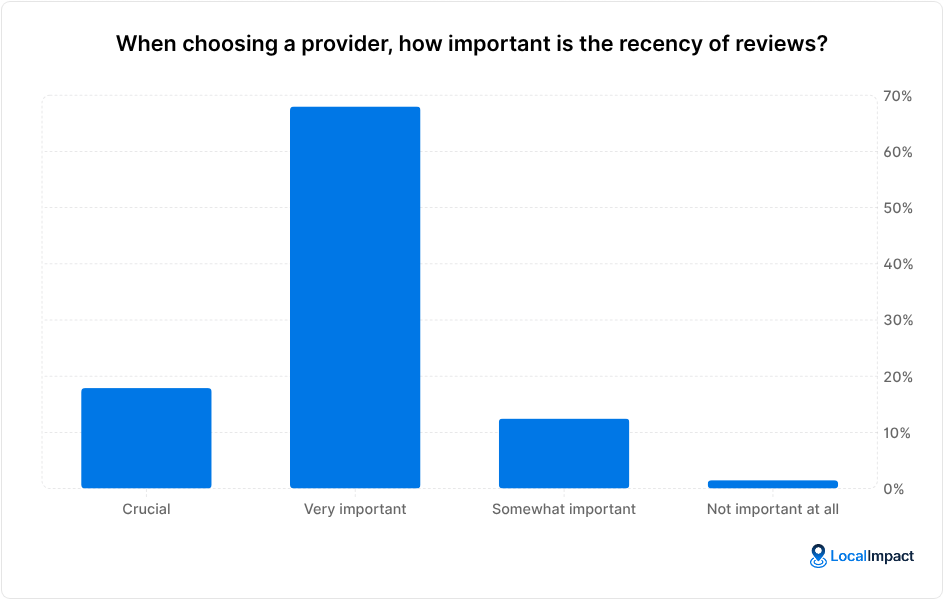
- Recency directly influences trust and visibility: In our research, 68% of consumers say it’s very important that a business has recent reviews.
- Steady momentum outperforms sudden spikes: Evenly distributed reviews signal authentic activity, while abrupt surges can trigger filtering or reduce credibility.
- Velocity compounds relevance: Each new review adds fresh, keyword-rich user-generated content that strengthens local search signals over time.
- Sustainable velocity requires systems: Automated timing, frictionless review paths, and staff participation create stable acquisition without risky bursts.
- Monitoring matters: Track acquisition rates and recency gaps to prevent slow velocity decline from turning into ranking decline.
What Is Google review velocity?
Google review velocity refers to the rate at which your business receives new reviews over time.
It’s not simply about how many reviews you’ve collected. It’s about how frequently they arrive and whether that pattern appears natural.
For example:
- If your business earns 2–3 reviews every week, that reflects steady velocity.
- If you receive 40 reviews in three days after months of silence, that reflects a spike.
Google’s algorithms are designed to detect patterns like these. They analyze timing, spacing, distribution, and consistency.
Velocity is fundamentally about momentum. A business that consistently generates customer feedback appears active, engaged, and operational. A business that had great reviews three years ago but none recently looks stagnant.
When optimizing review velocity, you should think in terms of cadence. Weekly or monthly acquisition rates matter more than lifetime totals. Google wants to see proof that customers are interacting with your business right now, not just historically.
Manage your online reviews with ease
Monitor, manage, and get more online reviews for your business with LocalImpact.
How velocity differs from volume, recency, and quality
Review signals can be broken into four main categories:
- Volume: The total number of reviews.
- Quality: The average star rating and sentiment.
- Recency: How recently reviews were posted.
- Velocity: Frequency and consistency of review growth.
These metrics overlap but are not the same.
A business may have strong volume (300 total reviews) but weak recency (none in six months). It may also have decent recency but erratic velocity (30 reviews in one week, then none for months).
Velocity incorporates recency but goes further. It evaluates pattern behavior over time.
For example:
- Business A: 150 reviews total, 20 added in the last month.
- Business B: 200 reviews total, none added in the last three months.
Despite having fewer total reviews, Business A often appears more relevant to Google because it demonstrates ongoing engagement.
When optimizing your Google Business Profile, you must monitor velocity independently from rating and volume. A perfect 5.0 average with no new reviews can underperform a 4.5 rating with steady acquisition.
Why review velocity matters for local SEO
Review velocity is not a minor supporting signal: it plays a meaningful role in how Google evaluates local businesses.
Beyond star ratings and total review count, the consistency and momentum of incoming reviews help determine whether your business appears active, trustworthy, and relevant in the present moment.
Review velocity as a ranking signal
Google publicly states that reviews contribute to “prominence,” one of the three core Local Pack ranking factors (alongside relevance and distance).
Industry research consistently shows review signals contribute meaningfully to local rankings.
While Google doesn’t publish exact weighting percentages, studies indicate review signals (including quantity, diversity, and velocity) account for a substantial portion of local ranking influence.
Velocity matters because it acts as a trust validator. When your review flow is consistent, it signals:
- Ongoing customer engagement
- Stable operations
- Sustained service quality
Google’s algorithm is built to reduce risk for searchers. Showing users businesses that are actively serving customers today reduces the risk of recommending outdated or inactive listings.
If two businesses have similar proximity and relevance, review momentum often becomes the tie-breaker.
Freshness amplifies relevance and keyword signals
Every new review is more than social proof — it is fresh, crawlable user-generated content added directly to your Google Business Profile.
Unlike your website copy, which you update intentionally, reviews are written in natural language by customers describing real experiences. That natural language strengthens your local and topical relevance in ways that are difficult to replicate manually.
Customer reviews often contain highly specific signals, including:
- Service mentions (e.g., emergency plumbing, boiler repair, etc.)
- Location references (neighborhoods, cities, landmarks)
- Product names and service types
- Problem descriptions and outcomes
- Timeframes (“same-day repair,” “within 24 hours”)
For example, a review that says, “Best emergency plumbing service in downtown Dallas — fixed my boiler the same day,” reinforces your relevance for multiple keyword combinations at once.
It supports searches like “emergency plumbing Manchester,” “boiler repair downtown Dallas,” and “same-day plumbing service” without you explicitly optimizing for those phrases.
Because reviews are timestamped, each one also adds a freshness signal. Google favors active listings that continuously generate new engagement. If your business stops receiving reviews, your profile stops accumulating new keyword data and recency signals.
Over time, freshness decays and competitors with steady review flow gain an advantage.
To make this practical, encourage customers to be specific without scripting them. Instead of asking for “a five-star review,” ask them to mention the service they received. This simple prompt increases keyword richness while preserving authenticity.
Steady review velocity keeps feeding Google new relevance signals. Without it, your listing becomes static. With it, your profile remains active, indexed, and competitively reinforced.
Competitive Differentiation in the Local Pack
In competitive markets, many businesses share similar ratings and review counts.
When everything else is equal, Google must decide which business appears in the top three Map Pack positions.
Consistent review velocity provides a differentiator.
If your competitors are earning 2 reviews per month and you are earning 6–8 consistently, that momentum becomes an advantage.
However, the key is proportion. Dramatically exceeding competitors overnight can trigger suspicion. Slightly outperforming them steadily is optimal.
Manage your online reviews with ease
Monitor, manage, and get more online reviews for your business with LocalImpact.
The psychology of review velocity
Search rankings are only part of the equation. Review velocity also shapes how real people perceive your business before they ever click, call, or visit.
The pattern and timing of your reviews influence trust, credibility, and purchase confidence just as much as the average star rating.
Why consumers trust recency more than perfection
Modern consumers rarely trust a profile that hasn’t been updated in months.
This isn’t a minor preference. In our research, 68% of consumers said it’s very important that a business has recent reviews.
If the most recent review is from last year, prospects may begin to question whether the business is still active, whether service quality has slipped, or whether management has simply stopped paying attention to customer experience.
Even without consciously analyzing it, the absence of recent feedback can create subtle doubt that affects purchasing decisions.
Fresh reviews act as reassurance.
Research consistently shows consumers value recent reviews more than average rating alone. A 4.4-star business with reviews from last week feels safer than a 5.0-star business with nothing new in six months.
Velocity directly influences consumer confidence before it influences rankings.
Why review spikes reduce trust
Customers are perceptive.
When they notice 50 five-star reviews appearing within two days, multiple reviews using nearly identical wording, or several posted at almost the exact same timestamps, it immediately raises suspicion.
Even if the reviews are legitimate, unnatural clustering damages credibility.
What healthy review velocity looks like
Benchmarks by business type
There is no universal “correct” number of reviews per month. Velocity should align with transaction volume.
As a general framework:
- Small local businesses: 2–5 reviews per month
- Mid-sized service businesses: 5–10 per month
- High-transaction businesses (restaurants, retail): 8–15+ per month
- Enterprise or multi-location: 10–20+ per month per location
The key is consistency.
If you are a local service provider handling 50 jobs per month, acquiring 5–8 reviews monthly is realistic and natural.
If you suddenly jump from 2 per month to 30 in one week, that pattern looks artificial.
Healthy velocity mirrors customer flow.
Distribution matters more than total
Consider two scenarios:
- Business A gets 12 reviews in one week, then none for 3 months.
- Business B gets 3 reviews every month consistently.
Business B has healthier velocity.
Even spacing signals authenticity. Clustering signals campaign bursts or manipulation.
When planning review acquisition, avoid sending large batches of requests simultaneously. Instead, stagger outreach weekly.
Google prefers “drip irrigation” over “flash flood.”
Justin Herring, founder of local SEO agency YEAH! Local, puts it simply:
"The shops that ask for a review after each job do better in the map listings than the ones who get 30 reviews in a day. It looks more real to Google.
Keep it consistent—that's the key."
Red flags that trigger Google’s suspicion
Sudden review spikes
The most common velocity mistake is mass outreach.
Sending 1,000 review requests at once can trigger unintended consequences, including filtered or hidden reviews, sudden ranking drops, or even a manual review of your Google Business Profile.
When activity spikes far beyond your normal pattern, Google’s systems may interpret it as manipulation rather than organic growth.
Google’s spam systems detect unusual acceleration relative to historical behavior.
If you normally receive one review per week, jumping to 20 per day raises flags.
Increase velocity gradually over time instead.
Uniform patterns and identical content
Google analyzes linguistic patterns within reviews to detect unnatural behavior.
When multiple reviews contain identical phrases, follow the same sentence structure, share nearly identical lengths, or read in a robotic and formulaic tone, the system may interpret them as coordinated or inauthentic.
Even subtle repetition across several reviews can trigger suspicion, especially when the language lacks the natural variation typical of genuine customer feedback.
Encourage customers to write naturally. Avoid providing scripted templates.
Authenticity beats optimization.
Review gating violations
Review gating is prohibited.
This typically occurs when businesses first ask customers whether they had a good experience, then direct only satisfied customers to leave a public Google review while routing dissatisfied customers to a private feedback form instead.
Although it may seem like a protective strategy, this selective process is considered review gating and violates Google’s guidelines.
Google explicitly bans this practice.
Even if your intent is reputation protection, gating can result in penalties.
Always request reviews neutrally from all customers.
How to build sustainable review velocity
Understanding review velocity is only useful if you translate it into a repeatable process.
The goal is not to generate occasional bursts of reviews, but to create a steady system that produces consistent acquisition aligned with your transaction flow.
Optimize the timing of your review requests
Timing is the highest-leverage variable in review acquisition.
Ask for a review within 24–48 hours after the service is completed, the delivery is confirmed, or a positive in-person interaction occurs.
This window is when the customer’s experience is still fresh and emotionally salient, making them far more likely to follow through and leave thoughtful feedback.
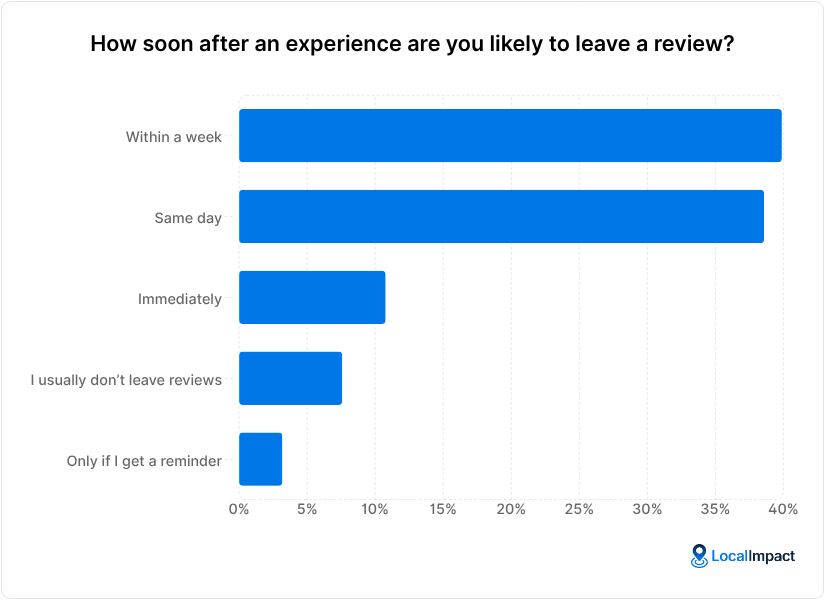
In our research, over a third of consumers said they write reviews on the same day as purchase, and most reviews are written within a week.
Waiting two or three weeks significantly reduces participation. The longer you delay the request, the more momentum you lose.
For service businesses, trigger automated requests when jobs are marked complete in your CRM.
For retail, send follow-ups tied to purchase receipts.
Every additional step in the review process lowers completion rates. Even highly satisfied customers will abandon a review request if the process feels confusing, time-consuming, or inconvenient.
Use:
- Direct Google review links: Send customers straight to the review form instead of your Google Business Profile. You can use our free Google review link generator to get started.
- QR codes in-store: Place scannable codes on receipts, counters, packaging, or signage so customers can leave a review instantly from their phone. You can create a QR code for your business using our QR code tool.
- SMS with embedded review URL: Text messages have high open rates, and a short clickable link reduces effort to almost zero. You can use LocalImpact to set up automated SMS review request campaigns.
- Email signature CTAs: Adding a subtle “Leave us a review” link to post-service emails and staff signatures creates ongoing, passive review opportunities. Over time, these micro-prompts compound into steady acquisition.
- Thank-you page buttons: Immediately after checkout or booking confirmation, present a clear review button. This captures customers at a moment of engagement, when satisfaction and attention are both high.
Never ask customers to “search your business and find the review tab.” Make the path as close to one click as possible.
Create an automated, always-on system
Manual review requests produce inconsistent velocity.
Automation creates cadence.
Integrate review requests directly into your existing systems so they become part of your normal operational flow.
That means triggering them through your CRM when a job is marked complete, connecting them to your POS system after a transaction closes, embedding them into your email automation sequences, and incorporating them into your SMS marketing workflows.
When review requests are built into the infrastructure of your business rather than handled manually, consistency becomes automatic and velocity stabilizes naturally.
Pro tip: Use LocalImpact to set up automated email and SMS review request campaigns that ensure every customer gets asked to leave a review.
Manage your online reviews with ease
Monitor, manage, and get more online reviews for your business with LocalImpact.
Train staff to ask naturally
Technology alone won't maintain consistent review velocity. Automated systems create opportunities, but frontline staff create momentum.
To turn review requests into a natural part of your operations:
- Train staff to recognize “review trigger moments”: The best time to ask is immediately after a customer expresses satisfaction: a compliment, a thank-you, visible excitement, or positive feedback about the service. Teaching employees to spot these moments dramatically increases success rates without making the interaction feel forced.
- Provide flexible phrasing instead of scripts: Avoid rigid, memorized lines. Instead, give examples such as, “If you enjoyed your experience, we’d really appreciate a quick Google review,” and encourage employees to adapt the wording to their own voice so it sounds authentic rather than rehearsed.
- Incorporate review requests into the service flow: For example, hair stylists can ask during checkout, contractors can ask at project handover, and restaurant staff can ask when presenting the bill after a positive interaction. Embedding the ask into existing touchpoints prevents it from feeling like an afterthought.
- Use light accountability to reinforce consistency: Track weekly review numbers and share progress with the team. When employees see how their efforts directly contribute to rankings and business growth, they’re more likely to participate consistently.
- Educate staff on why reviews matter: When employees understand that reviews impact Local Pack visibility, customer trust, and ultimately revenue stability, they are more invested in asking confidently and consistently.
When staff participation becomes habitual rather than occasional, review velocity stabilizes. This human layer prevents drought periods that commonly occur when businesses rely exclusively on automated follow-ups.
Measuring and maintaining healthy velocity
Most businesses talk about review velocity in theory but never actually measure it. If you’re not tracking velocity deliberately, you won’t notice a slowdown until rankings have already dropped.
Review velocity is not something you “set and forget.” It needs ongoing monitoring, just like traffic, conversions, or ad performance.
To manage velocity properly, you need to track specific indicators that reveal momentum, stability, and risk.
- Monthly review acquisition rate: This is the number of new reviews your business receives each calendar month, and it establishes your baseline pace. Track it in a simple spreadsheet or dashboard and compare month over month so sudden drops are identified early.
- 90-day rolling velocity average: Calculate the average number of reviews earned over the past 90 days to smooth out short-term fluctuations. This helps you see whether overall momentum is increasing, stable, or gradually declining.
- Competitive velocity comparison: Monitor how many reviews your top three local competitors gained in the past 30 and 90 days. If they consistently outpace you, they are strengthening their prominence signal relative to your listing.
- Recency gaps: Track how many weeks have passed since your most recent review to detect inactivity early. If you cross four weeks without new reviews, investigate.
- Rating distribution: Review how ratings are distributed across 5-star, 4-star, and lower categories rather than focusing only on your average. A natural distribution appears authentic, while sudden perfection or skewed patterns can raise suspicion.
Chris Kirksey, founder and SEO strategist at Direction.com, has seen this play out across the healthcare practices his agency manages.
"Practices that obtain between 6 to 10 new reviews each month maintain or improve their position in the map pack in more than 80% of audits.
Practices dropping below 2 new reviews in a particular month exhibit ranking slippage within 45 to 60 days in about 65% of cases."
For Kirksey, review velocity is about keeping Google's interest in your listing month after month.
If more than four to six weeks pass without new reviews, treat it as an early warning signal rather than a coincidence. Velocity decline often precedes ranking decline, especially in competitive markets. By the time you see visibility drops, the underlying momentum issue may have been developing for months.
Consistency protects visibility. Businesses that actively monitor these metrics can correct slowdowns quickly, maintain steady acquisition patterns, and avoid the feast-or-famine cycles that undermine both rankings and trust.
Review velocity is a long-term signal
Google review velocity is about proving, consistently and credibly, that your business is active, engaged with customers, and continuing to deliver real experiences worth talking about.
When reviews arrive at a steady pace, they signal ongoing activity, genuine customer interaction, and sustainable reputation growth. All of these align with what Google is trying to surface in local results.
Follow the tips outlined in this guide to reach a steady review velocity for your business and increase your chances of ranking high in search results.