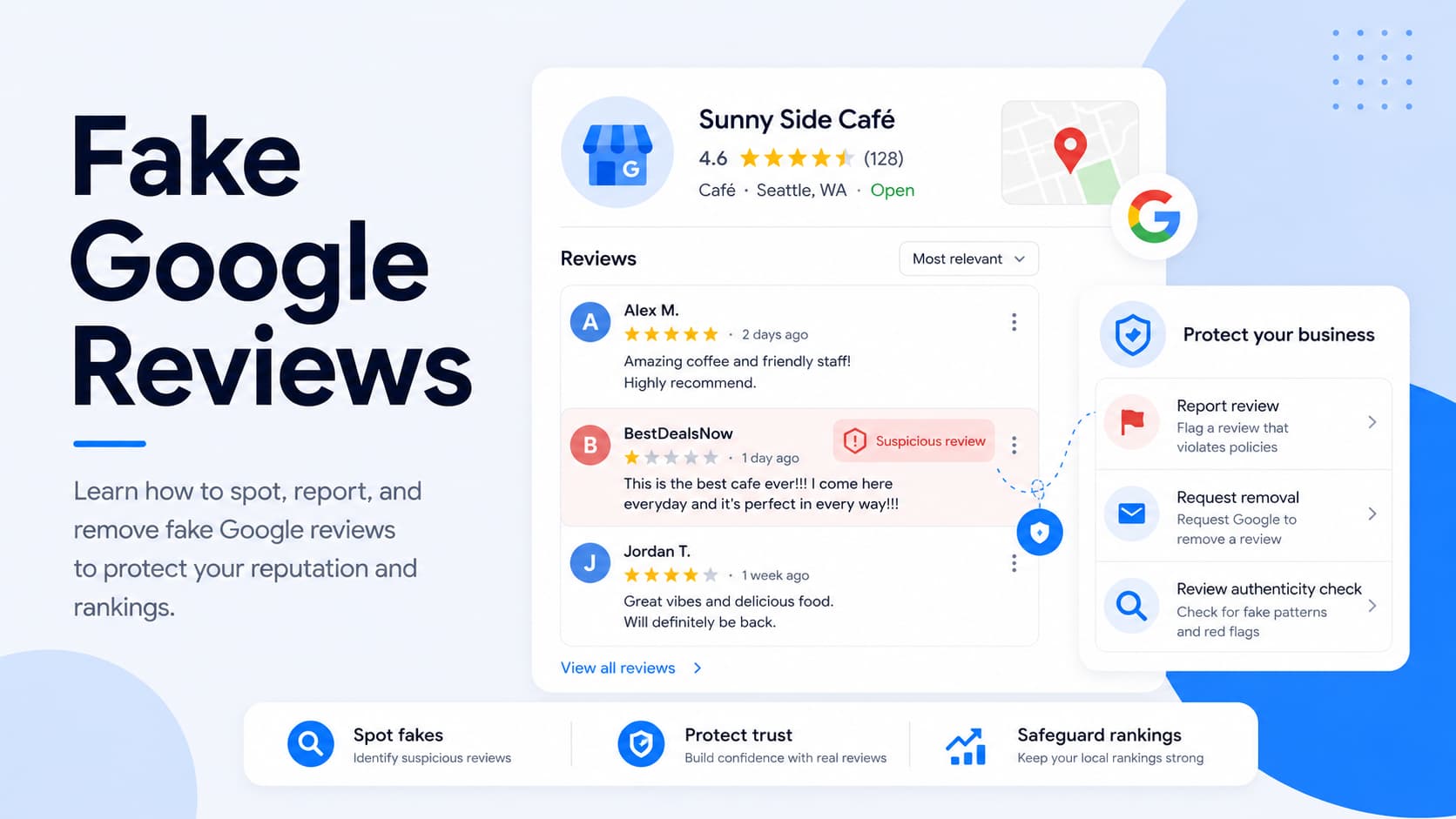
Fake Google reviews have become part of running a local business. They show up on your profile without warning, drag down your average rating, and shape what potential customers think before they ever call you.
Most coverage of this topic is written for shoppers learning to avoid getting tricked. This guide is for you, the owner absorbing the damage and trying to do something about it.
You'll learn how to:
- Tell a fake review apart from a harsh but genuine one
- Report and remove reviews that break Google's policies
- Respond in a way that protects you with everyone reading along
- Defend your profile before the next wave hits
The problem is widespread enough that planning for it makes sense. 72% of local business owners say they've received a fake review in the past 12 months, and only 8% are confident they've received none at all.
What are fake Google reviews?
A fake Google review is feedback posted by someone who never actually did business with you. It might praise a company to inflate its rating or attack one to damage its reputation, and either way it isn't tied to a real customer experience.
Here's an important distinction before you start flagging things. A harsh, critical, even unfair review can still be genuine if the person actually used your service and walked away unhappy.
Google treats a few specific categories as fake or policy-violating:
- Content with no real experience behind it: Reviews from people who never visited, bought, or interacted with your business fall squarely into this bucket. These are the classic fakes, whether they're glowing or scathing.
- Conflict of interest: Reviews written by competitors, current or former employees, or anyone with a stake in your rating aren't allowed. The same goes for owners reviewing their own business or a rival's.
- Off-topic content: Reviews that rant about politics, social causes, or anything unrelated to an actual experience with your business can be flagged. They don't reflect a customer interaction, so Google considers them removable.
Why fake Google reviews are a problem for local businesses in 2026
Fake reviews used to be an occasional annoyance. They've graduated into a category of operational risk that you now have to manage actively, the same way you'd manage inventory shrinkage or payroll fraud.
The damage reaches further than most owners expect. According to our survey on fake reviews, around 3 in 4 owners say fake reviews have hurt their business in some way, and the harm spreads across three areas:
- Marketing and revenue damage: 52% of owners report damage to their star rating, 33% report lost potential customers, and 28% report reduced revenue. A single fake review chips at the exact signals shoppers use to choose you.
- Operational drain: 40% of owners report meaningful time spent managing or responding to fake reviews, which is time pulled straight from running the business. Some go further, with 27% hiring a third-party service and 17% consulting a lawyer.
- Staff and hiring impact: 24% of owners say fake reviews have caused staff stress or morale issues, and 20% say they've made hiring harder. When a review accuses your team of something they didn't do, the people on the floor read it, and so do recruits.
What makes a single fake review so costly is how shoppers react to anything negative. 88% of consumers say they've avoided a business after reading negative reviews about it, so even one believable fake can cost you customers.
AI tools like ChatGPT and Google's AI summaries now pull from your public review signals when they suggest businesses to people.
Those recommendations don't stand on their own, though, since over half of consumers say strong, recent reviews are what makes them comfortable trusting an AI-recommended business.
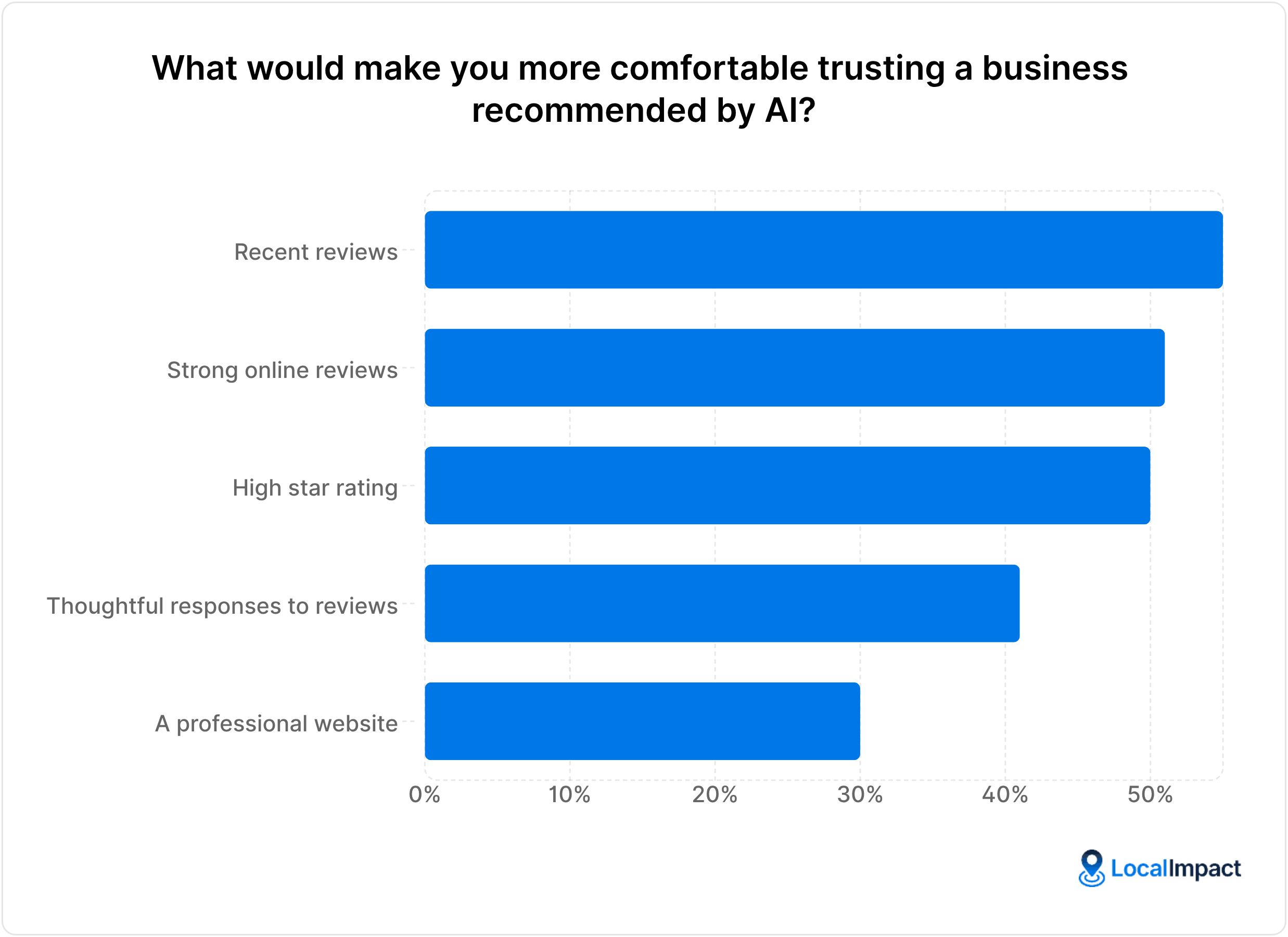
When AI points someone toward your business, a rating weakened by fakes is what loses them at the final step.
Types of fake Google reviews and who's behind them
Fake reviews come in a few recognizable shapes, and knowing the motive behind each helps you spot patterns faster. Owners describe a marketplace where fakery runs in two directions at once, with rivals inflating their own ratings and attackers tearing others down:
- Fake negatives from competitors: A rival posts one-star reviews to drag down your average and bump themselves up in local rankings. These often include hostile or promotional language, sometimes even naming the competing business.
- Coordinated negative attacks: Several fake negatives land in a short window, designed to tank your rating fast. 79% of owners believe they've been targeted by a coordinated attack at some point, so the clustered burst is a familiar pattern.
- Ex-employee revenge reviews: A former staff member with a grudge posts a damaging review dressed up as a customer complaint. These can feel specific, which makes them trickier to dispute.
- Fake positives on a rival's profile: A competitor buys glowing reviews to inflate their own rating and hide weak feedback. 70% of owners suspect their competitors of using fake positives this way.
- Paid and incentivized reviews: Some reviews come from people paid per post or rewarded with discounts and freebies. The reviewer may exist, though the opinion is bought rather than earned.
- AI-generated reviews: Bots now write reviews that read smoothly but stay vague, often overusing your business name or repeating phrasing. Flawless grammar with zero specific detail is a common giveaway.
How to spot a fake Google review
Most fake reviewers have never set foot in your business, so their reviews tend to leak that fact in small ways.
The most reliable tell comes from the content itself: 60% of owners say a review feels fake when it includes factual details that don't match the business, like a service you don't offer or a staff member who doesn't work there.
A few other signals are worth checking before you decide:
- No reviewer history: Click the reviewer's name and look at their profile. An account with no photo, no other reviews, or one created minutes ago is a strong flag.
- Generic or templated language: Real customers mention specifics like a dish, a name, or what happened. Vague praise or criticism that could apply to any business often means the writer was never there.
- Suspicious timing clusters: Several reviews appearing in a short burst, especially for a business that doesn't normally see high volume, points to a coordinated push. Natural reviews trickle in over time.
- Extreme-only rating patterns: A profile that posts nothing but one-star or five-star reviews, with no middle ground, reads as manipulation. Genuine reviewers leave a mix.
- Unrelated review history: If the account reviewed a dentist in one city, a mechanic in another, and a restaurant a thousand miles away within days, that's not a typical customer. It suggests a paid or fake account.
Treat any one of these as a reason to dig deeper rather than a verdict on its own. The strongest cases combine two or three signals, like factual inaccuracy plus a brand-new account plus a one-star burst.
Get more Google reviews for your business
Generate more Google reviews for your business with LocalImpact's automated tools.
What Google's review policy says about fake reviews
Knowing Google's rules makes your reporting far more effective, since a report only succeeds when the review clearly breaks a stated policy.
Google removes reviews that violate its content guidelines, and the categories most relevant to fakes include:
- Spam and fake content: Reviews that are repetitive, posted from fake accounts, or not based on a real experience all qualify. This is the category most fakes fall under.
- Conflict of interest: Reviews from competitors, employees, or anyone with a financial stake in your rating count as biased and removable. Reviewing your own business lands here too.
- Off-topic content: Reviews that don't describe an actual experience, including political or social rants, can be flagged. They're not feedback about your service.
- Restricted, illegal, or explicit content: Reviews promoting regulated goods, supporting illegal activity, or containing sexual or hateful material break the rules outright. Harassment and personal attacks fall here as well.
Further reading: Everything You Should Know about Google Review Policy
Why legitimate reviews sometimes disappear
Before you assume a missing review was fake or unfairly pulled, it helps to know that real reviews go missing all the time for ordinary reasons. Confusing a filtered genuine review with a coordinated fake attack sends you chasing the wrong problem.
The usual causes are worth recognizing:
- A spam filter caught it: Google's automated systems sometimes flag legitimate reviews by mistake, especially when several arrive in a short window or share similar wording. The review may reappear on its own, or stay gone.
- The reviewer deleted it: Customers can remove their own reviews anytime, and you won't get a notification when they do. A dropping review count without any policy issue often traces back to this.
- Your profile hit a snag: A suspension, a duplicate listing, or a recent profile merge can all make reviews vanish or take days to show up. Merge-related delays usually resolve within a few days once Google catches up.
If a batch of real reviews disappears at once, check that your profile is verified and in good standing before anything else.
Further reading: Missing Google Reviews: Why They Disappear & How to Recover Them
How to report and remove a fake Google review
Once you're confident a review is fake, reporting it is straightforward, though removal takes patience. Google lays out the official process for reporting inappropriate reviews, and here's the path that gives you the best shot at getting one taken down:
- Flag it from your Google Business Profile: Log in, open the “Reviews” section, find the review, and use the three-dot menu to select “Report review”. Pick the reason that matches the violation, like spam or conflict of interest.
- Document why it's fake: Save screenshots, note the timing, and record any proof the reviewer was never a customer. Evidence strengthens your case if you need to appeal later.
- Check status in the Reviews Management Tool: Returning to Google's tool shows where your report stands, with statuses like "Decision pending" before it's evaluated and "Report reviewed - no policy violation" once it has been. It's also where you can report additional reviews for any profiles you manage.
- Submit a one-time appeal if removal is denied: If a flagged review doesn't qualify for removal, Google lets you appeal once through that same tool, so make a clear, specific case for which policy it breaks. Keep the tone factual and include your evidence.
- Escalate to Google Support with evidence: For reviews that clearly violate policy and won't come down, contact Google Business Profile support directly. Provide screenshots, timing patterns, and records showing no matching customer.
Just know going in that the system works slowly. Only 28% of owners say a reported fake review was removed promptly, which means the review often keeps dragging on your rating while you wait.
How to respond to a fake Google review
Since removal can take days or weeks, your public reply is doing the real work in the meantime. The audience for that reply is every future customer who scrolls past it, so a calm, factual response protects you even when the fake stays up.
A reply that works usually does a few things:
- States you have no record of the interaction: A line like "we've reviewed our records and can't find a matching customer experience" signals to readers that the review is suspect. It plants doubt on the reviewer rather than on you.
- Stays professional and unemotional: Replying while frustrated rarely helps, and a defensive tone reads badly to everyone who sees it later. Keep it brief and matter-of-fact.
- Points readers to your genuine reviews: A gentle nudge like "we'd encourage you to check our other reviews for a clearer picture" reassures shoppers. It reframes the moment around your real track record.
This effort pays off with the people reading along. 78% of buyers say seeing a thoughtful response to a negative review made them more likely to trust a business, so a measured reply can turn a fake review into a display of professionalism.
What to do when Google won't remove a fake review
Sometimes Google decides a review stays, and you're left managing the impact instead of erasing it. The most reliable counterweight is a steady flow of authentic reviews that keeps your overall rating strong while the fake sits there with less and less weight.
The math is simple. One suspicious negative review loses most of its power when dozens of genuine, recent five-star reviews surround it.
Pro tip: You can use LocalImpact to set up automated email and SMS review requests and generate new reviews on autopilot. Every satisfied customer gets asked, and you can add follow-up reminders to nudge the ones who forget.
How to handle review extortion
Review extortion is a nastier variant, and it calls for a different playbook. Someone threatens to post a damaging review, or refuses to remove one they've already left, unless you pay them or meet some demand.
Here's how to handle it:
- Don't pay: Giving in tends to invite repeat demands, and paying doesn't guarantee the review comes down anyway. It marks you as someone willing to settle, which can bring more attempts.
- Document everything: Save the messages, emails, and screenshots that show both the threat and the demand. This record is what makes your report credible.
- Report it as a policy violation: Extortion attempts break Google's content policies, and your evidence supports the case for removal. Google provides a dedicated form for reporting it.
Further reading: Review Extortion: When Google Reviews Turn Into Ransom
Are fake Google reviews illegal?
Yes, posting fake reviews is illegal in the US, and the rules have tightened in recent years.
In August 2024, the Federal Trade Commission finalized a rule banning fake and incentivized reviews, with civil penalties that can reach tens of thousands of dollars per violation.
Legal action has gone after both sellers and buyers of fake reviews, including coordinated cases brought by large platforms.
For a targeted defamation campaign that's causing real harm, consulting an attorney about cease-and-desist letters or other options can make sense.
Keep in mind this is general information rather than legal advice, and a lawyer can tell you whether your specific situation warrants action.
Get more Google reviews for your business
Generate more Google reviews for your business with LocalImpact's automated tools.
How to protect your business from fake Google reviews
The scale of this problem isn't shrinking, so the habits you build now decide how much damage a coordinated attack can actually do. Most businesses are still managing it with limited tools, which leaves them exposed when a wave hits.
The exposure shows up in the data. Only 31% of businesses use a dedicated review management platform, and just 36% feel very well-equipped to handle a sudden spike of fake negative reviews.
A few moves close that gap:
- Claim and actively manage your profile: An unclaimed or neglected profile is more vulnerable to fakes and harder to defend. Keep your information accurate and your name clean to avoid handing attackers an opening.
- Set up review alerts: Notifications for every new review let you catch a suspicious one within hours rather than weeks. Early detection makes removal more likely and limits the damage.
- Watch for spikes: A sudden cluster of reviews, especially negative ones, is your signal that something coordinated may be underway. Spotting it early lets you start reporting and responding right away.
- Keep records: Save details on reviewer history, inaccurate claims, and timing patterns as you go. Documentation gives you a stronger case the moment you need to report.
- Build a response system before you need one: Monitoring, alerting, and a few templated replies are far easier to set up in advance than during an attack. Having them ready is most of what being equipped actually means.
Frequently asked questions about fake Google reviews
A handful of questions come up again and again. Here are clear answers to the most common ones.
Can you turn off Google reviews?
No, you can't disable reviews on a Google Business Profile. As long as your business is listed, reviews are an automatic feature, and the only option you have is to monitor them and report anything that violates Google's guidelines.
Rather than trying to switch the system off, the better play is to build a steady base of genuine reviews. A strong, recent collection makes the occasional fake far less influential.
How long does it take Google to remove a fake review?
It varies, and there's no guaranteed timeline. Flagged reviews are often evaluated within a few days, though many take up to two weeks, and complex cases can run longer.
Clear-cut violations tend to move faster, especially when the offending account is obviously fake. While you wait, responding publicly keeps the review from doing unchecked damage.
Are fake positive reviews a problem too?
Yes, fake positives distort the marketplace just as much as fake negatives. They mislead shoppers into trusting businesses that gamed their rating, and they create unfair competition for businesses earning reviews honestly.
70% of owners suspect competitors of using fake positives, so it's a widespread concern.
To report one on a competitor's profile, find the business on Google Maps, open the review, click the three-dot menu next to it, and select "Report review" with a reason like conflict of interest or spam.
Can fake Google reviews be traced?
To a degree, yes. Google uses signals like IP addresses, account behavior, geolocation patterns, and language analysis to detect and penalize fake review activity, though enforcement takes time and isn't always visible to you.
For your own purposes, the practical move is documenting patterns you can see, like a reviewer's history across unrelated businesses. That evidence supports your report even when you can't trace the account yourself.
Bringing it together
Fake reviews are now a recurring cost of running a local business, and the way you respond is what decides their impact. A clear system handles them without eating your week or your peace of mind.
Put together, the workflow looks like this:
- Spot them early: Watch for factual inaccuracies, thin reviewer histories, and timing clusters that don't match your normal flow. Catching a fake within hours rather than weeks makes removal more likely and limits the damage.
- Report and document: Flag the review through your Google Business Profile and save screenshots, timing notes, and proof the reviewer was never a customer. That evidence is what carries your case through an appeal or an escalation to Google support.
- Respond professionally while you wait: A calm, factual reply noting you have no record of the interaction does the real work, since removal is slow. Your audience is every future customer who reads it, not the person who left the fake.
- Dilute and prevent: A steady stream of authentic reviews keeps your rating strong while a stubborn fake loses its weight. Pair that with monitoring and alerts so the next coordinated attack gets caught early.
This matters more as AI reshapes how people find businesses, since your reviews are what decide whether AI-driven attention turns into a customer.
How LocalImpact can help
LocalImpact brings the whole system into one place. You can monitor Google reviews and reviews across dozens of other platforms and respond quickly using AI-powered replies.
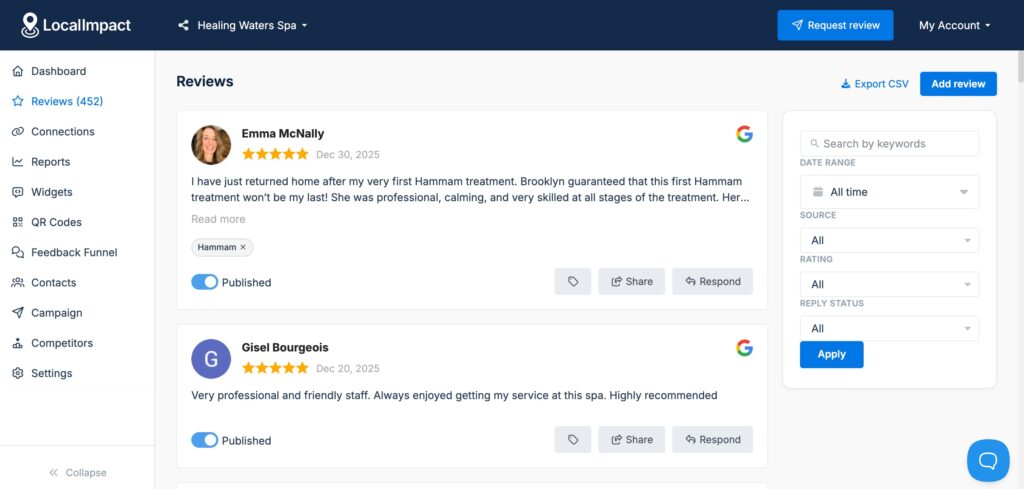
Automated email and SMS review request campaigns help offset fake negatives by generating a steady flow of authentic reviews from real customers.
The review widget lets you showcase your best reviews on your own website, where they aren't subject to platform manipulation.
Start your free trial today and turn your reviews into your strongest defense.