
Picking the right reputation management software for a small business can feel overwhelming when every platform claims to do the same thing.
We've spent the time evaluating these tools hands-on so you don't have to, and this guide breaks down the seven best reputation management software options for small businesses in 2026, with honest pros, cons, and pricing for each.
Best reputation management software for small businesses at a glance
| Software | Starting price | Free trial available? |
| LocalImpact | $19/month | Yes |
| NiceJob | $75/month | Yes |
| ReviewTrackers | $89/location/month | No |
| GatherUp | $99/month | Yes |
| Broadly | $799/month | No |
| Reviewshake | $29/month | Yes |
| TrueReview | $49/month | Yes |
How we chose these tools
Building this list took 200+ hours of hands-on testing, comparing platforms across the criteria that actually matter to small business owners, not just feature checkboxes. Here's what we evaluated:
- Ease of use: How quickly a small business owner or non-technical user can get up and running without needing a developer or extensive training.
- Review generation features: The quality and flexibility of automated review request campaigns, including email, SMS, and customizable follow-up sequences.
- Source coverage: The number and quality of review platforms each tool monitors, including niche, vertical-specific sites where they apply.
- Pricing transparency: Whether the tool publishes pricing upfront, requires a sales call, and how predictable monthly costs stay as the business scales.
- Integrations and automation: Native integrations with the CRMs, field service tools, and business platforms small businesses already rely on.
- Customer support quality: Real-world responsiveness, helpfulness, and onboarding experience based on hands-on time and verified user reviews.
1. LocalImpact
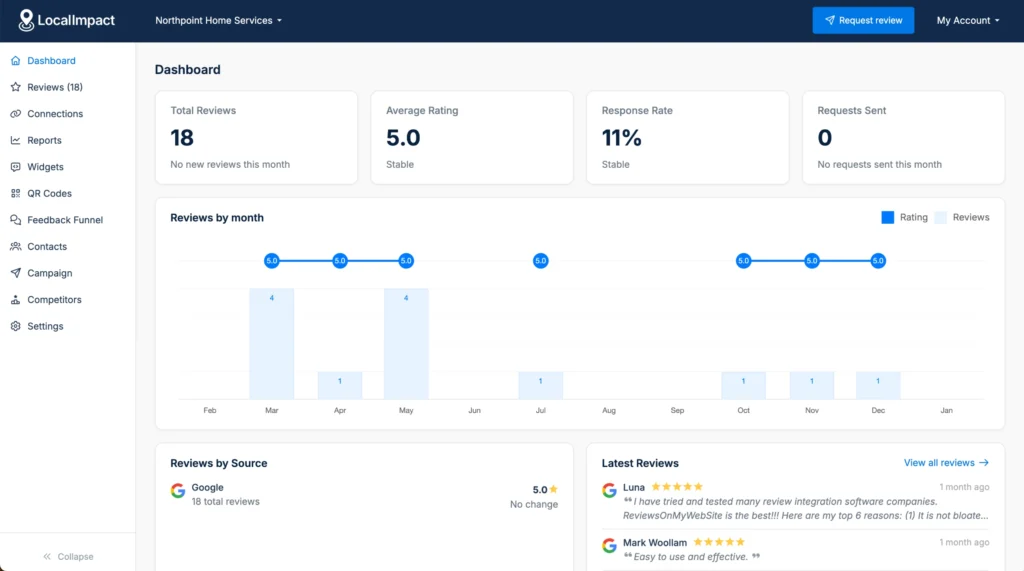
LocalImpact is a review management platform built around three core jobs: collecting more Google and Facebook reviews automatically, replying to them quickly with AI, and showcasing them on your website to build trust.
The platform supports a wide range of local business categories, including healthcare, dental, home services, legal, retail, and professional services, with reporting and workflows designed for the realities of each.
Key features
- Automated SMS and email review requests: Send branded review invitations on a schedule, with automated follow-ups that re-engage customers who didn't respond to the first message.
- AI review reply generator: Generate context-aware responses tailored to each review's sentiment, with one-click tone and length adjustments before publishing.
- Customizable review widgets: Embed a no-code review widget with list, slider, carousel, grid, masonry, and rating badge layouts, all with schema markup baked in for SEO.
- Feedback funnel: Route customers to public review sites or capture private feedback first, so you can resolve issues before they become public reviews.
- Social sharing graphics: Turn standout reviews into branded social media posts in seconds, with customizable templates, colors, and fonts.
- Multi-location and white label: Manage reviews across every location from one dashboard, with custom logo, favicon, and domain options for agencies reselling under their own brand.
What users say
Reviewers consistently highlight how quickly LocalImpact pays for itself, with ease of setup, multi-platform support, and responsive customer service coming up across nearly every five-star review.
"Software is simple to use and implement to websites, capture and follow up to review's, onboard clients and from multiple review sources. Affordable for businesses that need reviews on their website.
Customer support is outstanding!"
Pricing
LocalImpact offers a 14-day free trial with no credit card required.
Paid plans include:
- Growth ($49/month)
- Pro ($99/month)
- Agency ($149/month)
2. NiceJob
NiceJob is built around one core idea executed well: automatically firing off a review request the moment a job is marked complete in your CRM.
The native integrations with Jobber, Housecall Pro, ServiceTitan, JobTread, Service Fusion, QuickBooks Online, and HoneyBook are the foundation, and the request sequencing goes out as an SMS first followed by a three-email follow-up that's been pre-written for performance.
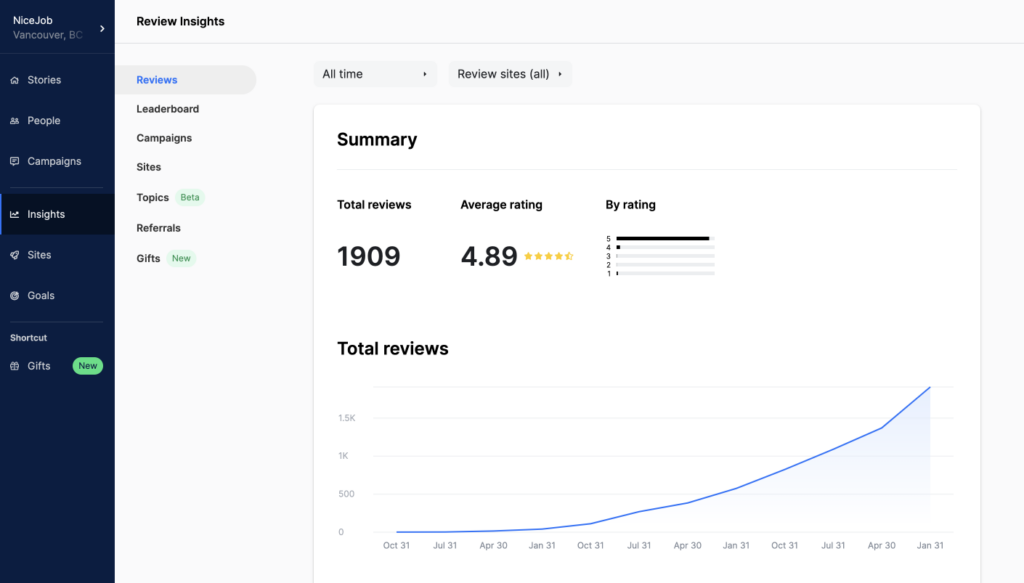
Beyond review generation, NiceJob bundles in social proof widgets, automatic social media posting, AI replies on the Pro plan, and a Stories feature that highlights your best reviews on a microsite.
Key features
- CRM-triggered review requests: Native integrations with Jobber, Housecall Pro, ServiceTitan, JobTread, and others fire off review invitations automatically the moment a job closes.
- SMS-then-email sequencing: A pre-written 1 SMS plus 3-email sequence proven for performance, with the cadence fully customizable in the dashboard.
- AI Review Replies (Pro plan): Responds to all reviews from the last 24 hours at 6pm ET daily, with customizable tone, voice, length, and rules like only replying to 3-star-and-up reviews.
- Social proof widgets: Engage, Trust Badge, and Microsite widgets add credibility to any page on your site, with multi-site review aggregation and schema markup baked in.
- Automatic social media posting: Best reviews get shared to Facebook automatically, with generated post formats reported to drive up to 3x more engagement than plain text.
- Insights and Competitor Insights: Track which team members are driving the most reviews, plus benchmark your review volume, rating, and customer sentiment against local competitors.
Pros & cons
Pros
- Native integrations with most major field service CRMs, with auto-triggered review requests on job completion
- The text-first sequencing lifts response rates compared to email-only flows
- Stories and Social Sharing keep your social channels active without manual posting work
- Customer support and onboarding consistently get specific shoutouts in user reviews
Cons
- Outside of home services and a handful of other verticals, native integrations are limited and many connections route through Zapier
- Widget customization is restrictive on the number of reviews displayed, fonts, colors, and styling
- Multi-location management gets clunky once you're juggling more than a handful of locations, with duplicated reviews showing up in some widgets
What we like
The text-then-email sequencing is a small structural detail that makes a real difference.
SMS lands first while the job is still fresh in the customer's mind, and the email follow-ups catch anyone who missed the text, which is why review counts often jump from a handful to dozens in the first couple of months.
What users say
Reviewers consistently highlight how hands-off NiceJob feels once it's wired into their CRM, with the automatic SMS-then-email sequencing and quick onboarding coming up across most five-star reviews.
"I really like the automation in NiceJob. It's synced with our CRM and is pretty much hands-off. Review invites are sent out automatically when a work order is completed in our CRM, which is great.
The invites go out first by text and then by email, and this sequence is customizable too.”
A frequent piece of feedback is that the website widgets fall short on customization, with users wanting more control over how many reviews display and how the styling matches their brand.
"I don't like the widgets and aspects that interact with the website to show reviews. I'd like more customization in terms of the number of reviews displayed, style, font, color, etc.
We want it to fit our website exactly, and that wasn't possible."
Pricing
NiceJob offers a 14-day free trial that does not require a credit card.
Paid plans include:
- Reviews ($75/month)
- Pro ($125/month)
- Sites add-on ($99/month + $199 setup fee)
3. ReviewTrackers
ReviewTrackers leans further into the enterprise end of the category than most tools on this list.
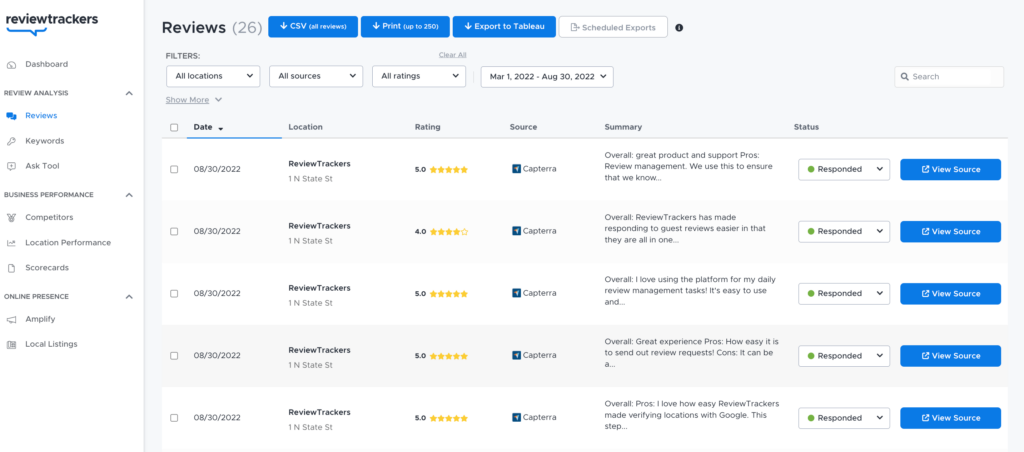
The platform combines review monitoring, AI-powered customer experience analytics, competitor analysis, local SEO, and local listings management into one workflow, with a proprietary Natural Language Processing engine that auto-categorizes feedback and surfaces sentiment trends.
Key features
- Review aggregation and monitoring: Pull reviews from the top directories that drive revenue, with automated alerts so teams can route feedback to whoever's best equipped to resolve it.
- Smart Response and AI-generated replies: Generate AI responses to reviews or use personalized Smart Response templates to auto-respond at scale while staying on brand.
- Customer experience analytics with NLP: Proprietary Natural Language Processing engine auto-categorizes feedback, identifies sentiment trends, and flags reviews for compliance or risk escalation.
- Competitor analysis: Automatically identifies and tracks competitors, benchmarks review velocity and rating performance, and breaks down where competitors excel or fall short.
- Local listings management: Maintain accurate business listing information across the internet to support online ranking and brand visibility.
- Hootsuite-integrated social and review workflow: Monitor, respond to, and collaborate on reviews and social mentions from one place, with team performance reporting baked in.
Pros & cons
Pros
- Strong analytics layer with NLP-based sentiment and topic categorization for spotting operational trends at scale
- Competitor analysis built into the core platform, with review velocity and rating benchmarking
- Native Hootsuite integration unifies review management and social media monitoring in one workflow
Cons
- Notifications can feel inconsistent, with some delays between when a review goes live and when alerts arrive
- The platform spans a wide feature set, which can take longer to fully adopt than simpler review tools
What we like
The Natural Language Processing engine genuinely separates ReviewTrackers from most review tools
Auto-categorizing thousands of reviews into themes and sentiment trends turns raw feedback into the kind of operational intelligence enterprise brands actually use to spot compliance issues, build retention strategies, and improve specific touchpoints.
What users say
Reviewers consistently highlight how much time the aggregated dashboard saves and how easy it is to manage reviews across multiple locations from one place, with several specifically calling out the response generator and the platform's intuitive interface.
"Having aggregated review data saves me a lot of time. Plus, the response generator is a big time-saver. The email portion has helped in getting reviews from customers, too.
Overall, the tool is simple but effective. The price is right, so that helps, too. Other platforms are too cumbersome, but ReviewTrackers is easy to set up and use."
A recurring piece of feedback is that review sites occasionally disconnect from the platform without alerting users, which can lead to gaps before someone notices the issue.
"Sometimes review sites disconnect themselves and I don't always catch it so that's frustrating. I also wish we could change things to our time zone - I track by the month and it ends in Britain's time zone making my tracking off on the end of the month sometimes."
Pricing
Pricing starts at $89/location/month.
4. GatherUp
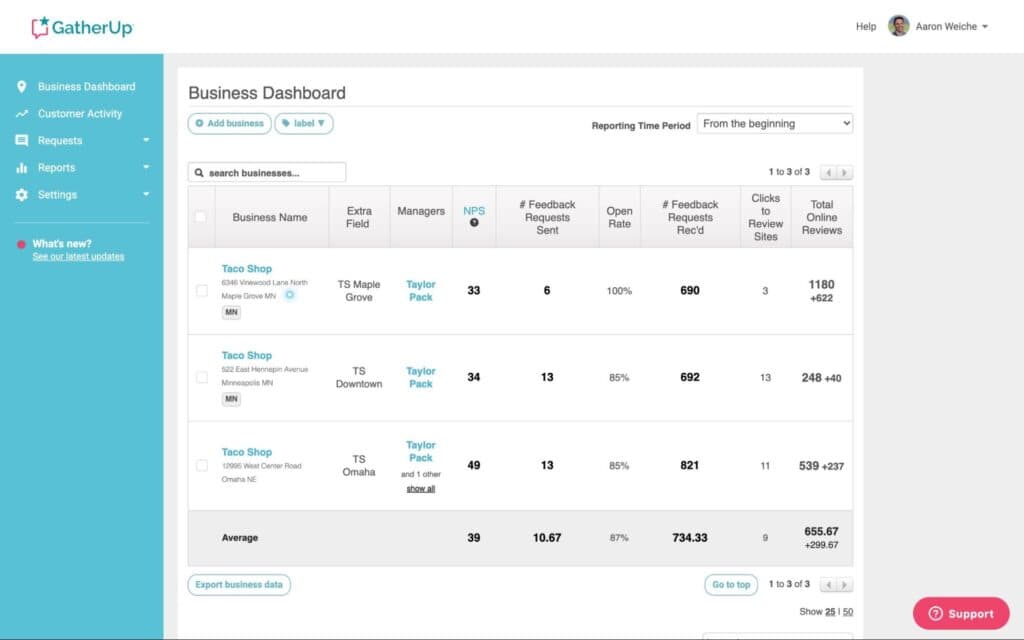
GatherUp is a reputation management platform built specifically for agencies and multi-location operators, structured around three stages: listen, understand, and engage.
The platform pulls together review requests by email and SMS, monitoring across 100+ review sites including Google Q&A, AI-driven analysis, and tools for responding at scale through SmartReply, AutoReply, and Suggested Replies.
GatherUp also stands out for its Review Defense product, a separate offering aimed at detecting, disputing, and defending against fake reviews.
Key features
- Email and SMS review requests: Automated requests and reminders with branded landing pages, plus segmented, scheduled, and tested SMS sequences for higher response rates.
- 100+ review site monitoring: Track and respond to reviews across Google, Facebook, Yelp, Glassdoor, OpenTable, Indeed, and Google Q&A, all from one dashboard.
- SmartReply, AutoReply, and Suggested Replies: AI-generated responses that match review sentiment, auto-publish replies to positive reviews, and surface one-click suggestions for negative feedback.
- Smart Insights and Auto-Tagging: AI-powered analysis surfaces the 10 most common themes across reviews automatically, with custom tag rules for keyword-level filtering.
- Review widgets and social sharing: Display first- and third-party reviews on-site with multiple layout options, plus turn reviews into branded graphics for Facebook, Instagram, and Google Posts.
- Review Defense add-on: Detects suspicious review activity, disputes fake reviews automatically, and benchmarks competitor review patterns for fraudulent behavior.
Pros & cons
Pros
- Smart Insights and Auto-Tagging surface review themes automatically without manual tagging work
- Tiered AI reply tools (SmartReply, AutoReply, Suggested Replies) cover both positive and negative review workflows
- Review Defense add-on tackles fake reviews directly, which is rare in this category
- Built specifically for agencies with white-label branding, multi-location dashboards, and reseller-friendly pricing tiers
Cons
- Review display widgets feel dated compared to more modern competitors, with limited design options
- The breadth of features and customization options can take time to fully learn
What we like
The Review Defense product genuinely separates GatherUp from most tools in the category.
Fake reviews are a growing problem for multi-location brands, and having automated detection, dispute workflows, and competitor fraud monitoring built into the same platform that handles your day-to-day review management is a meaningful differentiator.
What users say
Reviewers highlight how user-friendly and intuitive the platform is, with the onboarding process and customer support team coming up repeatedly across positive reviews.
"What we really like about GatherUp is how user-friendly and intuitive the platform is, making it easy for us to gather and manage customer reviews efficiently. The automation features are particularly helpful, allowing us to schedule review requests and follow-ups without any extra effort.
We also appreciate the centralized feedback management, which keeps everything organized and accessible in one place."
One area users have pointed out is the cost structure, especially for businesses managing a large number of locations.
"The product is expensive for what it provides, especially when you have a lot of locations."
Pricing
GatherUp offers a 14-day free trial. Paid plans include:
- Single location ($99/month)
- Multi-location ($60/month per location)
- Agency (custom pricing)
5. Broadly
Broadly is positioned as an all-in-one AI platform for local service businesses, with reputation management sitting alongside web chat, a unified messaging inbox, AI voice receptionist, local SEO, and a CRM.
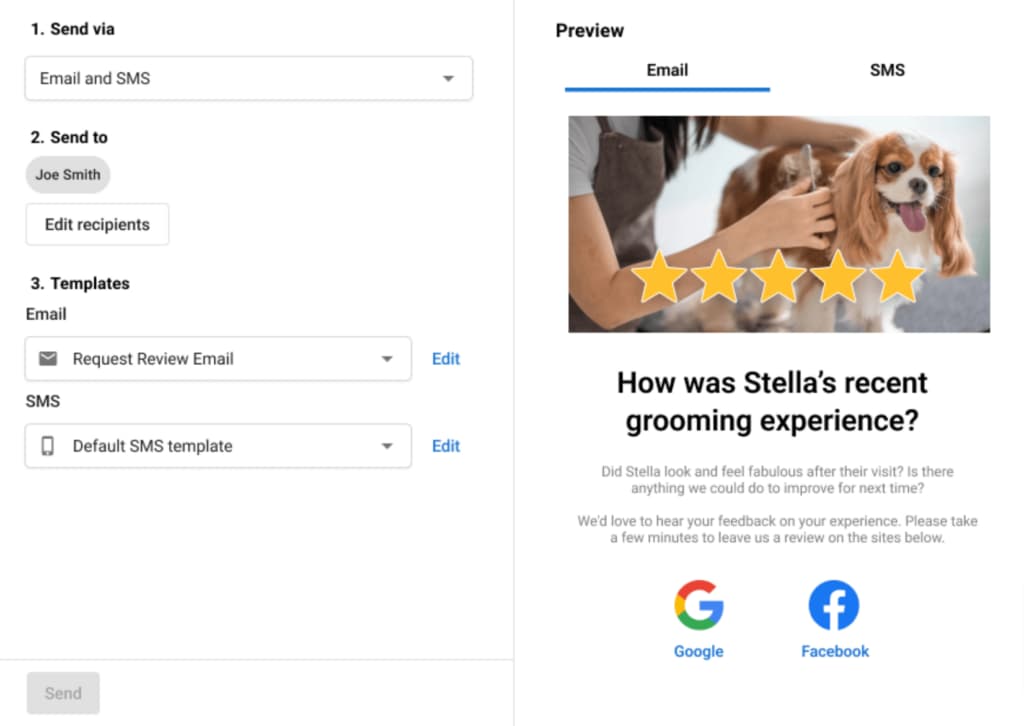
The reputation piece itself includes automated review requests by email and SMS, an AI assistant that drafts on-brand replies to incoming reviews, and NPS surveys for catching issues before they go public.
Key features
- Automated review requests: Send branded review invitations by text or email after a job or service is complete, with automatic follow-ups for non-responders.
- AI Reputation Specialist: Generate thoughtful, on-brand replies to incoming reviews automatically, matching the tone of the original feedback.
- NPS surveys and private feedback: Collect customer feedback after each interaction to spot issues early and resolve them before they turn into public reviews.
- Consolidated inbox: Pull reviews, web chat, SMS, email, Facebook, and Instagram messages into one shared dashboard so nothing slips through the cracks.
- Industry-specific integrations: Native connections with ServiceTitan, Jobber, Shopmonkey, Clio, Booker, Mitchell, PawLoyalty, PetExec, and QuickBooks trigger review requests automatically.
- Local SEO and listings sync: Keep business information updated across 40+ directories including Google, Facebook, Amazon Alexa, Yellow Pages, MapQuest, Siri, and CitySearch.
Pros & cons
Pros
- Reputation features sit inside a broader AI platform, so reviews, messaging, and customer follow-up all run in one workflow
- Native integrations with major field service and trade-specific CRMs trigger review requests automatically
- The NPS feedback layer catches negative sentiment privately before it lands on public review sites
- Local SEO and listings sync are built in rather than requiring a separate tool
Cons
- Connecting multiple Google Business Profile locations under one account is limited and can require separate accounts
- Email response customization is more restrictive than some users want
- Reviewers have flagged customer service and contract terms as recurring pain points
What we like
The NPS feedback loop is a smart structural choice. By collecting quick private feedback after each customer interaction, Broadly gives owners a chance to step in and resolve issues directly with the customer before that frustration ever shows up as a public one-star review.
What users say
Reviewers consistently call out how easy Broadly is to use across reviews, web chat, and payment requests, with several specifically mentioning how little tech know-how is needed to get value from the platform.
"Broadly is easy to use, you don't need to be tech-savvy to send reviews, respond to web chats from customers or request payments."
A recurring piece of feedback involves the limits around managing multiple Google Business Profile locations under a single account, which can push the cost up for businesses with multiple stores.
"Their software does not allow you to connect multiple GoogleMyBusiness stores under one account, you need separate accounts which end up costing more money."
Pricing
Broadly is priced at $799/month.
6. Reviewshake
Reviewshake is a review management platform hyper-focused on online reviews, covering four core jobs: collecting more reviews through automated invites, monitoring and responding from one inbox, showcasing reviews as social proof, and analyzing sentiment for actionable insights.
AI sits across the platform, generating on-brand reply suggestions, summarizing sentiment trends, and benchmarking your performance against local competitors.
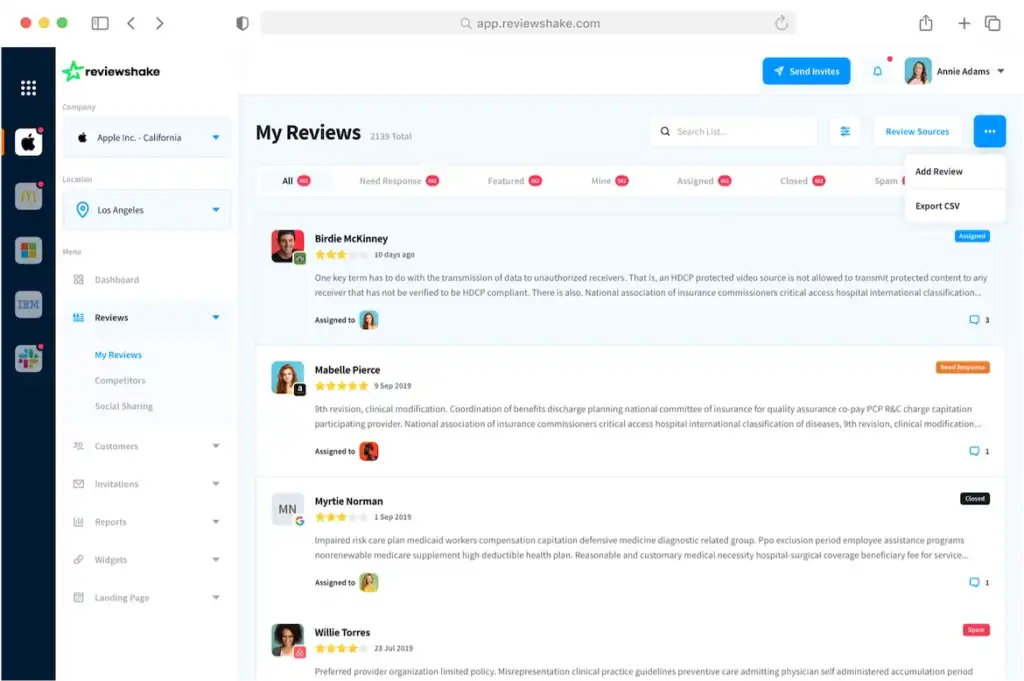
Reviewshake also leans hard into white-label functionality for agencies and resellers, with customizable widgets, branded social sharing, and multi-location dashboards built in.
Key features
- Multi-channel review collection: Send branded review invites by SMS, email, and QR codes, with automated reminders and smart timing rules to lift response rates.
- AI-powered reply suggestions: Generate on-brand draft responses to reviews instantly, with tone and language customization so replies stay consistent across locations.
- Sentiment analysis and trend tracking: AI summarizes sentiment across your reviews and your competitors' reviews, surfacing keyword patterns and emotional tone over time.
- Competitor benchmarking: Track competitor star ratings, response times, and feedback so you can spot gaps and stay ahead in your local market.
- Customizable review widgets: Embed responsive widgets in carousel, grid, or pop-up layouts that auto-update with new reviews and pass schema markup to search engines.
- Automated social sharing: Auto-post new 5-star reviews to Facebook and Google with branded layouts, plus trust badges for your site, email signatures, and digital ads.
Pros & cons
Pros
- Strong agency and reseller positioning with white-label tools built into the core platform
- AI features cover replies, sentiment analysis, and adaptive campaign optimization across the same dashboard
- Multi-channel review invites (SMS, email, QR) with A/B testing on subject lines and reminder cadence
- Responsive customer support consistently called out by users, with frequent product updates from feedback
Cons
- Some users have flagged limitations around review widget customization
- Native integration options are narrower than larger competitors, with many connections routed through Zapier
- Setting up the initial campaign workflow can take a bit of time to get familiar with
What we like
The combination of competitor benchmarking and sentiment analysis is the standout.
Most review tools tell you what your customers are saying. Reviewshake also tells you how that compares to the businesses you're competing against locally, which turns reputation management from a defensive task into something closer to a real competitive intelligence workflow.
What users say
Reviewers consistently highlight how easy Reviewshake is to set up, with the responsive customer support team coming up across many five-star reviews as a meaningful advantage.
"My favorite part would have to be the level of customer service I have received from the team. They are very knowledgeable and attentive. I typically receive a response within 30 - 60 minutes, if not sooner. The system is pretty easy to use and it seems to work!"
One area users have pointed out is the depth of native integrations and the need to lean on Zapier for connecting customer data from CRMs or POS systems.
"Some downsides would include the need to use zapier instead of having internal integration functionality to bring customer data in without the need for additional software."
Pricing
Reviewshake offers a free trial you can use to test out the software. Paid plans include:
- Starter ($29/month)
- Growth ($59/month)
- Ultimate ($99/month)
7. TrueReview
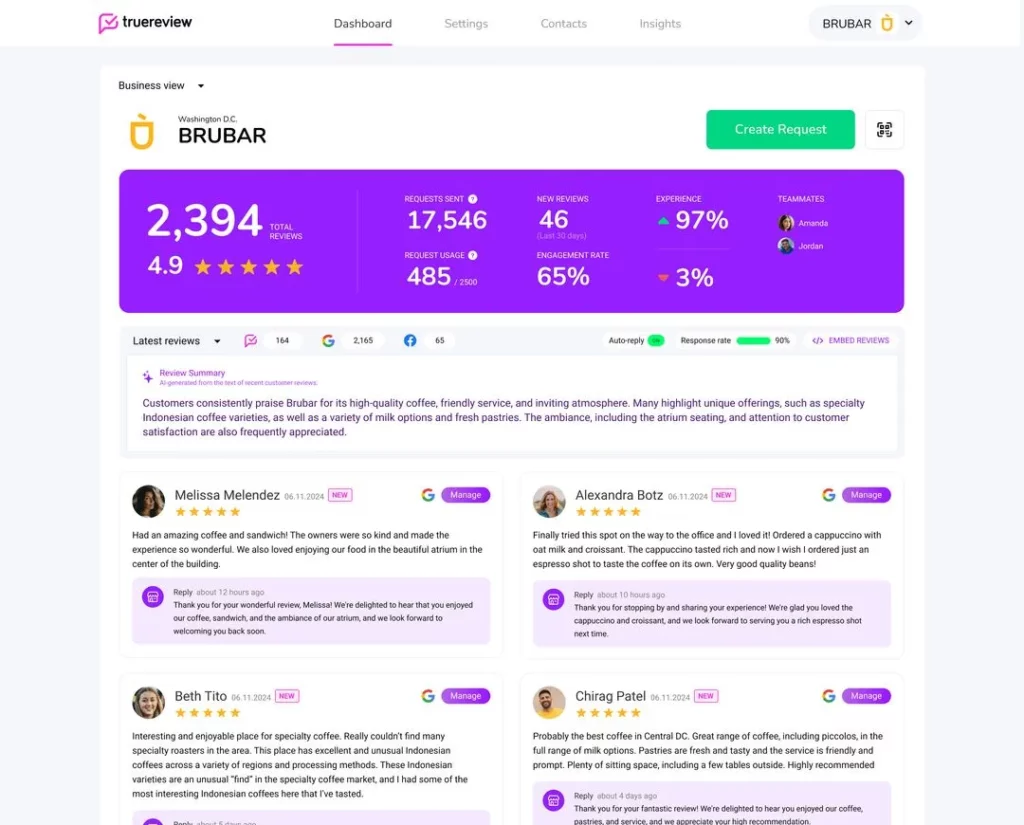
TrueReview is a focused review request tool built around one core job: getting more reviews through automated SMS and email outreach, with smart drip campaigns and follow-ups to lift response rates.
The platform connects to existing CRMs through Zapier or its API, so review requests can fire automatically when a payment is received, a job is completed, or any other trigger your CRM supports.
TrueReview also covers the basics around responding and showcasing, with an AI Review Response Generator, embeddable review widgets for over a dozen platforms, and a Social Review Post Generator for turning testimonials into branded social media posts.
Key features
- Automated SMS and email review requests: Send review invitations through Zapier-triggered workflows or TrueReview's API, with smart resend rules based on time windows and customer engagement signals.
- Drip campaigns with engagement filters: Resend only if the customer didn't open, click, or leave a review, with custom timing rules so you're not pestering people who've already responded.
- AI Review Response Generator: Generate unique, human-sounding replies to incoming reviews instead of copying templates that all read the same way.
- Embeddable review widgets: Display reviews from Google, Facebook, Yelp, BBB, Zillow, Avvo, Healthgrades, TripAdvisor, Trustpilot, OpenTable, and other vertical-specific platforms directly on your website.
- CRM integrations: Native connections with ServiceTitan, Square, Acuity Scheduling, LionDesk, Mangomint, Google Contacts, and Google Sheets, plus Zapier for everything else.
- Multi-business management: Run review campaigns across multiple business locations from one account, with teammate permissions and review mentions for tracking who's responsible for which conversations.
Pros & cons
Pros
- Smart engagement filters and drip campaigns avoid over-messaging customers who've already responded
- AI-generated review responses are flexible enough to feel human rather than templated
- Vertical-specific industry pages and widgets for legal, dental, automotive, real estate, and property management
Cons
- Some users have flagged that the small business pricing tier doesn't include enough business locations or teammate seats, with a noticeable jump to the premium plan
- The platform doesn't currently offer a fully white-labeled version with your own logo and branding
- Identifying customers who clicked the review link but didn't leave a review on an external site can require some manual digging
What we like
The smart engagement filters are a thoughtful touch. Review request software can easily slip into spammy territory if it keeps pinging customers who've already responded, and TrueReview's resend rules around timing, phone number, and prior engagement help avoid that.
What users say
Reviewers consistently call out how easy TrueReview is to set up and how responsive the customer support team is, with several specifically mentioning the SMS-based requests as the key driver behind their review volume increases.
"It is easy to use and efficient. It integrates with all major platforms where people go for reviews. The best part is we can send out our review requests via text or email which has allowed us to get more reviews than we expected."
One area users have pointed out is the pricing structure for very small businesses, with the step up to higher tiers feeling steep.
"The pricing tiers are not as friendly for really small businesses and the segmentation to review negative reviews is difficult to navigate."
Pricing
TrueReview offers a 14-day free trial with up to 250 review requests, no credit card required.
Paid plans include:
- Starter ($49/month)
- Small Business ($99/month)
- Premium ($299/month)
How to choose the right reputation management software for your small business
Every small business has different needs, and the best tool for a solo plumber isn't necessarily the right fit for a dental clinic. Here are the questions that should guide the decision:
- Match the tool to your business model: A field service business will get more value from a platform that triggers review requests from a job completion event, while a multi-location operator needs strong location-level dashboards and reporting. Picking a tool whose strengths line up with how you actually generate revenue saves both time and budget.
- Take pricing structure seriously: Custom pricing makes shopping comparisons harder and often leads to surprises after signing. If budget predictability matters, look for platforms with published pricing and month-to-month billing, since those are the easiest to walk away from if the fit isn't right.
- Account for the full source list: If your industry depends on niche review sites like Healthgrades, Avvo, or Tripadvisor, double-check that the tool you're evaluating actually monitors those sources. Missing a vertical platform on day one usually means missing it for the life of the contract.
- Plan for the integrations you already use: A reputation tool that talks to your existing CRM or field service software will deliver more value with less manual work, so check for native integrations and webhook support before signing. Zapier helps cover gaps, but native integrations are almost always smoother in practice.
- Weigh growth headroom against current cost: The cheapest plan today can become a constraint a year from now if your business doubles in locations or staff. Picking a tool with a clear upgrade path saves the cost and disruption of migrating to a new platform when you outgrow the entry-level plan.
The right answer almost always comes down to fit rather than feature count. Run a 14-day trial on your two or three shortlisted options, send a few real review requests, and let the daily-use experience pick the winner.