Multi-location review management is one of the hardest parts of running a growing business, and owners know it.
We asked business owners what they find toughest about protecting their reputation online. One answer came out above budget, time, and every other concern: coordinating reviews across multiple teams and locations.
It's the top reputation management challenge owners report in our State of Online Reputation Management report.
There's a good reason for this. The work of managing reviews compounds as you add locations, because every new branch brings its own profile, its own stream of reviewers, and its own way of replying.
And a single underperforming location can drag down how people see your entire brand.
In this guide, you'll learn how to build a review management system that keeps every location consistent while still sounding local. Reviews are one piece of a wider multi-location marketing strategy, and getting them right does a lot of the heavy lifting.
We'll cover operating models, listings, brand voice, responses, review generation, metrics, fake reviews, and the software and AI that hold it all together.
What is multi-location review management?
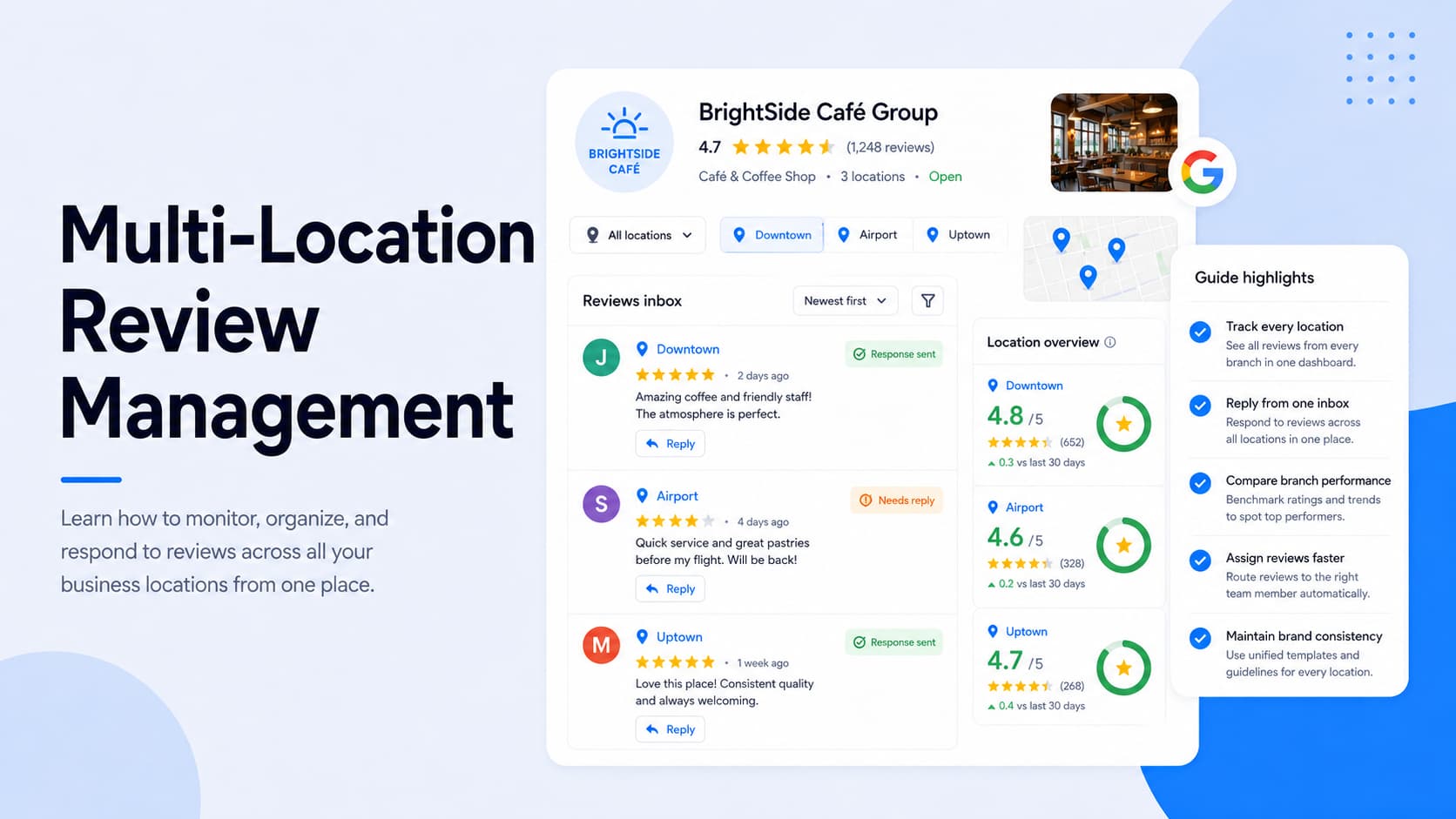
Multi-location review management is the practice of monitoring, responding to, and generating reviews for a business that operates in more than one place.
It involves managing separate public reputations under one brand, at both the brand level and the individual location level, across Google and other review sites.
Each location usually has its own Google Business Profile, its own star rating, and its own customers leaving feedback.
Your job is to keep all of those reputations healthy and on-brand at the same time, without losing track of which review belongs to which branch.
Why multi-location review management is harder than single-location
A single-location owner knows every customer interaction and can respond with real context. But once you multiply the locations, structural problems start to show up:
- Inconsistent brand voice: When different people at different branches write responses independently, one location sounds warm and casual while another sounds stiff or defensive. Customers who check reviews for two of your locations will notice the mismatch.
- High review volume: Ten locations averaging 15 reviews a month means 150 responses monthly. At five to eight minutes per response, that's most of a part-time role, and the math only gets worse at 25 or 50 locations.
- Lack of local context: A corporate responder can't reference the team member a reviewer mentioned or the event a branch just hosted. This makes responses feel generic exactly when reviewers want to feel seen.
- Limited visibility: According to our research, 55% of businesses monitor just two or three review platforms. Spread that thin coverage across dozens of locations and reviews start slipping through unnoticed.
- Owner bottleneck: For 51% of businesses, the owner is the one managing reviews. This stops working the moment volume climbs, and reviews end up unanswered or delayed.
- Greater crisis exposure: A wave of negative reviews at one branch is a contained problem. The same pattern across several branches is a brand-level event.
Centralized, decentralized, or hybrid: choosing your model
The first big decision you need to make is who owns the responses. There are three models to choose from.
Corporate-managed puts a central team in charge of every review across every location. This gives you tight control over brand voice, consistent responses to similar issues, and clean data in one place.
The downside of this approach is that the corporate team is far from local context. This can slow down responses that need a manager's first-hand knowledge.
Location-managed hands each branch responsibility for its own reviews. Responses come faster and feel more personal, since the people replying know the customers and the location.
But this approach comes with the risk of drift. A handful of branches straying from brand standards can skew how the whole company looks online.
Hybrid splits ownership by review type. Local teams handle routine and positive reviews, while corporate steps in on negative, sensitive, or brand-level reviews that carry more risk. This is the model we'd recommend for most multi-location brands.
Franchises are where this choice gets constrained. Franchisees own their locations, so corporate can't take over every response the way a company-owned chain can. The franchise agreement sets the limits, and a hybrid split usually works best inside them.
Strong franchise reputation management gives corporate brand oversight while leaving each franchisee room to reply with local knowledge.
How do you choose the right model for your business? Consider the following factors:
- Workload and team size: A small chain of near-identical shops can run reviews centrally with one person. A large or varied network needs trained people at each location.
- Control needs: More corporate oversight buys consistency but adds steps. Weigh how much approval bureaucracy your team can absorb before replies start slowing down.
- Geographic and industry spread: Locations spread across regions or cultures benefit from local voices who understand the market. And industries like hospitality rely heavily on location-specific responses.
Manage your business's reviews with LocalImpact
Get more 5-star reviews and take control of your online reputation with LocalImpact.
Building your review management framework
Whichever model you pick, it needs structure underneath it.
The good news is that the tooling is well established. Our research shows that 78% of businesses use software to manage reviews, with only one in five still working manually.
Start with one source of truth
Every review across every location and platform should flow into a single dashboard.
Logging into separate Google, Yelp, and Facebook accounts for each branch is how reviews get missed and response times slip. A unified view also lets you compare locations at a glance and spot a branch trending down before it becomes a crisis.
Define roles and tiered response protocols
Clarify who handles what before volume forces the question. A common structure gives location managers the first pass on routine reviews, a regional or marketing lead quality review, and a senior leader final say on sensitive cases.
Then, sort reviews by how much oversight they actually need:
- Tier 1, routine positive reviews: Four and five-star reviews with general praise can be auto-approved or cleared at the location level. This keeps your response rate high without tying up senior people.
- Tier 2, mixed or moderately negative reviews: Three-star reviews and minor complaints should route to a regional manager for a quick check before publishing. The extra set of eyes catches tone problems before they go public.
- Tier 3, high-risk reviews: One-star reviews alleging safety issues, legal claims, or staff misconduct need corporate review, sometimes with legal input. These are the responses most likely to do damage if rushed.
Set up notifications, escalation, and crisis plans
Speed matters most on negative reviews. Set up real-time alerts that reach the right person the moment a review lands, and build escalation triggers that automatically push high-risk reviews up the chain. This way, a Friday-night one-star review doesn't sit unanswered until Monday.
Crisis planning is where most businesses are exposed. According to our research, 37% of businesses have only an informal crisis plan, and 30% have none at all.
Make sure to document who owns a reputation incident, which scenarios trigger escalation, and what templated first responses look like. This will allow your team to move quickly under pressure.
Finally, fold review metrics into your regular location performance reviews. When managers know their response rate and average rating get discussed alongside financials, review work stops being an afterthought.
Setting up and maintaining listings across locations
Before you can manage reviews, each location needs an accurate, claimed presence on the platforms that matter.
Start with a listing policy. Decide whether each location gets its own profile or whether you manage at the brand level. Keep in mind that some platforms, like Trustpilot, only allow one listing per domain, so brand-level is your only option there.
From here, prioritize platforms in rough order of impact:
- Google: Google Business Profile drives local search visibility and Maps presence, and it natively supports multiple locations. Each branch needs its own verified profile here before anything else.
- Major networks: Facebook, Yelp, Apple Maps, and Bing cover most of the places consumers check next. Claim and verify each location on the ones your customers actually use.
- Industry and local sites: Niche platforms like Healthgrades, Tripadvisor, and Houzz carry real weight in specific verticals. You can also add geographically local review sites where a particular branch's community relies on them.
Across all platforms, keep your NAP (name, address, phone) information consistent. Google rewards accurate, matching information and penalizes contradictions.
And if you're setting up dozens of listings at once, bulk claiming and verification tools will save you an enormous amount of time.
Creating a brand voice that scales
Brand voice is one of the hardest things to hold steady across locations. It's also one of the most visible to customers reading your responses.
The fix is a guideline document that's specific enough to ensure consistency and flexible enough to allow local personality. Your guidelines should include four parts:
- Tone guidelines with examples: Define where you sit on dimensions like formal versus casual and measured versus enthusiastic. Then, show three to five model responses, since concrete examples teach voice far better than abstract adjectives.
- Do and don't language lists: Spell out preferred phrases like "we'd love to make this right" and prohibited ones like "per our policy" or anything blame-shifting. Explicit lists keep different managers from improvising in different directions.
- Response structure templates: Provide a skeleton for common scenarios, such as thank, acknowledge a specific detail, then invite a return visit. Managers fill in the specifics while the structure holds consistency.
- A localization layer: Within the shared structure, each location adds a line only they could write, like a team member's name or a local detail. The guidelines keep you sounding like one brand, and the local touch keeps you sounding like people.
Responding to reviews across locations
Consumers expect a reply, and they expect it soon. Our State of Online Reviews report shows that 70% of consumers want a response within one to three days.
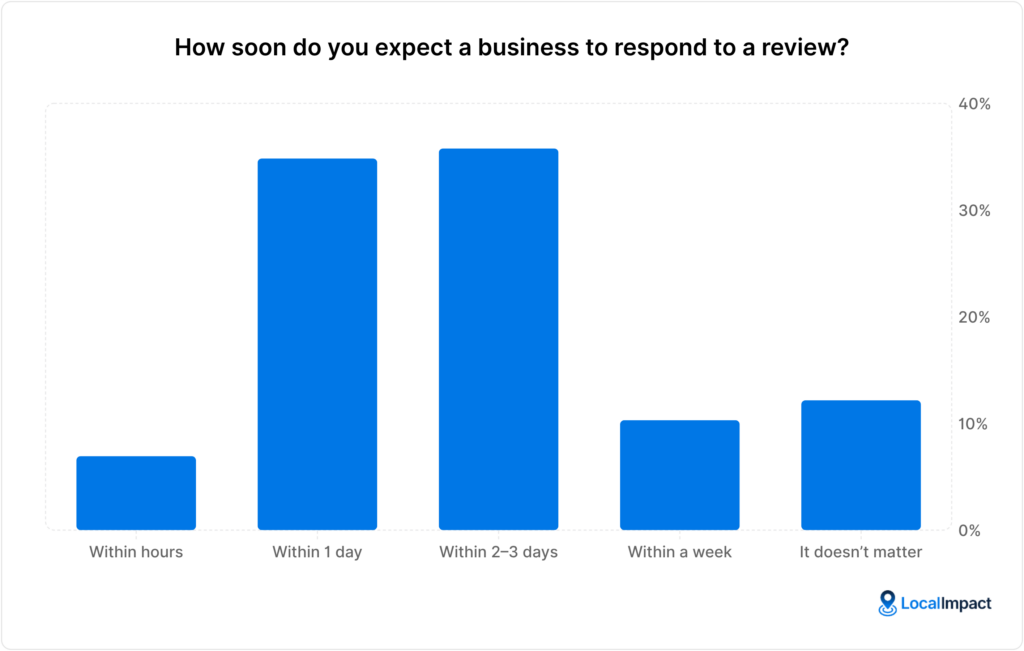
This means you should set internal targets of 24 to 48 hours for all reviews, and faster for negative ones.
For positive reviews, a quick, specific thank-you reinforces loyalty and shows future customers that you're paying attention.
Negative reviews need more care. Acknowledge the issue without over-apologizing, offer a specific fix instead of a generic promise, and move sensitive conversations offline with a direct contact.
And the effort pays off. 78% of consumers say a thoughtful response to a negative review made them more likely to trust the business.
One pitfall to watch out for: identical responses across locations. When a prospective customer sees the same word-for-word reply on two branches, the responses read as automated. Make sure every reply carries at least one detail specific to that review.
Pro tip: You can use LocalImpact to respond to reviews across 30+ review platforms and manage your reputation across multiple locations from one central place.
Generating more reviews at every location
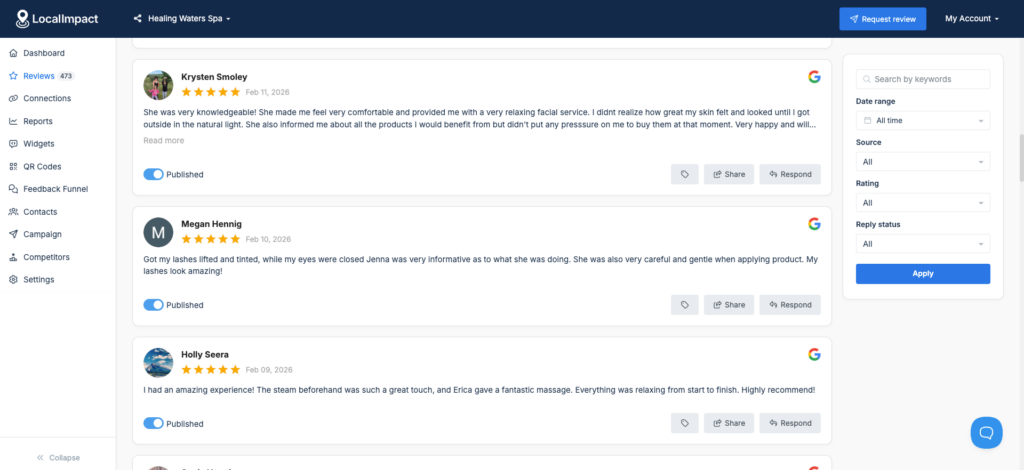
Replying is half the work. The other half is generating a steady flow of fresh reviews, and a standardized request process keeps every location asking the same way.
Here's what to focus on:
- Timing and channel: Send requests within 24 hours of a visit or purchase, while the experience is fresh. And lean on SMS where you can, since it has far higher open rates than email.
- Automation: Trigger review requests off a completed sale, a payment, or a closed appointment. Follow up with a short sequence instead of a single message, because people rarely act on the first prompt.
- Platform policies: Yelp prohibits businesses from directly soliciting reviews. Adjust your approach per platform instead of sending the same request everywhere.
- Weaker locations: Branches with thin or low ratings need review generation the most. Our research shows that 78% of consumers won't even consider a business rated below four stars, so a focused push on a struggling location can break the cycle of low volume and low ratings.
Pro tip: Use LocalImpact to set up automated email and SMS review request campaigns and generate reviews on autopilot.
Manage your business's reviews with LocalImpact
Get more 5-star reviews and take control of your online reputation with LocalImpact.
Metrics and KPIs to track across locations
Multi-location review management needs metrics at both the location and aggregate level. Here's what you should track:
- Response rate and response time: Measure the percentage of reviews answered and the median time to respond, by location. Aim for 100% coverage and sub-24-hour replies.
- Average rating trends: Watch the direction of each location's rating over time. A sudden drop points to a specific incident, while a slow decline suggests a systemic issue like staff turnover.
- Review volume and sentiment: Monitor how many reviews each location pulls in and which themes recur inside them, like wait times or staff friendliness. Volume spikes, especially negative ones, are early warnings that something changed at a branch.
- Recovery rate: Track how often negative reviewers raise their rating after your response. Locations with high recovery rates are doing something worth copying everywhere else.
Turning reviews into operational insight
Reviews are operational feedback. And when you pull them together across locations, they surface patterns no single branch could see on its own.
Group feedback into themes and run sentiment analysis to find where praise and complaints cluster. If one branch is consistently praised for its check-in process and another is criticized for the same thing, you've found a fixable operational gap.
You'll also want to watch for "swing" topics that show up in both positive and negative reviews. For a home service business, this might be punctuality.
Feed these insights back into operations, staffing, and training. This is how review management delivers value beyond the marketing team.
Handling fake, spam, and unfair reviews
Fake reviews have become a recurring operational risk, and they hit multi-location brands especially hard.
In our research on fake reviews, 72% of owners reported receiving a fake review in the past year. And 79% believed they'd been targeted by a coordinated attack at some point.
The deeper problem at scale is removal speed. Only 28% of reported fake reviews get taken down promptly.
This lag multiplies across dozens of listings, since each fake review keeps dragging down a star average while you wait.
Here's what you can do about it:
- Flag reviews that violate platform guidelines: Learn each site's content rules and report reviews that break them, such as second-hand experiences or obvious spam. Detailed documentation of why a review is suspicious strengthens your case.
- Prioritize striking-distance locations: Identify branches sitting one or two reviews away from the next rating threshold and clear flaggable reviews there first. Small wins move those ratings fastest.
- Document everything: Keep records of reviewer history, factual inaccuracies, and timing patterns for each disputed review. Organized evidence speeds up reporting across multiple platforms and locations.
Common mistakes to avoid
A handful of errors show up again and again in multi-location review programs:
- Identical template responses: Using the same reply word-for-word across locations reads as robotic the moment someone compares two branches. Use templates as frameworks and add a specific detail to each response.
- Neglecting low-performing locations: Pouring resources into your busiest branches leaves struggling ones to spiral downward on fewer reviews and lower ratings. Intervene early on weak locations to break the cycle.
- No cross-location learning: Letting insights stay siloed wastes the biggest advantage of managing reviews centrally. Study your top performers and replicate their approach across the network.
- Decentralized platform access: Individual managers holding their own logins means lost visibility, no pre-publication review, and access that walks out the door when they leave. Centralize access with permissions instead.
- Treating reviews as marketing-only: Complaints about wait times or cleanliness are operations problems that need operations fixes. Loop in operations leaders to turn review data into real improvement.
What to look for in multi-location review software
The right platform turns an overwhelming manual process into a manageable one. Here are the capabilities you should prioritize:
- Unified multi-location dashboard: Every review, every platform, every location in one filterable view. You should be able to toggle between a brand-wide overview and a single-location deep dive.
- Role-based access and approval workflows: Location managers see their branch, regional managers see their region, and corporate sees everything. Look for configurable approval paths by review type.
- Location comparison analytics: Side-by-side metrics on rating, response rate, response time, and volume help you spot leaders and laggards. Exportable reports make leadership reviews straightforward.
- AI response generation and per-location voice: On-brand draft responses for every review, tuned to each location's context. This is what makes a 100% response rate realistic at scale.
- Listing management and exports: Bulk listing updates, verification, and clean data exports for reporting round out the toolkit.
How AI is changing multi-location review management
AI solves the core multi-location problem: holding quality steady across locations no matter the volume.
Configured with your brand voice, it produces consistent, on-brand draft responses every time. And it still reads each review and addresses its specific points.
AI also handles localization. You can feed the system location-specific context like the manager's name or a recent offering, so a response at your Chicago branch can reference the local special while a response in Austin mentions the new patio.
There's a bigger picture here, too. AI now shapes the early research stage of the buying journey. According to our research on AI and the buying journey, 44% of consumers would consider a business they'd never heard of if AI recommended it.
But reviews still close the deal. When AI and reviews conflict, 41% of consumers trust the reviews.
This means that a brand surfaced by AI faces fresh scrutiny across every location's review profile. Weak reviews at any branch undercut the visibility AI provides.
Frequently asked questions about multi-location review management
How do I manage Google reviews for multiple locations?
Centralize all your locations into a single dashboard, assign clear ownership for who responds to what, and set response-time targets by review type. A review management platform lets you monitor and reply across every branch without logging into separate accounts.
Should corporate or each location respond to reviews?
A hybrid model works best for most brands. Local teams handle routine and positive reviews, while corporate handles negative, sensitive, or brand-level ones. Your exact split depends on team size, how much control you need, and how spread out your locations are.
What's the best software for multi-location review management?
Look for a platform that pulls every location into one dashboard, monitors all your review sites in one place, and generates on-brand replies with AI. Automated email and SMS review requests help every branch keep collecting fresh reviews, and review widgets let you display your best reviews on each location page.
LocalImpact does all of this across 30+ platforms.
How many review sites should I manage per location?
Start with Google, then add the major networks like Facebook and Yelp, then one or two industry-specific sites your customers actually use. Aim to cover at least four to five platforms per location to reduce blind spots.