
AI tools like ChatGPT and AI-powered search summaries are quickly becoming part of how people research products and services.
But how much are they actually influencing buying decisions? And more importantly, are they changing who consumers trust?
To find out, we surveyed 1,068 US consumers about how they use AI during the buying process, what role it plays in their decisions, and how it compares to traditional trust signals like online reviews.
Our goal was simple: understand whether AI is replacing reviews or just reshaping how people get to them.
The results show that while AI is now firmly embedded in the research stage, reviews still play a decisive role when it’s time to choose a business.
Key takeaways
- AI is mainstream in buying research: 6 in 10 consumers use AI often or almost always when researching purchases, and 70% say it has helped them decide what to buy multiple times.
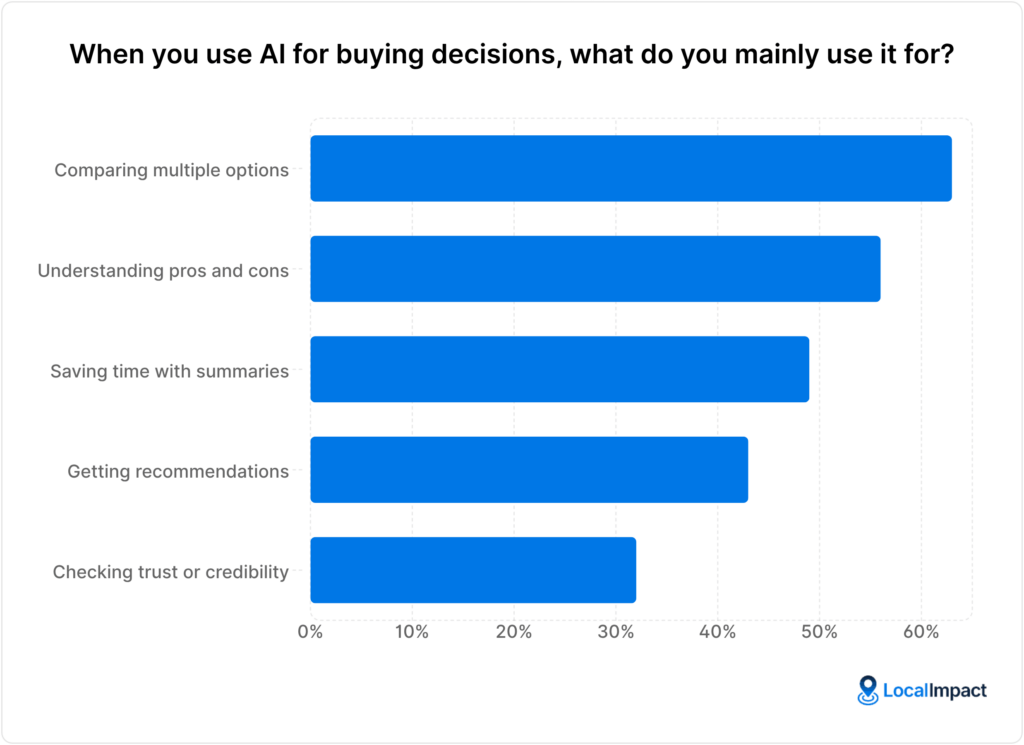
- AI is primarily used to compare and summarize: 63% use it to compare options quickly, 56% to understand pros and cons, and 49% to save time with summaries.
- Trust in AI is solid, but cautious: Over 80% trust AI at least moderately, yet 36% worry about bias or sponsorship and 33% cite concerns about inaccurate or outdated information.
- Reviews are still the most trusted source: Consumers trust online reviews more than AI recommendations or advice from friends and family when choosing a business.
- When AI and reviews conflict, reviews win: 41% would trust reviews over AI, and 46% would read reviews more carefully if AI recommended a poorly rated business.
- AI can introduce new businesses, but reviews decide the outcome: 44% would consider an unfamiliar business recommended by AI, yet only a small minority say an AI recommendation alone is enough to earn trust.
AI is now part of everyday buying research
6 out of 10 consumers say they use AI tools often or almost always when researching products or services. And 70% state that AI has helped them decide what to buy or which business to choose multiple times.
When it comes to purchase-related research, consumers most frequently use AI for online shopping (66%) and expensive products (48%). But they also use it to research local services (38%) and travel or experiences (40%).
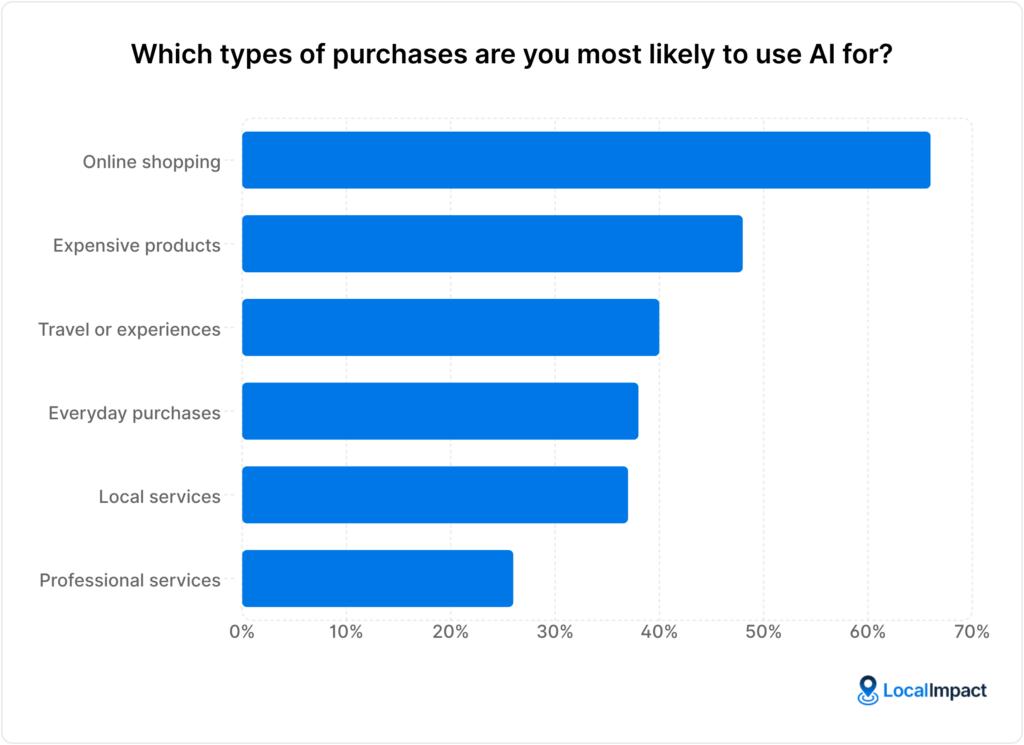
As the numbers show, consumers are becoming increasingly more comfortable about using AI across different categories and types of purchases.
What consumers actually use AI for
When asked what they mainly use AI for during buying research, the most commonly cited use cases included:
- Comparing multiple options quickly (63%)
- Understanding pros and cons (56%)
- Saving time with summaries (49%)
Less than half use AI to get direct recommendations, and an even smaller share use it to check trust or credibility. This suggests that most consumers view AI as a way to reduce effort early in the process, not as a substitute for independent judgment.
Trust in AI is real, but limited
More than 80% of respondents said they trust AI recommendations at least moderately.
Compared to other information sources, most respondents rated AI as about as trustworthy or slightly more trustworthy than alternatives.
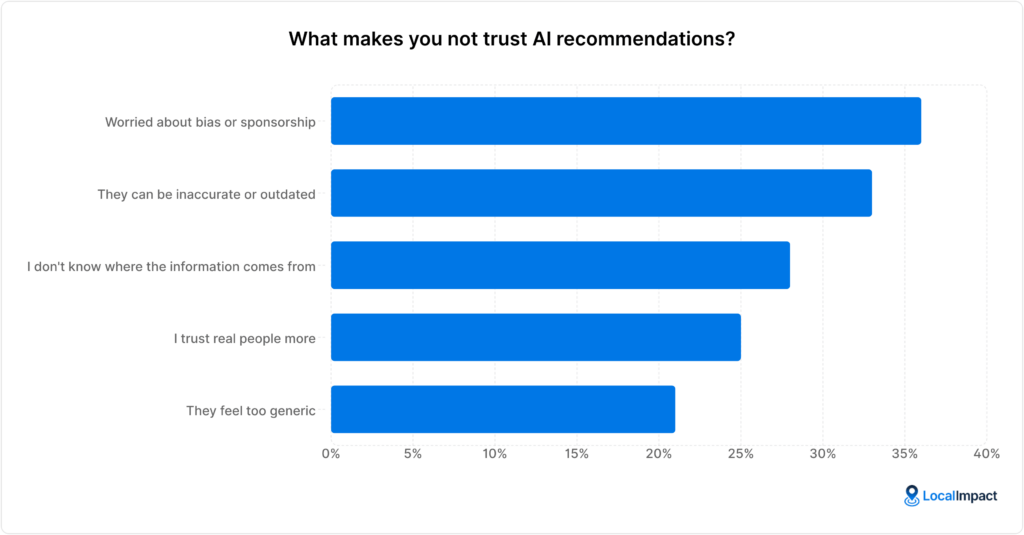
When asked what makes them distrust AI recommendations, consumers most commonly mention concerns about bias or sponsorship (36%), inaccurate or outdated information (33%), and not knowing where the information comes from (28%).
When it comes to emotional decisions, health-related choices, and expensive purchases, consumers still tend to prefer human judgement.
Reviews remain the most trusted signal
When choosing a business to buy from, consumers trust online reviews over advice from friends and family and AI recommendations.
In situations where AI recommendations and online reviews are conflicted, 41% of consumers would trust online reviews more. And if AI recommended a business with poor reviews, 46% would read the reviews more carefully before deciding.
This preference for reviews is consistent with broader consumer behavior patterns.
Reviews offer specific, experience-based information from people who have already engaged with a business. They are perceived as harder to manipulate and easier to evaluate than abstract recommendations or generalized summaries.
Even as AI becomes more capable and more widely used, reviews remain the primary trust anchor in the buying journey.
Manage your online reputation with ease
Monitor, manage, and get more online reviews for your business with LocalImpact.
AI can introduce new businesses, but reviews decide the outcome
AI plays a meaningful role in expanding consumer consideration sets. 44% of respondents said they would be somewhat or very likely to consider a business they had never heard of if it was recommended by an AI tool.
However, openness doesn’t equal trust.
When consumers evaluate whether to trust a business recommended by AI, online reviews become highly influential.
Over half of respondents said recent reviews, strong overall reviews, and high star ratings would make them more comfortable trusting an AI-recommended business. Thoughtful responses to reviews also ranked highly.
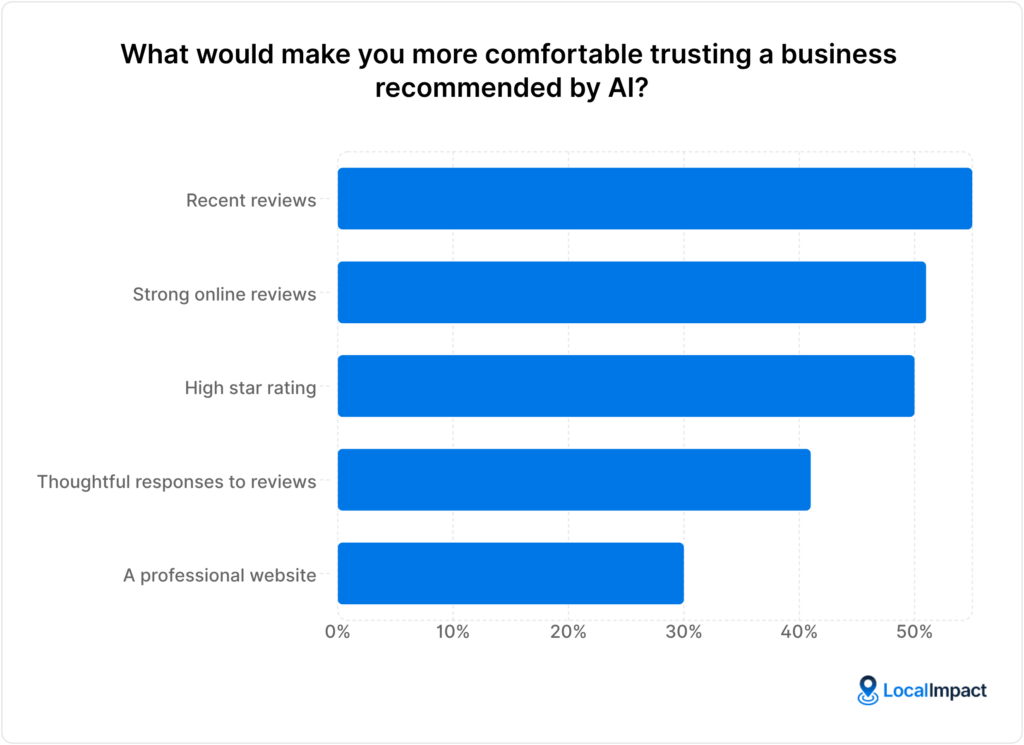
Only a small fraction of respondents said an AI recommendation alone would be enough to trust a business.
This indicates that AI can help businesses get noticed, but reviews largely determine whether that attention turns into action.
What this means for businesses
Our survey data points to a clear shift in how consumers gather information when evaluating purchase decisions.
AI is increasingly shaping the early stages of the buying journey. It helps consumers compare options faster, understand trade-offs, and discover new businesses. As AI adoption continues to grow, visibility in AI-assisted research will matter more.
At the same time, reviews remain the strongest trust signal at the moment of decision. Consumers rely on them to validate AI recommendations, resolve uncertainty, and assess credibility.
For businesses, this means that AI exposure and reputation are tightly linked.
Being surfaced by AI is valuable, but it also brings greater scrutiny. Businesses with weak, outdated, or poorly managed reviews are unlikely to benefit fully from AI-driven discovery.
As consumers continue to rely on AI more over the next several years, the importance of maintaining a strong, credible review presence is likely to increase.