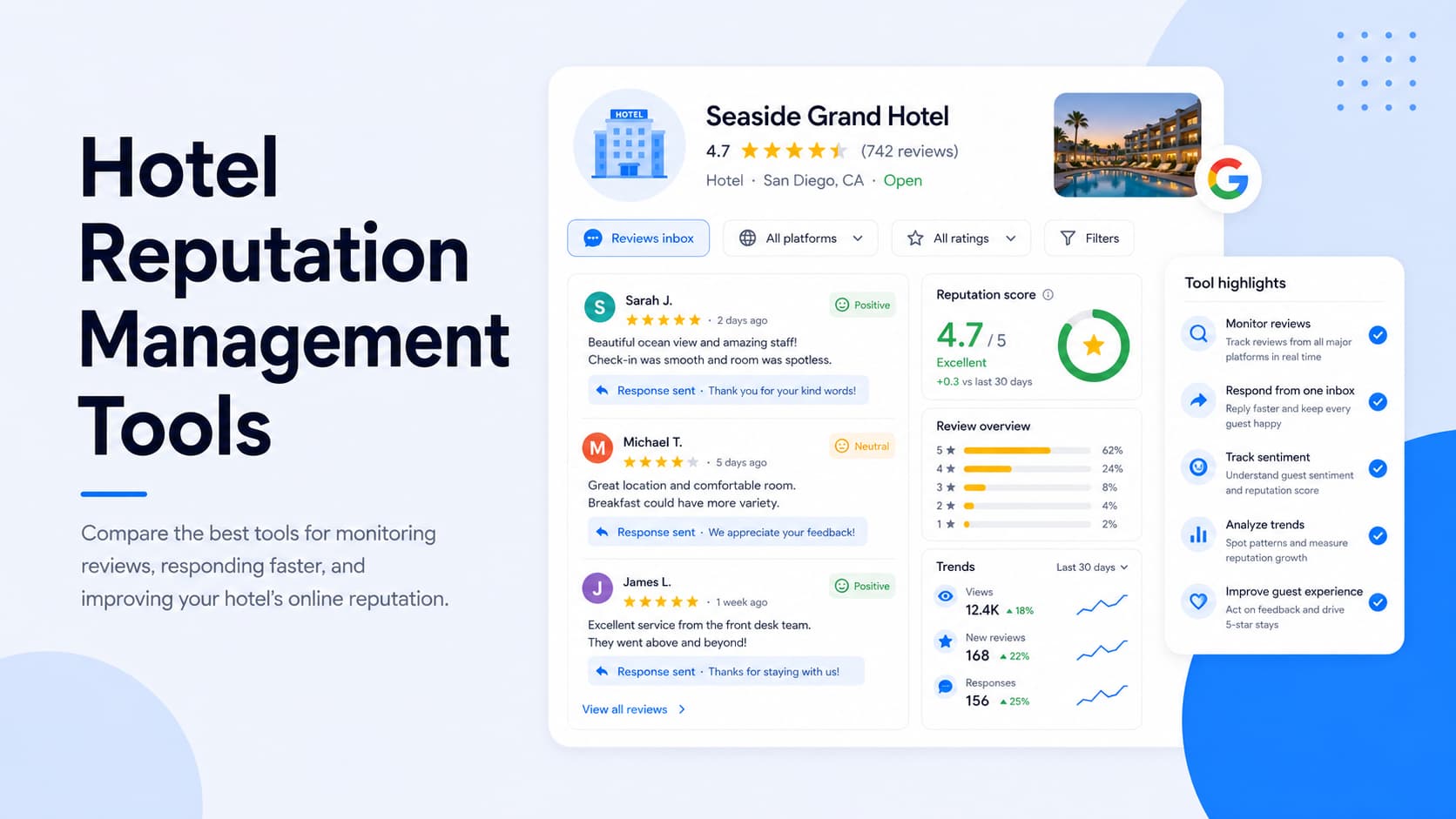
Guest reviews now decide bookings before a traveler ever reaches your site, and managing them across Google, TripAdvisor, Booking.com, and a dozen other platforms is more than any front desk can handle by hand.
We put the leading hotel reputation management tools through hands-on evaluation so you don't have to, weighing how each one collects, responds to, and analyzes guest feedback.
Below you'll find seven platforms broken down by features, pricing, strengths, and where each fits best.
Best hotel reputation management tools at a glance
| Software | Starting price | Free trial available |
| LocalImpact | $49/month | Yes |
| Mara AI | $160/month | Yes |
| Customer Alliance | $108/month | No |
| ReviewTrackers | Custom pricing | No |
| Reputation | $80/location/month | No |
| NiceJob | $75/month | Yes |
| Yext | Custom pricing | No |
How we chose these tools
We logged more than 200 hours testing hotel reputation management software across real guest-feedback workflows before settling on this list. Here’s everything we looked at:
- Hospitality relevance: We prioritized tools that explicitly support hotels and hospitality operators, since generic review software often misses online travel agency (OTA) coverage and post-stay workflows.
- Review collection and response: We assessed how well each platform automates review requests and drafts replies, since volume and response speed are what move ratings.
- Feedback analysis: We weighed the depth of sentiment and topic analytics, because turning scattered comments into clear themes is where reputation work actually drives improvement.
- Platform coverage: We checked which review sources each tool monitors, with weight given to the OTAs and review sites where hotel guests actually leave feedback.
- Ease of use: We evaluated how quickly a team could set up the tool and fold it into daily operations without heavy training.
- Pricing transparency: We looked at how clearly each platform presents pricing and whether the entry tier is realistic for the property size it targets.
1. LocalImpact
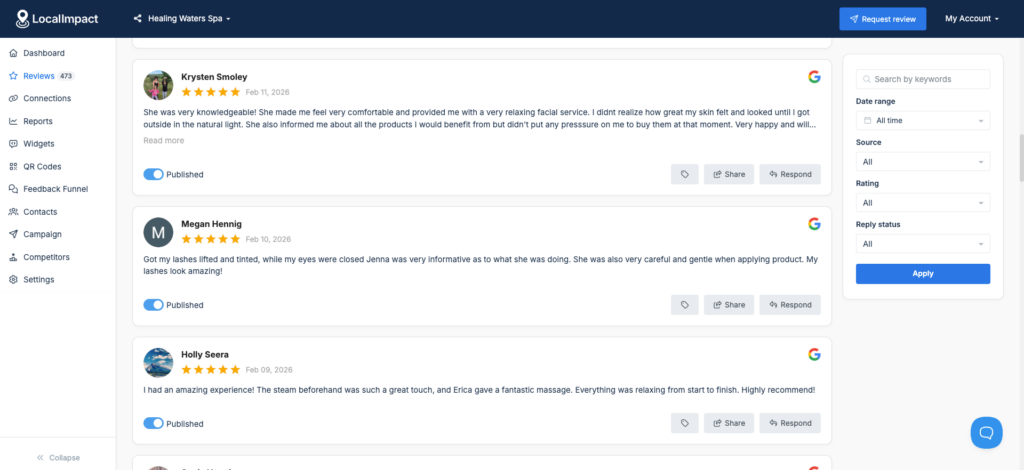
LocalImpact is a review management platform built for local and service-based businesses, with a dedicated path for hotels and other hospitality operators.
It centers on collecting Google and Facebook reviews through automated requests, then turning that feedback into social proof across your website and search listings.
For hospitality, the platform frames review velocity as the lever for Google Maps visibility, pairing automated outreach with AI-assisted responses and performance reporting.
It also supports multi-location properties through a single dashboard, which helps groups keep review growth consistent across sites.
Key features
- Automated review requests: Sends review invitations by SMS and email after a stay or appointment, with follow-up reminders that re-engage guests who didn't respond the first time.
- AI review replies: Generates personalized AI responses in seconds and can auto-respond to positive reviews, while sentiment analysis adjusts tone across positive, neutral, and negative feedback.
- Feedback funnels: Gives guests a branded choice between leaving a public review or sending private feedback, so you can route issues internally before they reach public platforms.
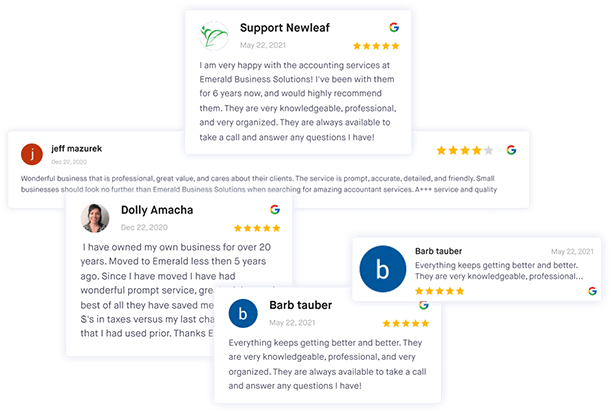
- Review widget: Embed reviews from Google, Facebook, Yelp, TripAdvisor, and other sources on your website with schema markup and a daily refresh that surfaces your newest feedback.
- Social sharing: Converts individual reviews into branded, ready-to-post social graphics without design work.
- Multi-location dashboard: Manages review activity across every property from one place, with aggregate reporting and templates that keep responses consistent.
Pros
- Steady review flow without manual chasing: Generate reviews with automated SMS and email sequences plus follow-up reminders keep volume climbing across every location on autopilot.
- Hands-off responses for positive reviews: AI can publish replies to positive Google reviews automatically, while editing tools keep you in control of sensitive cases.
- Broad platform coverage for hospitality: Collection and monitoring span Google, Facebook, Yelp, and TripAdvisor, which matches where hotel guests actually leave feedback.
- In-person capture options: QR codes and standalone staff links let front-desk teams request reviews at checkout without logging into the platform.
- Responsive, human support: Reviewers repeatedly single out fast, hands-on help during setup and onboarding.
What we like
The feedback funnel's branded public-or-private split is a standout for hotels, since it gives front-desk teams a way to catch a frustrated guest privately while still steering happy guests toward Google and TripAdvisor.
The daily-refreshing website widget reinforces that by keeping your strongest recent reviews visible on the booking page.
What users say
Reviewers highlight how quickly the platform integrates with a website and how much manual work the automation removes, with support singled out as a recurring strength.
"Software is simple to use and implement to websites… Customer support is outstanding!"
They also point to the breadth of integrations and the granular control over what displays on the site.
"I appreciate how seamlessly it integrates not only with major sites (e.g., Google, Yelp, and Facebook) but also ones that are specific to attorneys (e.g., Avvo). I like the precise and granular control that LocalImpact offers users."
Pricing
LocalImpact offers a 14-day free trial on every plan, with no credit card required.
Paid plans include:
- Growth: $49/month
- Pro: $99/month
- Agency: $149/month
Manage your hotel's online reviews with ease
Monitor, manage, and get more online reviews for your hotel with LocalImpact.
2. Mara AI
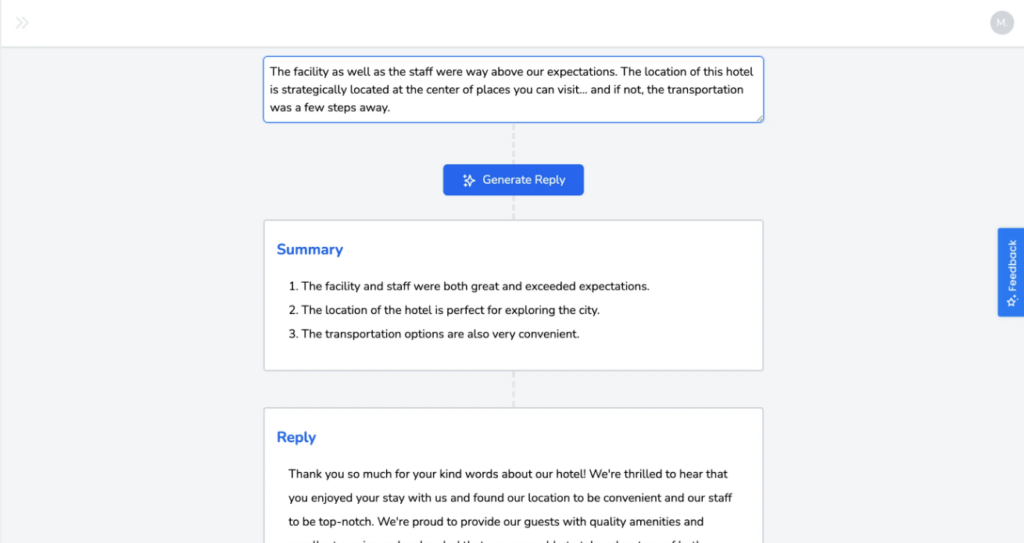
Mara is an AI reputation platform built specifically for hotels, centered on review response and guest-feedback analysis, with collection handled mainly through surveys.
When we worked with it, the draw was speed: a central inbox pulls reviews from Google, Booking.com, TripAdvisor, and other sources, and the AI drafts personalized replies that need only light edits before publishing.
Across our hands-on time, the platform leaned hard into hospitality specifics.
It detects recurring review topics, writes in your trained brand voice, and surfaces analytics that read like a human summarized every review, which makes it a fit for single properties and groups managing dozens of sites.
Key features
- Central review inbox: Consolidates reviews from every connected source into one queue and works across languages, so multilingual guest feedback lands in a single workflow.
- Brand Voice AI: Trains on your existing replies and updates daily, generating responses that match your tone without starting from a blank page.
- Smart Snippets: Lets you teach the AI how to handle recurring topics like paid parking or limited vegan options, then weaves that guidance in without repeating the same wording.
- Review automation: Applies rules such as auto-replying to text-free four and five-star reviews, while routing others to a human for verification first.
- Review analytics: Builds pro and con lists, impact scores, and property comparisons, with an "Ask Reviews Anything" chat for querying feedback directly.
- AI-aided surveys: Routes happy guests toward public Google or TripAdvisor reviews and sends unhappy ones to a private channel that lands in your inbox.
Pros
- Genuinely fast response drafting: Replies come back ready in seconds, and hoteliers report cutting per-review time from several minutes to under two.
- Strong multilingual handling: One-click replies in any language make it practical for properties with an international guest mix.
- Topic-level analytics that drive action: Category scoring across areas like housekeeping and front office points you to specific fixes like a slow front desk or a noisy AC unit.
- Survey routing that protects public ratings: Steering dissatisfied guests to a private channel before they post helps shape what reaches Google and TripAdvisor.
- Built for groups: Property comparison and group-level reporting hold up when you're overseeing many sites at once.
Cons
- Replies still need a final pass: Even strong drafts usually want a light human edit before they go live, so it's not fully hands-off.
- Response-first scope: The platform shines on responding and analyzing, so review generation beyond surveys stays thin.
- Per-property pricing adds up: The flat rate per property can climb quickly for larger portfolios.
What we like
The Smart Snippets feature stood out most in our use: teaching the AI how to handle a specific recurring complaint once, then watching it apply that guidance naturally across dozens of reviews without parroting the same sentence, solves a real problem for high-volume properties.
The "Ask Reviews Anything" chat is a close second for how quickly it answers pointed questions like what guests think of breakfast.
What users say
Users consistently call out how much time the tool saves and how natural the AI-generated wording feels across platforms and languages.
"I absolutely love how MARA - AI Review Reply Assistant streamlines my response process to customer reviews.
It's incredibly efficient; I just copy a review, and voilà, I get a personalized reply suggestion in no time. The fine-tuning feature ensures my responses align perfectly with my brand's tone.
lus, its versatility across different review platforms and languages is a game-changer for managing feedback."
The main critique is mild and matches our own read, that a final human touch is still part of the flow.
"While MARA - AI Review Reply Assistant is a valuable tool, I'd say my minor dislike stems from the need for a last fine-tuning step."
Pricing
Mara offers a free trial with no credit card required, so you can test the review response generator before committing.
Paid plans include:
- Inbox & Analytics (monthly): $160/month per property
- Inbox & Analytics (annual): $130/month per property
3. Customer Alliance
Customer Alliance pairs review management with structured guest surveys in a single platform built for hotels.
Working in it, the standout was true two-way OTA integration, which let us publish replies straight to Booking.com and Expedia without logging into each OTA separately.
The platform suits operators who want guest feedback to inform decisions across the property.
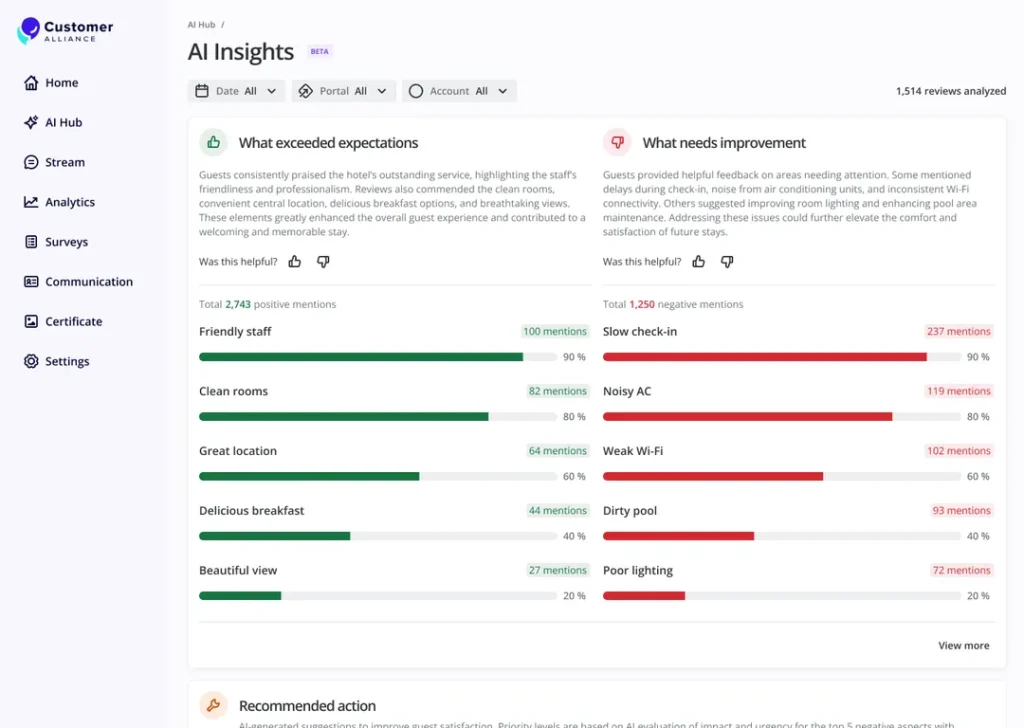
During our hands-on time, the survey-and-review combination gave a fuller read on sentiment by department, with AI analysis surfacing the themes moving CSAT and NPS.
Key features
- Two-way OTA review stream: Centralizes reviews from major travel platforms and lets you publish replies directly to OTAs from the dashboard, no extranet switching.
- AI Reply Assistant: Drafts responses in seconds and learns your brand voice from your edits, with translation so you can reply in the guest's language.
- Guest surveys: Collects structured feedback during and after the stay across departments like spa, restaurant, and front desk, scored with CSAT and NPS.
- AI Hub: Combines AI Insights, which groups feedback by topic and sentiment, with Key Driver Analysis that ties specific experience areas to satisfaction scores.
- Reporting and benchmarking: Generates scheduled CSAT, NPS, and sentiment reports and benchmarks your performance against a custom competitor set.
- Review distribution: Splits review-request traffic between Google, TripAdvisor, and HolidayCheck to grow your presence on open portals.
Pros
- Reply publishing without extranet friction: Direct two-way OTA integration means responses post to Booking.com and Expedia from one screen, cutting copy-paste work.
- Surveys and reviews in one view: Combining post-stay surveys with portal reviews gives a department-level read that review-only tools miss.
- Feedback tied to satisfaction drivers: Key Driver Analysis points leadership to the changes most likely to move CSAT and NPS, with quarter-over-quarter tracking.
- Built-in competitor benchmarking: Comparing your scores against a chosen competitor set helps you see market position without a separate tool.
- Hands-on success support: Case-study customers repeatedly credit the success team with proactive setup help and regular check-ins.
Cons
- Touchpoint pricing takes deciphering: Each touchpoint counts as either review management or a single survey, which makes plan sizing less obvious upfront.
- Occasional post-update glitches: Users note the platform can hit minor bugs after its frequent updates.
- Depth can outsize a small property: The survey and analytics layers can feel heavier than a single independent hotel needs day to day.
What we like
The during-stay survey is the quiet standout: triggering a quick check-in survey one day after arrival lets the team fix a room or service issue while the guest is still on property, before it ever becomes a public review.
It's a genuinely proactive use of feedback that pairs well with the post-stay review push.
What users say
Reviewers point to ease of use and the way it centralizes the guest experience picture.
"I like how it helps us to provide the best customer experience and to provide a solution to our customers."
The main critique is mild and matches the glitch note above.
"I don't like the glitches it may have once in a while, usually after the updates that have been made consistently."
Pricing
Customer Alliance doesn't offer a free trial or free plan, access starts with a booked demo, and entry pricing is published while higher tiers route through sales.
Paid plans include:
- Core: from $108/month
- Growth: from $178/month
- Pro: from $208/month
- Enterprise: custom pricing
Manage your hotel's online reviews with ease
Monitor, manage, and get more online reviews for your hotel with LocalImpact.
4. ReviewTrackers
A multi-location reputation platform at its core, ReviewTrackers aggregates reviews from across the web into one dashboard for monitoring, responding, and analysis.
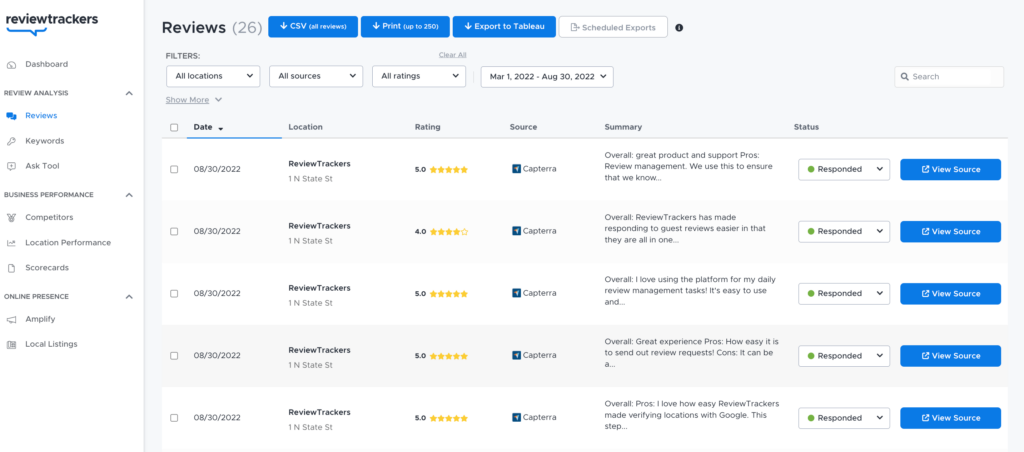
Testing it, the aggregation and filtering stood out: pulling reviews from many directories into a single queue and sorting by responded versus unanswered made daily review work fast.
The platform leans analytical, with natural language processing that categorizes feedback by theme and sentiment, plus competitor tracking and local listings tools.
It's a strong fit for hotels that want sentiment trends and local-search performance, and OTA platforms sit outside its main focus.
Key features
- Review aggregation: Centralizes reviews from major directories into one workflow so you can monitor every location without checking sites individually.
- AI review responses: Generates replies and applies Smart Response templates to auto-respond on brand, cutting response time across high review volumes.
- Review generation: Automates request campaigns by email and SMS to build review volume and lift local-search visibility.
- Customer experience analytics: Uses natural language processing to categorize feedback by topic and sentiment, surfacing trends across large review sets.
- Competitor analysis: Tracks rival ratings, review velocity, and sentiment so you can benchmark performance in your local market.
- Local listings management: Keeps business information consistent across directories to support local-search rank.
Pros
- Fast review triage: Filtering responded against unanswered reviews keeps a busy front office on top of replies without missing feedback.
- Genuinely useful sentiment analysis: Automatic topic and sentiment categorization turns a flood of reviews into themes a team can act on.
- Competitor benchmarking built in: Tracking rival review velocity and sentiment helps you see where you stand locally without a separate tool.
- Responsive, named support: Reviewers repeatedly credit specific success-team members with quick, helpful answers.
- Quick to set up and learn: Users describe setup as simple and the platform as easy to fold into a daily routine.
Cons
- Direct response gaps on some platforms: Replying from within the tool can be inconsistent depending on the review source.
- Source coverage skews to mainstream directories: Users want wider crawling, and the OTA platforms guests book through aren't a focus.
- Notifications can be erratic: Alerting is hit or miss for some users, which matters when speed of response is the goal.
What we like
The competitor module is the standout for a hotel watching its local market: tracking a rival property's review velocity and sentiment side by side with your own gives a clear read on where you're gaining or losing ground in the map pack.
It pairs well with the local listings tools for properties focused on near-me search.
What users say
Reviewers point to the time saved by aggregating reviews from many sources and filtering by response status.
"The ability to filter out responded and unresponded reviews makes everything so much easier & quicker to ensure that all reviews are answered in a timely manner.
Additionally, the capability to draw out reviews from multiple outlets makes this a much needed tool!"
The mild critiques tend to center on coverage and profile-management depth.
"Not a dislike, but features that help you secure, verify, and manage profiles better would be tremendously helpful. Apple Business Connect, for example, is tricky to verify and having a built in solution within ReviewTrackers would be helpful."
Pricing
ReviewTrackers offers the following plans:
- Data Only
- Essential
- Custom
Pricing for these plans isn't publicly available. You'll need to reach out to the sales team for a quote.
5. Reputation
Designed for multi-location brands at enterprise scale, Reputation unifies reviews, listings, surveys, and social in one platform.
In our testing, the draw was the single source of truth, every location's reviews and listings sitting in one dashboard with clear per-location performance.
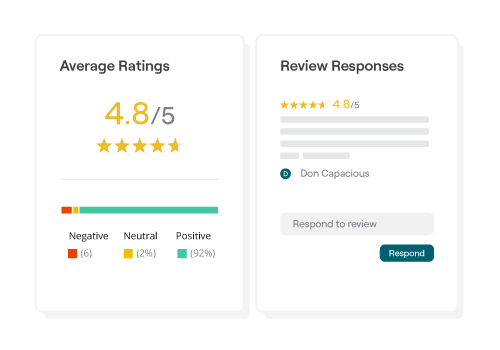
The platform leans heavily toward large portfolios, pairing deep analytics with AI querying and issue-routing workflows. For hotels, it fits groups managing many properties, since its strength shows at scale.
Key features
- Reviews and Review Booster: Triggers review requests by SMS and email after a stay, drafts AI responses, and centralizes feedback from Google, Facebook, and Yelp in one inbox.
- Business listings and local SEO: Keeps property data accurate across search, maps, and AI surfaces to support discovery.
- Surveys: Runs conversational, AI-driven surveys that ask follow-up questions based on sentiment, then routes happy respondents toward public reviews.
- Reputation IQ: Answers plain-language questions across your review and survey data, surfacing trends and root causes without building reports.
- Competitive Insights: Benchmarks rating, sentiment, volume, and topics against a defined competitor set by location and region.
- Actions: Converts negative reviews and low survey scores into routed tickets with SLA timers and escalation.
Pros
- Genuine single source of truth across locations: Reviews, listings, surveys, and social roll into one dashboard, which holds up well across a large property portfolio.
- Survey-to-review loop protects public ratings: Private surveys catch unhappy guests before they post, while happy respondents get prompted to leave a public review.
- Plain-language data querying: Reputation IQ lets a manager ask questions and get answers without digging through dashboards or exports.
- Issue resolution is built in: Actions turns feedback into assigned, tracked tickets so recurring problems actually get resolved and stop resurfacing.
- Responsive, named support: Reviewers repeatedly credit specific reps with quick, helpful service across onboarding and daily use.
Cons
- Social and reporting lag the review tools: Several users describe the social metrics and report customization as less polished than the core review features.
- RepScore can feel opaque: The reputation score shifts without a clear explanation, which frustrates teams trying to act on it.
- Dense for non-marketing users: The platform is feature-rich enough that onboarding a front-line manager who just needs to respond takes time.
What we like
The Actions workflow is the standout for a hotel group: a one-star review mentioning a specific issue can auto-generate a ticket routed to the right property manager, with an SLA timer that escalates if it sits unresolved.
It closes the gap between spotting a problem and actually fixing it across many properties.
What users say
Reviewers point to the time saved by managing every location's feedback from one place.
"I like how Reputation makes it easy to keep track of what customers are saying all in one place.
It helps me stay on top of reviews, respond quickly, and understand where we are doing well and where we can improve.
It centralizes everything so I'm not bouncing between Google, social media, and other platforms, saving time and ensuring I don't miss responding to anything."
The mild critiques center on occasional bugs rather than core function.
"The occasional bug is still present, something like responses being duplicated on my dashboard.”
Pricing
Reputation doesn't offer a free trial or free plan; pricing is per location and starts with a sales conversation.
Paid plans include:
- Rep Core: $80 per location per month
- Rep Core + Pulse: $115 per location per month
- Rep Core + Surveys: $150 per location per month
- Enterprise: custom pricing
6. NiceJob
A review generation platform built for budget-conscious small businesses, NiceJob puts collection, social proof, and review sharing on autopilot, with hospitality among its named verticals.
The platform centers on generating review volume and amplifying it across your site and social.
For hospitality, it works best for independent and boutique properties focused on growing Google review volume without a heavy analytics layer. Its automation and low entry price make it an easy starting point for a small front-office team.
Key features
- Automated review campaigns: Sends a pre-built SMS and email sequence after a visit, with follow-up reminders, then shares new reviews to Google, Facebook, and beyond.
- AI review replies: Drafts and auto-publishes responses on a daily cycle, with rules to limit auto-replies to reviews above a chosen star threshold.
- Social proof widgets: Embeds reviews, recent bookings, and a trust badge on your site to convert visitors, with a hosted microsite option.
- Social sharing: Turns reviews into branded social posts the platform claims drive more engagement than plain text.
- Referrals: Runs automated referral campaigns to turn happy guests into new bookings.
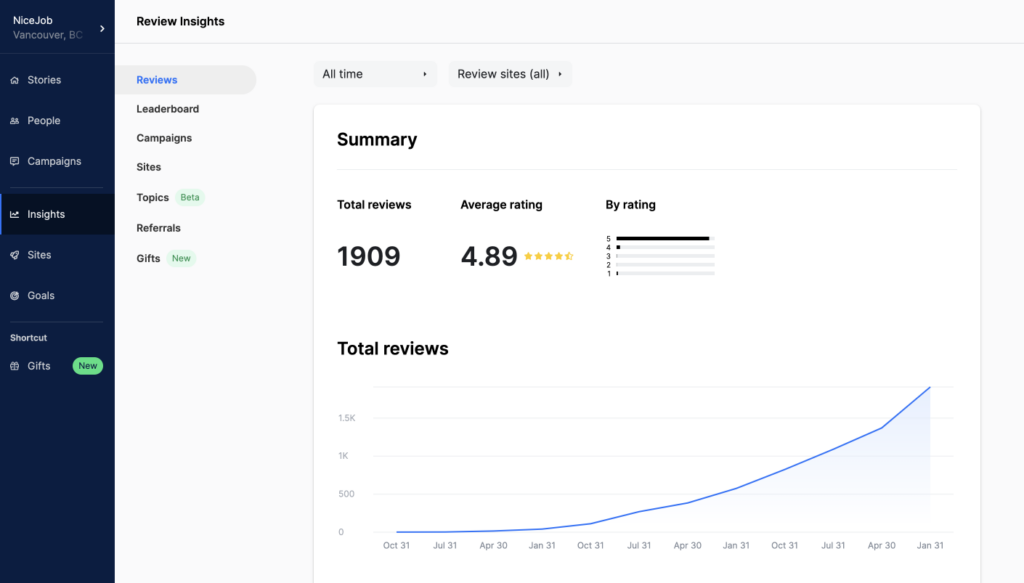
- Insights: Tracks which sites drive the most reviews, campaign performance, and competitor ratings and sentiment.
Pros
- Truly hands-off review generation: Once it's wired to your CRM, requests fire automatically at job completion with no manual follow-up.
- Fast, simple setup: Users repeatedly describe getting up and running in fifteen to twenty minutes.
- Strong, accessible support: Reviewers single out quick access to a live person during onboarding and after.
- Affordable entry point: Pricing sits well below enterprise platforms, which suits independent operators watching budget.
- Effective social proof tools: The website widgets and microsite turn collected reviews into conversion assets without design work.
Cons
- Limited widget customization: Several users want more control over how many reviews show and the styling to match a site exactly.
- Multi-location gets clunky: Switching between locations and duplicated reviews across sites frustrate users running more than one property.
- No review export: You can't export your reviews, which limits how you reuse the data elsewhere.
What we like
The rules engine on AI replies is the practical standout: setting auto-response to fire only on reviews of a chosen rating and above lets a small team clear the easy positives automatically while keeping a human on anything that needs a careful touch.
What users say
Reviewers point to the automation and the speed of setup as the core draw.
"I really like the automation in NiceJob. It's synced with our CRM and is pretty much hands-off.
Review invites are sent out automatically when a work order is completed in our CRM, which is great. The invites go out first by text and then by email, and this sequence is customizable too."
The milder critiques tend to center on widget styling and display control.
"I don't like the widgets and aspects that interact with the website to show reviews. I'd like more customization in terms of the number of reviews displayed, style, font, color, etc.
We wanted it to fit our website exactly, and that wasn't possible."
Pricing
NiceJob offers a 14-day free trial with no credit card required.
Paid plans include:
- Reviews: $75/month
- Pro: $125/month
Manage your hotel's online reviews with ease
Monitor, manage, and get more online reviews for your hotel with LocalImpact.
7. Yext
Built for multi-location enterprises, Yext combines listings, reviews, and local search into one platform, with a dedicated hospitality offering aimed at hotels and resorts. Spending time in it, the core strength showed quickly: its reach.
Verified property data and review responses push out across more than 80 review platforms and a vast publisher network without an aggregator in between.
The platform frames reviews as ranking signals for both traditional and AI search, pairing review management with listings accuracy. For hotels, it suits large chains managing many properties, since the value compounds at portfolio scale.
Key features
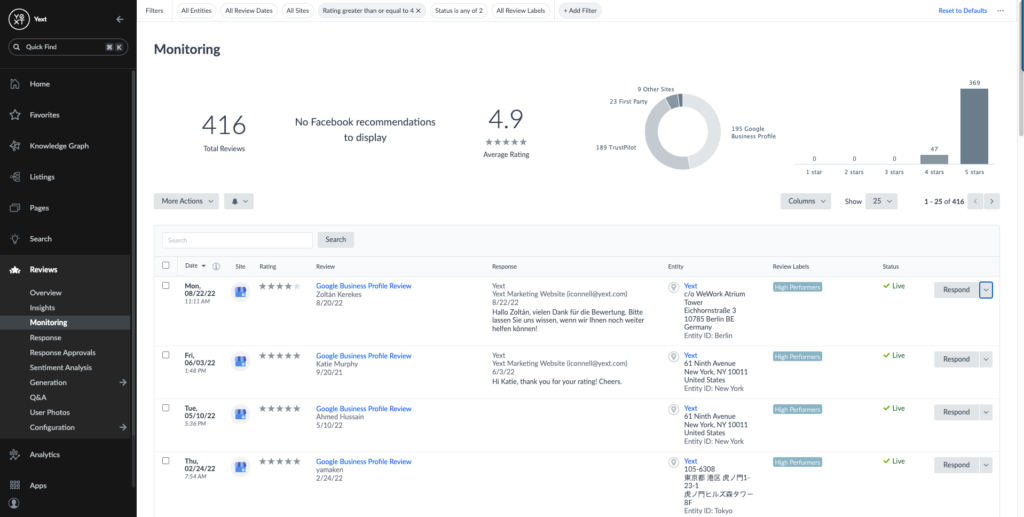
- Review monitoring: Pulls reviews from Google, Facebook, Yelp, and 80-plus industry sites into one dashboard, with smart filters and alerts so nothing slips across thousands of locations.
- Review generation: Routes review requests by email, text, or QR code to the platforms that most influence search visibility, using a balancing algorithm.
- AI review responses: Drafts empathetic, on-brand replies from templates and rules, with optional auto-response and approval workflows.
- Knowledge Graph and listings: Maintains verified property data and distributes it across maps, directories, and AI surfaces like ChatGPT and Gemini.
- Competitive intelligence: Benchmarks your reviews score against nearby rivals on rating, count, recency, and response time.
- Scout visibility engine: Surfaces where competitors outrank you by property and gives next steps to close the gap.
Pros
- Unmatched distribution reach: Property data and responses propagate across 80-plus review sites and a large publisher network from one place, with no aggregator delay.
- Reviews tied to search visibility: The platform connects review signals directly to traditional and AI search ranking, which fits a discovery-driven hotel goal.
- Robust, customizable analytics: Users build custom reports down to the location, folder, or tag level rather than relying on fixed dashboards.
- Strong listings accuracy at scale: One update syncs property details everywhere, a real time-saver for chains managing thousands of properties.
- AI-assisted review governance: Preapproved response templates and role-based controls help large teams reply quickly and stay compliant.
Cons
- Steep learning curve: The depth of features means new users need a while to find their way around everything.
- Support and ticketing frustrations: Several users cite slow ticket resolution and project-manager turnover that delays answers.
- Enterprise-level cost: Pricing skews high, especially as location count climbs, which puts it out of reach for smaller operators.
What we like
The Scout visibility engine is the standout for a competitive hotel market: instead of just reporting your scores, it pinpoints exactly where a rival property is outranking you in search and hands back specific actions to win those high-intent moments.
Pairing that with the listings reach into AI surfaces like ChatGPT positions a property for how travelers increasingly research trips.
What users say
Reviewers point to centralized management across many locations and the depth of the analytics.
"I use Yext primarily to monitor reputation for a client across all their different locations. I really like that it brings all the different review sites into one platform, which is super helpful for us.
I think the user interface is very strong, making it easy to navigate. The analytics are also robust."
The milder critiques tend to center on the learning curve that comes with the feature depth.
"The platform is very feature-rich, which is part of what makes it so effective. However, this comes with a learning curve. It takes time to get fully comfortable with everything Yext offers."
Pricing
Yext doesn't publish pricing; plans are quote-based and start with a sales conversation, and reviewers describe annual contracts that skew toward enterprise budgets.
How to choose the right hotel reputation management tool for you
The right fit comes down to your property size, where your guests leave feedback, and how much of the work you want automated.
- Property count and scale: A single boutique property and a fifty-site group have very different needs, since per-location pricing and group reporting reward scale while a single hotel pays for depth it won't use. Match the tool's design to your portfolio so you're not buying enterprise governance for one front desk or outgrowing a single-location tool in a year.
- Review source coverage: Hotel guests leave feedback on OTAs like Booking.com and Expedia alongside Google and TripAdvisor, so a tool that only pulls mainstream directories leaves blind spots. Confirm the platform monitors and ideally responds to the specific sites where your bookings and reviews actually concentrate.
- Collection versus analysis: Some tools excel at generating review volume while others go deep on sentiment and survey analytics, and few do both equally well. Decide whether your bigger gap is getting more reviews or understanding the ones you already have, then weigh your choice accordingly.
- Response automation and control: AI-drafted replies save time, but auto-publishing without review can misfire on sensitive feedback. Look for rules that let you automate the easy positives while a human still reviews anything sensitive.
- Pricing model and transparency: Pricing ranges from flat monthly rates to per-location and quote-based enterprise contracts, which changes the math quickly as you add properties. Map the entry tier and per-location cost against your actual portfolio so the total holds up at your size, not just the headline number.
The strongest choice is the one that matches where your guests already talk and how your team actually works. Start with that fit, then let features break the tie.
Wrap-up
Strong review management turns scattered guest feedback into higher ratings, better visibility, and more direct bookings, and the right tool turns review management into a steady routine.
Most platforms here offer a free trial or a demo, so the fastest way to find your fit is to test one against your own reviews.
LocalImpact is a straightforward place to start, with a 14-day free trial and no credit card required. Get started for free today.