Most coverage of fake reviews focuses on consumers getting tricked. The businesses absorbing the damage tend to get less attention.
To understand what fake reviews actually look like from the other side of the screen, we surveyed 400 US business owners.
The results suggest fake reviews have become a near-universal experience for local businesses, and a problem most owners feel they're handling without much help.
About this study
This survey was conducted in April 2026 through Pollfish, an independent research platform.
All 400 respondents were screened to confirm they own or manage a local, brick-and-mortar business in the United States, including categories like restaurants, retail stores, medical practices, and home services companies.
The survey covered their experiences with fake reviews over the past 12 months, the platforms involved, the impacts they've felt, and how they've responded.
Key takeaways
- 72% of local business owners say they've received a fake review in the past 12 months.
- 25% received six or more fake reviews in a single year.
- 79% believe their business has been targeted by a coordinated fake review attack at some point.
- 70% suspect their competitors of using fake positive reviews.
- Only 28% of reported fake reviews get removed promptly.
- 24% of owners say fake reviews have caused staff stress or morale issues.
- Only 31% of businesses use a dedicated review management platform.
Fake reviews aren't a fringe problem anymore
If you run a local business, fake reviews are now part of the job. 72% of the owners we surveyed say they've received at least one fake review in the past 12 months, and only 8% are confident they've received zero.
The volume isn't trivial either. A quarter of owners report receiving six or more fake reviews in the past year, with 7% saying they've received more than ten.
When asked which platforms are involved, the answers cluster around the biggest names: Google, Facebook, and Yelp.
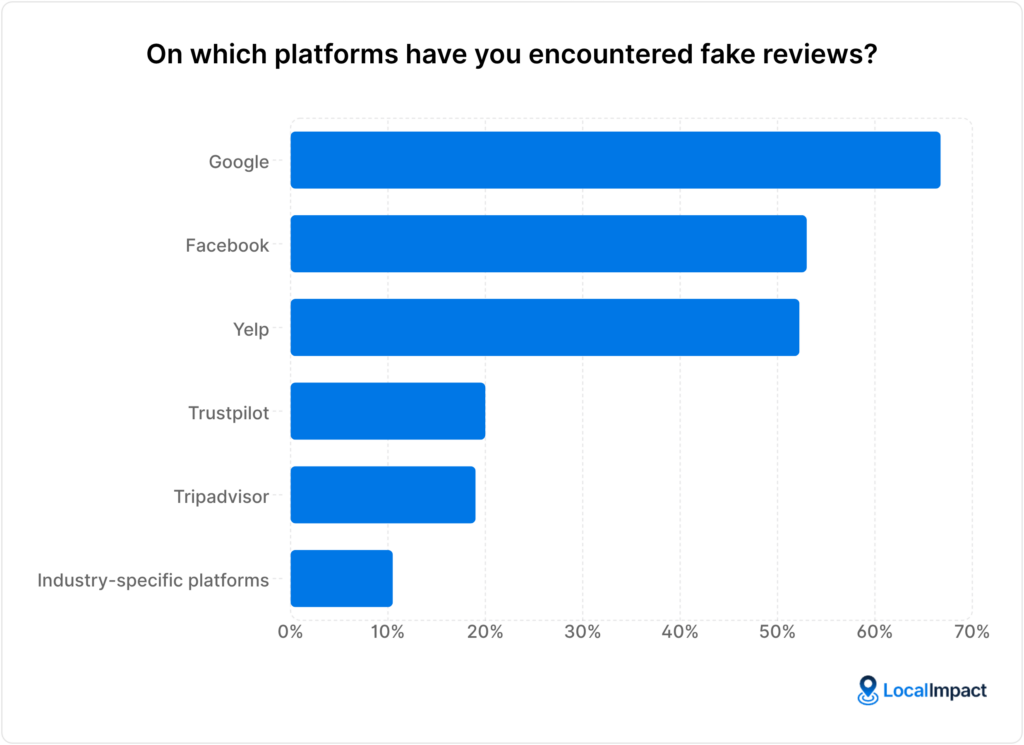
Wherever consumers are looking for businesses, fake reviews are showing up. And the platforms with the largest review economies are also the ones generating the most reports of fakes.
Most owners think someone is targeting them on purpose
This is where the data shifts from annoying to alarming.
When we asked whether owners believed their business had ever been targeted by a coordinated fake review attack, defined as multiple fake negative reviews posted in a short period, 42% answered "yes, definitely." Another 37% said "yes, I suspect so."
Combined, nearly 4 in 5 owners believe someone has deliberately gone after their reputation at least once.
That number sits alongside another striking finding: 70% of owners suspect their competitors of using fake positive reviews to inflate their own ratings.
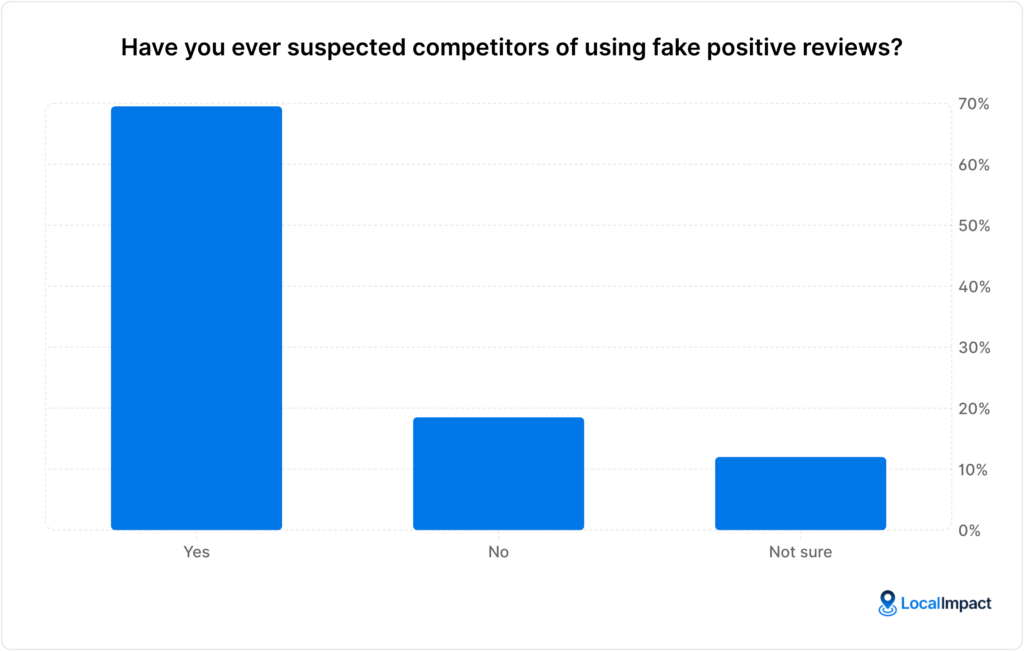
So the picture isn't a passive one. Owners describe a marketplace where fake reviews are being weaponized in two directions at once.
Some businesses are getting hit with coordinated negative campaigns. Others are competing against rivals they suspect are gaming their ratings upward. Either way, the assumption among owners is that fakery is intentional, frequent, and competitive.
How owners spot a fake
When owners flag a review as suspicious, what tips them off?
The most common signal is factual inaccuracy. 60% of owners say a review feels fake when it includes details that don't match the business: a service the business doesn't offer, a location that doesn't exist, a staff member who doesn't work there.
Other detection signals include:
- Verifying the reviewer was never actually a customer
- No prior review history on the reviewer's account
- Multiple suspiciously similar reviews appearing in a short window
- Suspected competitor involvement
- Platform flagging or auto-removal
The damage goes well beyond star ratings
About 3 in 4 owners say fake reviews have hurt their business in some way, with 11% reporting a significant negative impact and 28% reporting a moderate one.
The types of damage break into three buckets:
- Marketing damage: This is what most people expect. 52% report damage to their overall star rating. 33% report lost potential customers. 28% report reduced revenue.
- Operational drain: 40% report meaningful time spent managing or responding to fake reviews. That's hours pulled away from running the business. 17% have gone as far as consulting a lawyer about a fake review, and 27% have hired a third-party service to help manage the problem.
- Staff and HR impact: This one tends to get overlooked. 24% of owners say fake reviews have caused increased staff stress or morale issues, and 20% say they've made it harder to attract new hires. When a review accuses your team of something they didn't do, the people working on the floor read it. Recruits read it too.
Get ahead of the problem
LocalImpact lets you monitor reviews across 30+ platforms in one place and respond quickly with AI-powered replies.
Reporting a fake review works, but slowly
When owners report a fake review to the platform that hosts it, the system does technically function. It just doesn't function quickly. Only 28% of owners say their reported review was removed promptly.
About a third of reports get a fast resolution. The majority of owners are stuck waiting, getting refused, or operating in a gray zone where they can't tell if their report is being reviewed at all.
In the meantime, the fake review keeps doing its work. It sits on the profile, drags down the star average, and influences potential customers who never know it was disputed.
This lag is arguably the central problem. The damage from a fake review is immediate. The remedy isn't.
Most owners feel exposed
Despite the scale of the problem, most local businesses are still managing it with limited tools. Only 31% use a dedicated review management platform.
When asked how well-equipped they'd feel handling a sudden spike in fake negative reviews, only 36% said "very well-equipped." 17% admitted they aren't well-equipped or aren't equipped at all.
If you're managing reviews manually, a coordinated attack is hard to respond to in real time.
You're refreshing platforms by hand, drafting individual replies, and trying to document patterns from memory. By the time you've worked through a wave of fake reviews, the damage to your star rating has already been done.
Monitoring tools and response workflows shorten that gap, which is most of what "being equipped" actually means in practice.
What this means for local businesses in 2026
Fake reviews used to be an occasional annoyance. Based on the latest data, they've graduated into a category of operational risk that local businesses now have to manage actively, the same way you'd manage payroll fraud, inventory shrinkage, or any other recurring cost of doing business.
A few takeaways worth carrying forward:
- Assume it's going to happen: With 72% of owners reporting fake reviews in the past year and 79% believing they've been deliberately targeted at some point, planning for fake reviews is realistic, not paranoid.
- Build a response system before you need one: Setting up monitoring, alerting, and templated response workflows after an attack starts is much harder than setting it up in advance.
- Document everything: Detailed records of why a review is suspicious, including reviewer history, inaccurate claims, and timing patterns, give you a stronger case when you report.
- Pay attention to the staff impact: If your team is reading fake accusations about themselves, that's a workplace issue you can address, even when you can't get the review taken down right away.
The scale of the problem isn't going down. The tools and habits you build now are what determine how much damage a coordinated attack can actually do.
How LocalImpact can help
LocalImpact is an online reputation management platform that helps local businesses monitor, generate, and respond to reviews across 30+ platforms, including Google, Yelp, and Facebook.
You can use it to track new reviews, manage all reviews from one central location, and generate personalized responses quickly using AI.
Automated email and SMS review request campaigns help offset fake negative reviews by generating a steady flow of authentic ones from real customers. And the review widget lets you showcase your top customer reviews on your website, where they aren't subject to platform manipulation.
If fake reviews are part of your reality, having the right system in place can shorten response times, surface attacks earlier, and reduce the day-to-day cost of managing the problem.