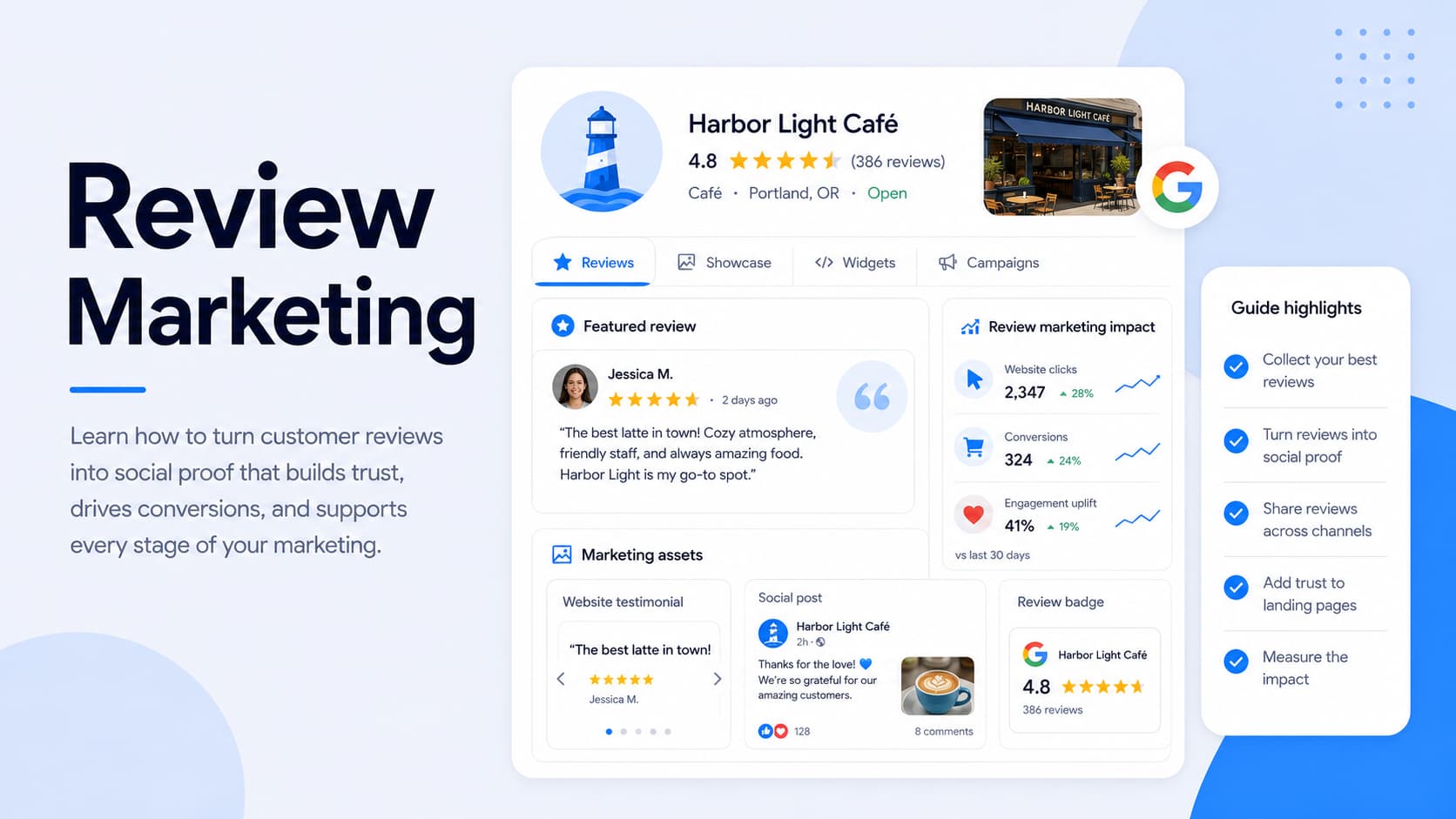
White label reputation management lets agencies sell review monitoring, review generation, and reputation services under their own brand, with a software provider powering the delivery behind the scenes. Clients see the agency's logo on every screen and report, while the platform handles the heavy lifting.
Demand for the service keeps growing. 86% of small business owners say online reviews are extremely or very important for attracting new customers, and most of them lack the time and tools to manage their reputation well.
In this guide, we'll cover how white label reputation management works, what a typical solution includes, how to pick a provider, and how to turn the service into a recurring revenue stream for your agency.
What is white label reputation management?
White label reputation management is a rebrandable solution that lets one company sell reputation management under its own name while another company provides the underlying technology or fulfillment.
Agencies buy access at wholesale rates, apply their own branding, and resell the service to clients at a price they set themselves.
The model comes in three forms:
- Software: A rebrandable platform the agency resells as its own product. Clients log into a dashboard carrying the agency's logo and domain, then handle monitoring and responses themselves.
- Services: Fulfillment work like review responses and monitoring performed by the provider's team under the agency's brand. The agency owns the client relationship while specialists handle the daily work.
- Combined: The agency resells the platform and layers its own managed service on top. This setup produces the strongest margins because the software automates most of the delivery.
Most agencies land on the combined model. The platform does the repetitive work, and the agency's account managers add oversight, strategy, and reporting.
Offer reputation management under your own brand
Use our white label reputation management solution to help clients collect reviews, monitor feedback, and build trust in one place.
How white label reputation management works
The mechanics are straightforward. An agency signs up with a white label provider, pays a wholesale rate per client or location, and configures the platform with its own logo, domain, and branding.
From there, the agency packages the service, sets retail pricing, and sells it under its own name. Everything above the wholesale cost and the team's oversight hours is margin.
Clients experience the whole thing as the agency's product. They log into a branded dashboard, receive branded reports, and interact with the agency's team, while the provider's infrastructure runs review requests, monitoring, and AI-drafted responses in the background.
Why agencies offer white label reputation management
We've covered the full business case in our guide to why agencies should offer reputation management services, but the short version comes down to four points:
- Consumers rely on reviews to choose businesses. 92% of consumers have read an online review in the past year, and 78% won't consider a business rated below 4 stars. Every local business your agency serves is being judged on its review profile.
- Business owners want to hand the work off. In 51% of businesses, the owner personally manages reviews across platforms. A pitch built on time savings lands with most of your client roster.
- The budget line already exists. 78% of businesses already use tools or software to manage reviews. Your offer upgrades a DIY tool expense into a managed service with expertise attached.
- Fake reviews are pushing owners to seek help. 1 in 4 local business owners have hired a third-party service to help manage fake reviews. Businesses are paying for outside reputation help right now.
What's included in a white label reputation management solution
The exact feature set varies by provider, but a complete solution covers five components:
- Review monitoring. The platform tracks new reviews across Google, Yelp, Facebook, and industry-specific sites, then alerts the right person when one lands. Broad coverage matters because 55% of businesses monitor only 2 to 3 platforms and miss feedback everywhere else.
- Review generation. Automated SMS and email campaigns request reviews from customers after a job or purchase, with follow-ups for anyone who doesn't respond. Review count growth is the most visible result the service produces, which makes this component the core of the offer.
- Review response. The platform centralizes replies across platforms and drafts them with AI, so response times stay short. Speed matters here because 70% of consumers expect a business to reply within 1 to 3 days.
- Reporting and benchmarking. Branded reports show clients their review growth, rating trends, response activity, and standing against local competitors. Reporting is what proves the retainer's value month after month.
When you scope your own service, decide which of these components each pricing tier includes. A written scope keeps delivery consistent and makes the offer easy to pitch.
How to choose a white label reputation management provider
The provider you pick shapes your margins, your workflow, and how professional the service looks to clients. Evaluate options against these criteria:
- White labeling depth. The dashboard should carry your logo, favicon, and custom domain with no vendor branding visible anywhere. Clients should experience the platform as your product from login to report.
- Multi-client management. You need to run every client and location from one account. Juggling separate logins per client stops scaling past your first handful of accounts.
- Review site coverage. The platform should pull reviews from the major platforms plus the vertical-specific sites your clients' customers actually use. Gaps in coverage become gaps in your service.
- Client-ready reporting. Reports should be brandable, easy to share, and simple enough for clients to understand at a glance. Competitor benchmarks make them considerably more compelling.
- Compliance practices. The provider's review generation workflows should follow platform policies and federal rules on review solicitation. A provider that cuts corners here puts your agency's name at risk.
- Support and pricing. You'll want responsive human support and pricing that leaves room for healthy margins at your planned retail rates. Watch for forced contracts or minimums that don't fit your client volume.
How to add white label reputation management to your agency
We've published a full walkthrough on how to add reputation management to your agency's service lineup, but here’s the short version:
- Define your scope. Decide exactly what clients get across monitoring, generation, response, and reporting, then write it down as a one-page service description. You'll reuse it in proposals, onboarding, and your pricing page.
- Price per location. A per-location retainer is the simplest model for clients to understand, and it grows automatically when a client opens a second office. Split tiers by service depth, from monitoring-only up to managed responses with quarterly strategy calls.
- Document your delivery workflow. Build an onboarding checklist, set a weekly oversight workflow for account managers, and define an escalation path for negative and fake reviews. Fast documentation matters because only 28% of reported fake reviews get removed promptly.
- Sell to existing clients first. Anyone who's complained about a bad review or has a thin Google profile is a warm lead. Open with a free reputation report, since their own data does most of the selling for you.
Aim for three to five pilot clients in the first month. Their before-and-after numbers become the case studies that power your future sales conversations.
Offer reputation management under your own brand
Use our white label reputation management solution to help clients collect reviews, monitor feedback, and build trust in one place.
Compliance and risk: what agencies need to know
FTC rules on reviews
The FTC's rule on consumer reviews and testimonials took effect in October 2024.
It prohibits creating or selling fake reviews, paying for reviews that express a particular sentiment, publishing undisclosed insider reviews from employees or their relatives, and suppressing negative reviews through intimidation or selective display.
Violations carry civil penalties that can run into the tens of thousands of dollars per violation, and the FTC started sending warning letters to companies under the rule in late 2025. Enforcement risk applies to the businesses you serve and to the parties assisting them, which includes agencies.
For your clients, the threat runs in both directions. 72% of local business owners received at least one fake review in the past year, and 79% believe they've been targeted by a coordinated attack, so your clients are more likely to be victims of fake reviews than perpetrators.
Your monitoring and documentation workflows are part of their protection.
Platform review policies
Google prohibits review gating, meaning you can't discourage negative reviews or selectively solicit positive ones. Every customer needs the same opportunity to leave a public review, regardless of how happy they seem.
Incentives are off the table too. Offering discounts, gifts, or payment in exchange for reviews violates Google's policies and can lead to review removal or profile suspension, which would land on your client's most valuable marketing asset.
A few practical rules keep your service compliant:
- Send review requests to every customer. Automated campaigns that go out after every job satisfy this requirement by default. Filtering requests by expected sentiment counts as gating.
- Keep feedback funnels honest. Funnels stay compliant when every customer keeps the option to post publicly. Routing unhappy customers away from public review pages crosses the line.
- Never draft or seed reviews. Your team responds to reviews and requests them from real customers, and that's where the involvement ends. Writing reviews on a client's behalf violates both FTC rules and platform policies.
- Document suspicious reviews before reporting. Reviewer history, factual inaccuracies, and timing patterns strengthen removal requests. Detailed records also protect your client if a dispute escalates.
Vet your provider's compliance practices during selection, because their workflows execute under your brand.
Reporting and proving value to clients
Reporting is where the retainer earns its renewal. Each monthly report should cover four numbers:
- Review growth. New reviews per platform against the pre-launch baseline. This figure is the clearest proof the service works, and clients can verify it themselves on Google.
- Rating trends. Average star rating over time across the platforms you monitor. Even small climbs matter when 78% of consumers filter out businesses below 4 stars.
- Response rate and speed. The share of reviews answered and the average time to reply. These metrics show the service's quality dimension beyond raw volume.
- Competitor benchmarks. Where the client stands against two or three named local competitors on review count and rating. Nothing motivates a renewal like a rival pulling ahead.
There's also a positioning angle here. Only 30% of small businesses track reviews as a marketing success metric, so your reporting gives clients a data point most of their competitors never look at.
Frequently asked questions
What is white label reputation management?
White label reputation management is a rebrandable software or service solution that lets agencies sell reputation management under their own name. A provider supplies the platform and infrastructure, while the agency handles branding, pricing, and the client relationship.
How does white label reputation management work?
An agency purchases platform access at wholesale rates, applies its own logo and domain, and resells the service at prices it sets. Clients interact with the agency's brand while the provider's technology runs review requests, monitoring, and response tools in the background.
What's the difference between white label software and white label services?
Software gives the agency a rebrandable platform its team or clients operate directly. Services add fulfillment, where the provider's specialists handle review responses and monitoring under the agency's brand. Many agencies start with software and layer managed services on top as they grow.
Who should use white label reputation management?
The model fits marketing agencies, SEO firms, web design shops, and consultants that serve local businesses and want to add a recurring service without building technology in-house. It works especially well for agencies whose clients already ask about reviews.
Does reputation management improve local SEO?
Review signals influence local rankings, and star ratings affect click-through on both organic and paid results. Consistent review growth, fast responses, and accurate listings all support a business's visibility in local search.
Start offering white label reputation management with LocalImpact
LocalImpact's white label reputation management software gives agencies a fully branded platform for delivering the service at scale. You customize the dashboard with your own logo, favicon, and domain, and clients see it as your product with no LocalImpact branding anywhere.
Everything runs from a single account. You manage every client and location from one dashboard, with role-based access that lets you invite team members and clients while controlling exactly what each of them sees.
The platform automates the delivery layer for you:
- Automated review generation. Personalized SMS and email review requests go out after jobs or appointments, with automated follow-ups for customers who don't respond. QR codes and staff review links cover in-person touchpoints too.
- AI-powered review replies. The AI response assistant drafts personalized replies in seconds and can automatically respond to positive Google reviews on your behalf. Custom instructions keep every reply consistent with each client's brand voice.
- Review monitoring in one inbox. Reviews from Google, Facebook, Yelp, and other platforms flow into one place, so nothing slips past your team. 30+ platforms are supported.
- Client reporting and benchmarks. Track review growth, rating trends, and response activity for every client, with competitor comparison reports built in. Branded reputation score reports double as sales collateral for prospecting.
- Review widgets and social sharing. Help clients showcase their best reviews on their websites and turn them into branded social posts. Both features give your retainer visible deliverables beyond the review platforms themselves.
LocalImpact also connects with tools your clients already use, including Jobber, Housecall Pro, QuickBooks, HubSpot, and Mailchimp, so review requests trigger automatically from their existing workflows.
You can start a 14-day free trial with no credit card required and have your first client onboarded this week.