Most people who need a lawyer aren't browsing. They're under pressure, moving fast, and making a decision based on a handful of signals, most of which have nothing to do with how good you are in a courtroom.
To understand how legal consumers actually choose a law firm in 2026, we surveyed 1,068 U.S. adults who hired a lawyer within the past three years.
Every respondent went through the full process: from searching to contacting to hiring.
What emerged is a picture of a decision that's faster, narrower, and more ruthless than most firms realize.
About this study: This survey was conducted in March 2026 through Pollfish, an independent research platform. All 1,068 respondents were screened to confirm they had hired a lawyer within the past three years.
The survey covered how they found, evaluated, and contacted law firms. Responses were collected from a nationally distributed U.S. sample.
Key takeaways
- Most people research only two to three firms before making a decision, and nearly one in five look at just one.
- Google Search is the top discovery channel (36%), followed closely by personal referrals (33%). AI search tools like ChatGPT and Gemini already account for nearly 10% of first-contact discovery.
- The two biggest dealbreakers are slow or no response to inquiries and poor online reviews.
- Nearly half of respondents would hesitate to contact a firm rated below 4.0 stars.
- Most people read between three and ten reviews before deciding whether to reach out. They prioritize detailed client experience descriptions over star ratings.
- Over three-quarters of respondents say a thoughtful response to a negative review increases their trust in the firm.
- 72% of potential clients expect a response within the same business day.
The shortlist is shorter than you think
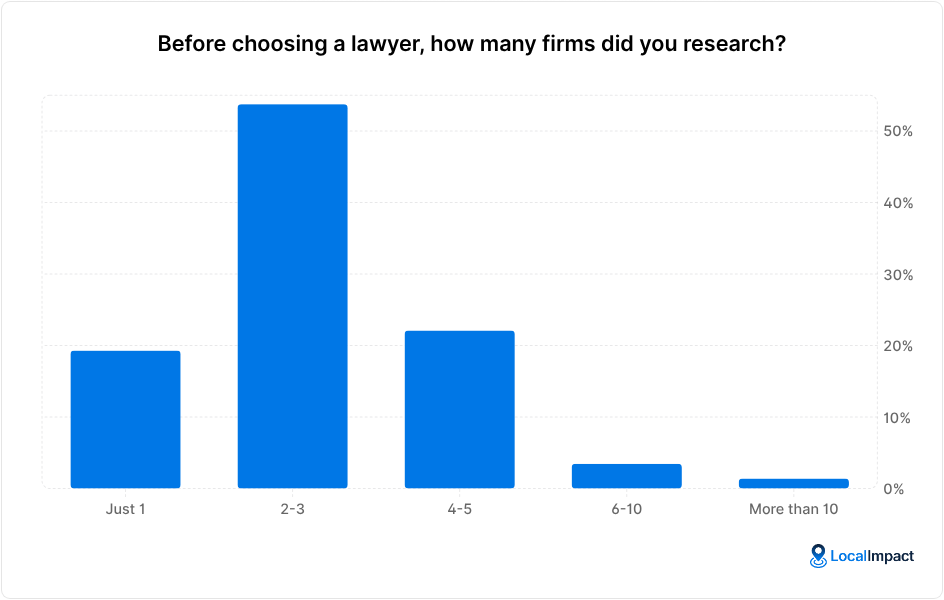
More than half of respondents (54%) said they researched only two to three law firms before choosing one. Another 19% looked at just one. Fewer than 5% considered six or more.
This is a small window. For most firms, the entire competition for a new client happens within a set of two or three options. Getting into that set matters enormously, and getting eliminated from it happens quickly.
Google Search remains the dominant entry point. 36% of respondents said it was how they first found the firm they ended up contacting. Personal referrals from friends, family, or other lawyers accounted for another 33%.
AI search tools like ChatGPT and Gemini came in at 9%, already ahead of legal directories (6%), social media (3%), and online ads (2%).
When asked where they go first to research lawyers online, the numbers reinforce Google's dominance: 50% start with Google Search results, followed by law firm websites (16%) and legal directories (9%).
The two fastest ways to lose a potential client
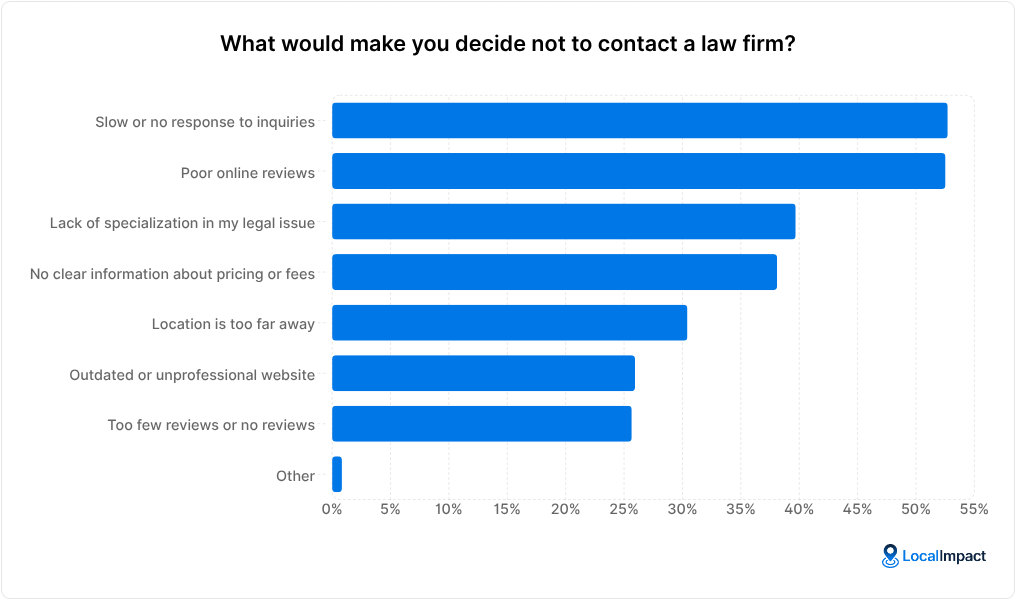
Once someone has a short list of two or three firms, the elimination process is swift. We asked respondents what would make them decide not to contact a law firm, and two factors rose well above the rest.
Slow or no response to inquiries
This was the single most-selected dealbreaker, cited by 52% of respondents. The expectations around speed back this up: nearly three-quarters of respondents expect to hear back within the same business day, and about 15% expect a response within an hour.
This carries extra weight when you consider that 60% of respondents made their first contact with a firm by phone. A missed call with a next-morning callback may already be too late. The client has two other firms on their list and limited patience.
Poor online reviews
Poor online reviews were cited by 52% as a reason to avoid a firm entirely. And the bar is high: nearly half of respondents said they'd hesitate to contact any firm rated below 4.0 stars.
Having too few reviews or no reviews at all was a separate dealbreaker for about a quarter of respondents. In other words, a thin review profile can be almost as damaging as a bad one.
How people actually read law firm reviews
The majority of people (63%) read somewhere between three and ten reviews before deciding whether to reach out to a firm. A significant portion read even more than that.
Very few people skim just one or two, and only about 5% skip reviews entirely.
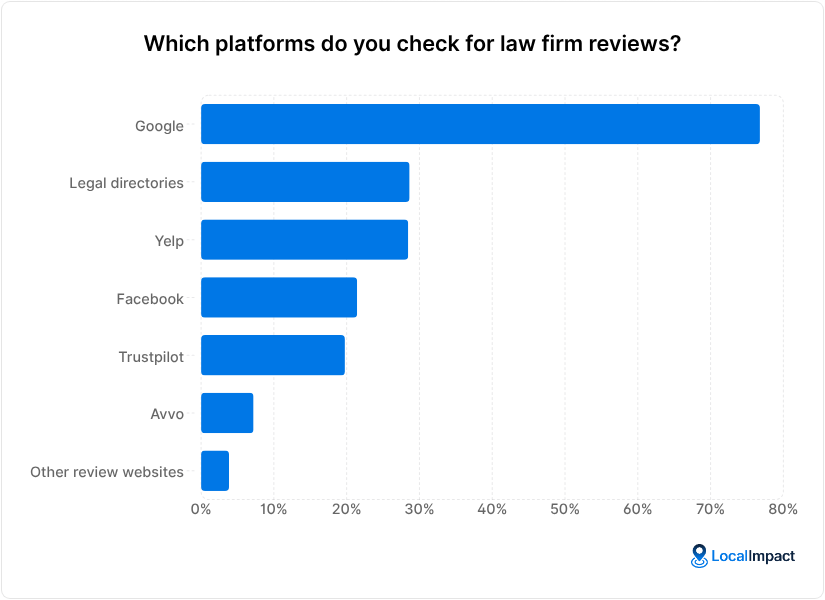
Where they read them is equally clear. Google is the dominant review platform by a wide margin: 76% of respondents check Google reviews.
Legal directories like FindLaw and Martindale came in second at 28%, followed closely by Yelp (28%), Facebook (21%), and Trustpilot (19%).
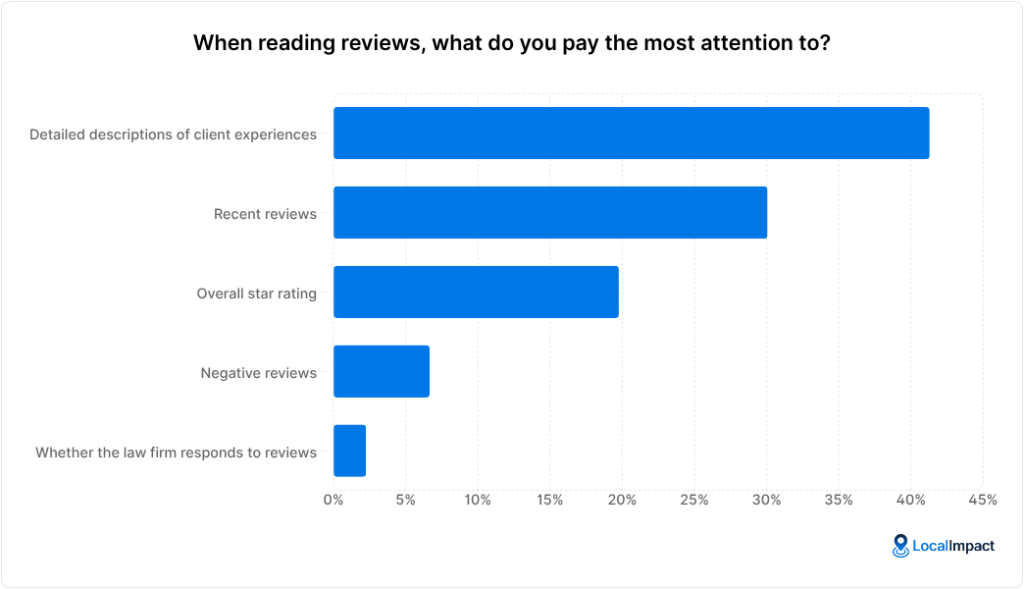
What's worth paying attention to is what people focus on when reading reviews. The most common answer was detailed descriptions of other clients' experiences. Recency of reviews came second.
The overall star rating, which many firms focus on as the headline metric, actually ranked third. People want the story behind the stars.
One of the clearest signals in the data: over three-quarters of respondents said that when a law firm responds thoughtfully to a negative review, it increases their trust. Only 6% said it had the opposite effect.
This is a meaningful finding for firms that treat negative reviews as purely damaging. A considered, professional response can actually strengthen a firm's reputation in the eyes of prospective clients who are reading through the full review profile.
Improve your law firm's online reputation
Manage and improve your law firm's online reputation with LocalImpact.
What ultimately triggers the call
When we asked what makes someone decide to reach out to a specific firm, the top three answers were:
- A recommendation from someone they trust (28%)
- The lawyer's experience or credentials (23%)
- Strong online reviews (19%)
Transparent pricing, free consultation offers, and a professional website trailed behind.
The pattern here is consistent with the rest of the data. Trust signals carry the decision.
Reviews, credentials, and personal endorsements account for over 70% of what drives someone to make that first call.
What this means for law firms
The path from "I need a lawyer" to "I'm calling this one" is short, fast, and heavily filtered. Most people consider a handful of firms, spend real time reading reviews, and expect a fast response once they reach out.
The firms that win this process are the ones that show up when someone searches, maintain a strong and current review profile, and respond to inquiries quickly.
The firms that lose it often never know they were even in the running.
How LocalImpact can help
LocalImpact is an online reputation management platform that allows you to monitor, generate, and showcase online reviews for your law firm.
You can use it to read and reply to all the reviews your law firm gets across 30+ platforms, including Google, Yelp, and Avvo.
It supports automated email and SMS review request campaigns, allowing you to generate reviews on autopilot.
LocalImpact also offers a review widget you can use to showcase your top client reviews on your website.