
Picking the right reputation management software for a senior care business is a high-stakes call, since families researching assisted living, home health, or memory care often spend weeks reading reviews before they ever pick up the phone.
We've put in 150+ hours testing the leading platforms across review collection, response workflows, multi-location reporting, and the kinds of integrations that matter for senior care operators.
Below are the six tools that earned a spot, what each does best, and what real users say about them.
Best senior care reputation management software at a glance
No time to read through the full article? Here’s a quick overview.
| Software | Starting price | Free trial available? |
| LocalImpact | $19/month | Yes |
| Broadly | $799/month | No |
| NiceJob | $75/month | Yes |
| Reviewshake | $29/month | Yes |
| Birdeye | Custom pricing | No |
| ReviewTrackers | $89/location/month | No |
How we chose these tools
We spent over 150 hours getting hands-on with the leading reputation management platforms, signing up for trials, sending real review invites, and putting the response workflows through their paces. Here's what we evaluated:
- Review generation: How easily the platform sends automated review invites by email and SMS, and how well follow-up sequences keep response rates up.
- Platform coverage: Whether the tool pulls reviews from the sources senior care families actually use, including Google, Facebook, Caring.com, A Place for Mom, and Yelp.
- Response workflows: The speed and quality of reply tools, including AI-assisted drafting and shared inbox features for teams.
- Reporting and analytics: How clearly the dashboard surfaces ratings, sentiment, and trends across single or multiple locations.
- Ease of setup and use: Whether a non-technical office manager can get the platform running without outside help.
1. LocalImpact
LocalImpact is a reputation management platform built for local service businesses, with a feature set that fits senior care operators running anything from a single assisted living community to a multi-location home care network.
The platform automates review requests by SMS and email, generates AI-powered replies to incoming reviews, and embeds a customizable review widget on your website.
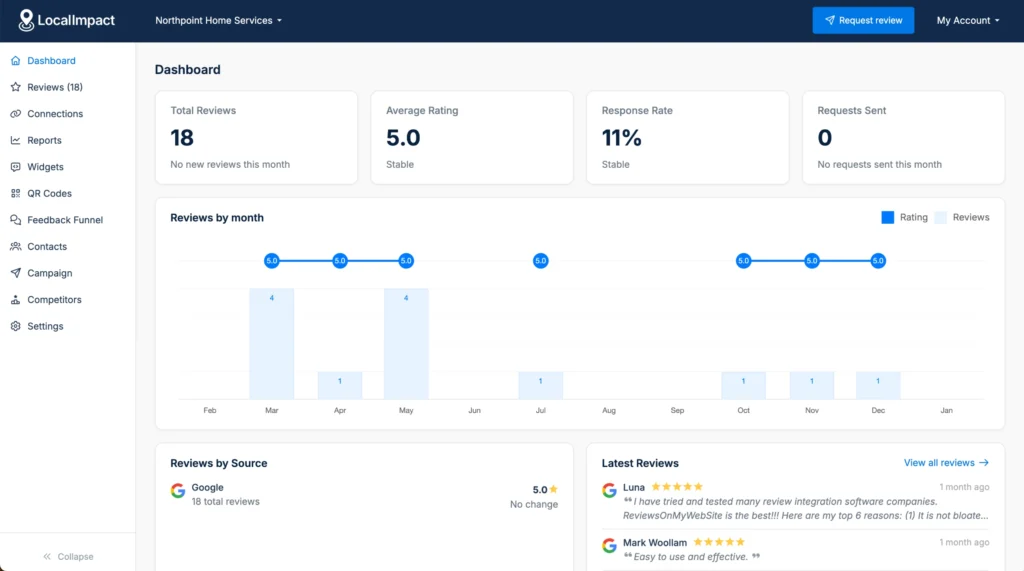
Reviews from 36+ platforms flow into a single dashboard. AI handles first-draft replies, and review widgets, social sharing posts, and a white-label tools are all built into the core platform.
Key features
- Automated review requests: Sends personalized SMS and email review invites with automated follow-ups that re-engage customers who didn't respond the first time.
- AI review reply assistant: Generates context-aware response drafts based on each review's sentiment, with one-click controls to adjust tone, length, and clarity before publishing.
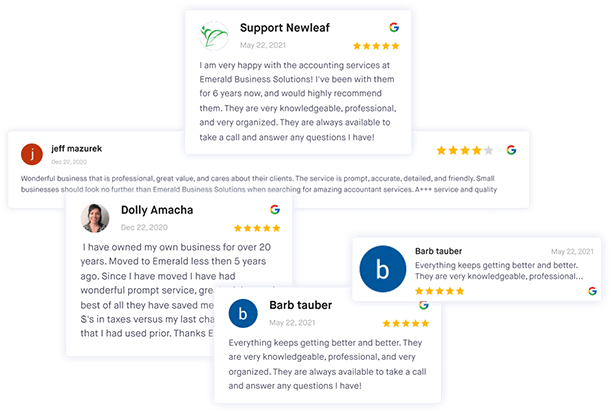
- Review widgets: Embeds reviews on your site with code-free copy-and-paste widgets in eight layouts including list, slider, carousel, grid, masonry, and rating badges.
- Social sharing: Turns customer reviews into branded social media graphics with customizable templates so you can publish polished posts without design tools.
- Feedback funnels: Routes happy customers to public review platforms while capturing private feedback from unhappy ones, giving you a chance to resolve issues before they go public.
- White label: Rebrands the entire dashboard with your own logo, favicon, and domain so agencies can sell reputation management services.
What users say
Users consistently call out how easy LocalImpact is to set up and how responsive the support team is.
"The platform is extremely easy to set up and integrate with my existing website. The dashboard is simple to navigate, and the automation tools save me time collecting and displaying reviews.
Customer support is quick to respond and always helpful.
I like how the features are well thought out, making it easy to maintain a professional online presence without technical headaches."
Pricing
LocalImpact offers a 14-day free trial with no credit card required.
Paid plans include:
- Growth ($49/month)
- Pro ($99/month)
- Agency ($149/month)
Manage your online reputation with ease
Monitor, manage, and get more online reviews for your business with LocalImpact.
2. Broadly
Broadly has evolved from a review request tool into a broader AI Workforce platform that covers reputation, web chat, local SEO, social media, and a self-updating CRM.
The AI Reputation Specialist drafts on-brand replies to incoming reviews, while the AI-assisted Web Chat widget captures website visitor information and continues conversations over SMS.
The consolidated workflow is where Broadly differentiates.
Inquiries from web chat, Facebook, Instagram, and website forms land in one inbox alongside review activity, which fits the reality of family members reaching out across many channels at odd hours when researching care options.
Key features
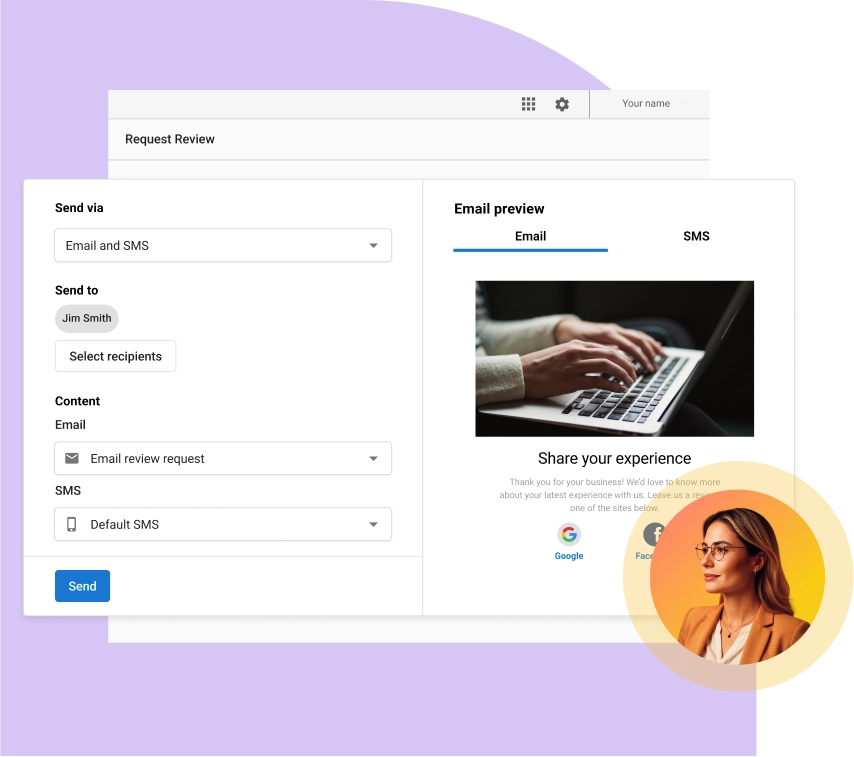
- AI Reputation Specialist: Automatically requests reviews after a job or visit by text and email, then drafts on-brand AI replies that match the tone of each piece of feedback.
- AI-assisted Web Chat: Engages website visitors with a preconfigured AI that knows your business, captures contact info, and continues conversations over SMS.
- Consolidated inbox: Unifies messages from Google, Facebook, Instagram, web chat, and website contact forms into a single shared workspace.
- Local SEO and listings: Keeps business information consistent across 40+ directories including Google, Facebook, Yelp, Apple Maps, and voice assistants like Siri and Alexa.
- NPS and feedback surveys: Collects quick post-interaction sentiment so you can spot at-risk customers before issues turn into public reviews.
- CRM AI: Auto-updates contact and opportunity records based on meeting recordings and sales activity, with built-in coaching for sales teams.
Pros & cons
Pros
- Bundles reviews with web chat, CRM, and local SEO so smaller operators don't need to stitch tools together
- Pre-built integrations with QuickBooks, Jobber, ServiceTitan, Clio, and other operator-facing systems work well out of the box
- AI-drafted review replies adapt to review sentiment without needing prompt tuning
Cons
- Some users report friction with contract terms and cancellation processes
- Many features are gated behind higher tiers, which can compound monthly cost as you add capabilities
What we like
The "not recommended" workflow is a clever touch. When a customer signals dissatisfaction in their feedback, Broadly routes them to a private channel rather than a public review form, giving operators a real chance to fix problems before they become Google reviews.
What users say
Users consistently mention how hands-off Broadly feels once it's set up and how reliably it brings in reviews.
"Broadly has saved me hours of time by completely automating the client review process. Setting up custom forms and following up with clients was very time consuming. Once we signed up with Broadly our reviews skyrocketed and all we had to do was watch them roll in."
One recurring piece of feedback centers on customer service responsiveness over time.
"I think their customer service is horrendous. It's impossible to get support from them. We've been using Broadly for years, and they have gone downhill."
Pricing
Broadly is priced at $799/month.
3. NiceJob
NiceJob is a reputation marketing platform built around the idea that the best moment to ask for a review is right when a job wraps up in your CRM.
Review invites fire automatically the moment a visit is marked complete, with one SMS and a three-email follow-up sequence that's already been tuned for performance.
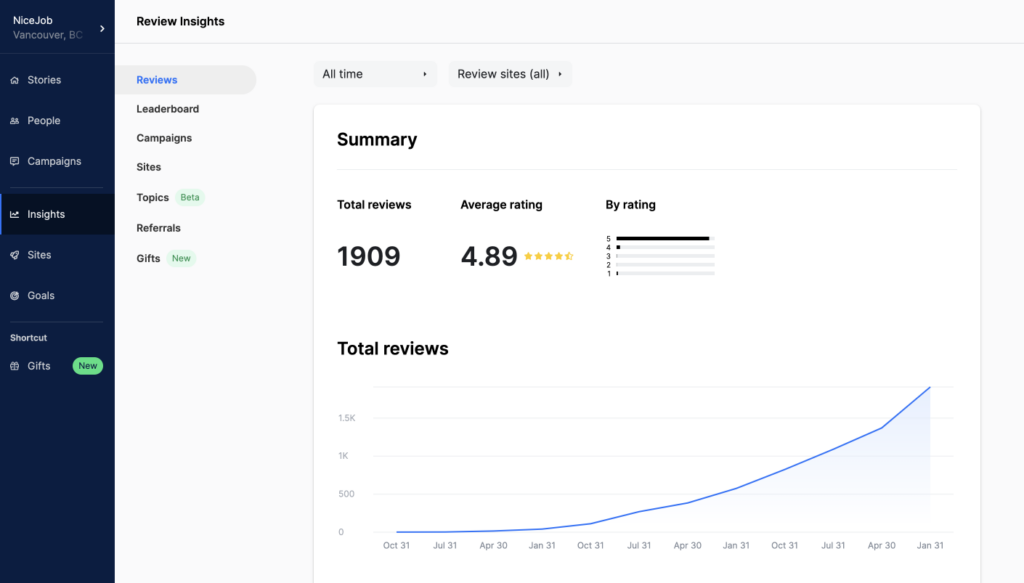
The trigger-based workflow is the strongest part of the product.
AI Replies auto-responds to incoming feedback with customizable tone and rules, while the social proof widgets and microsite handle the display side, so the full review lifecycle runs without manual intervention once the CRM is connected.
Key features
- Automated review campaigns: Sends a pre-built SMS-and-email review request sequence the moment a job is marked complete in your connected CRM.
- AI Replies: Auto-responds to incoming reviews with customizable tone, voice, and length settings, plus rules like only auto-reply to 3-star-and-up reviews.
- Social Proof widgets: Embeds review widgets, trust badges, and a hosted microsite that displays your reviews across the web.
- Social Sharing: Auto-posts your best reviews to Facebook, Instagram, and other channels, generating posts NiceJob says drive up to 3x more engagement than text-only updates.
- Insights and competitor tracking: Tracks review volume, ratings, sentiment, and per-team-member performance, and benchmarks your competitors on the Pro plan.
- Get Repeats: Re-engages past customers with reminders to book again, which fits home care's recurring service model well.
Pros & cons
Pros
- Sends invites to the on-site contact rather than the billing contact, which lifts the quality and detail of reviews
- AI Replies includes useful guardrails like minimum star rating rules so high-touch negative reviews still get a human response
Cons
- Widget styling is functional but limited, with users wanting more control over font, color, and the number of reviews displayed
- Native integrations are concentrated in home services and field service CRMs, so other senior care tech stacks may need Zapier
What we like
NiceJob's Get Repeats feature is an unusual addition that goes beyond review collection. It re-engages past customers with reminders to book again, which turns the same platform you're using to manage reviews into a soft lead-nurture channel for repeat business.
What users say
Users consistently call out how hands-off the automation feels once it's connected to a CRM.
"I really like the automation in NiceJob. It's synced with our CRM and is pretty much hands-off. Review invites are sent out automatically when a work order is completed in our CRM, which is great.
The invites go out first by text and then by email, and this sequence is customizable too. I especially appreciate how it sends invites to the onsite contact of the job, who directly interacts with our service team."
The most common piece of constructive feedback is around website widget customization.
"I don't like the widgets and aspects that interact with the website to show reviews. I'd like more customization in terms of the number of reviews displayed, style, font, color, etc. We want it to fit our website exactly, and that wasn't possible."
Pricing
NiceJob offers a 14-day free trial that does not require a credit card.
Paid plans include:
- Reviews ($75/month)
- Pro ($125/month)
- Sites add-on ($99/month + $199 setup fee)
4. Reviewshake
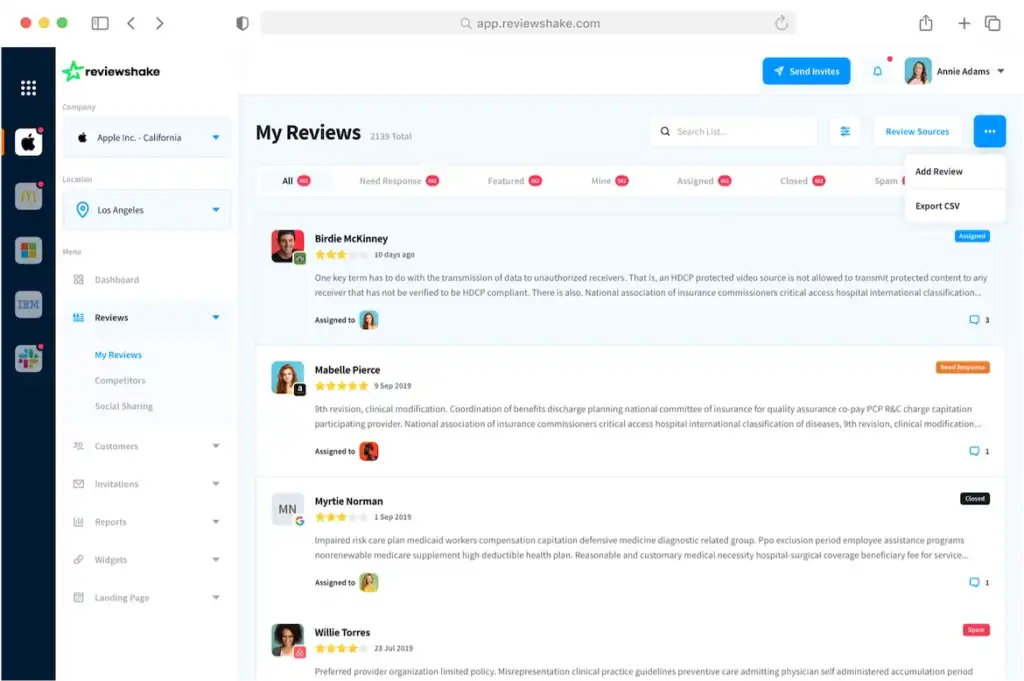
Reviewshake is a reputation management platform built around the idea that monitoring reviews from one dashboard is more valuable than juggling tabs across dozens of sites.
SMS and email review campaigns run with QR code fallbacks, AI reply suggestions draft on-brand responses across locations, and sentiment analysis surfaces trends in what customers are actually saying.
Key features
- Multi-channel review campaigns: Sends review invites by SMS, email, and QR codes with smart timing rules and automated follow-up reminders that Reviewshake says double conversion rates.
- AI-powered reply suggestions: Drafts on-brand responses for every review with adjustable tone and language, so multi-location teams can keep messaging consistent.
- Sentiment analysis and trend reporting: Uses AI to surface what customers love and where issues are emerging, with keyword and tone detection across every review.
- Location benchmarking: Compares average ratings, response times, and review trends across branches, regions, or clients side by side.
- White-label platform: Lets agencies rebrand the entire platform under their own identity to resell reputation management as a service.
Pros & cons
Pros
- Location benchmarking surfaces underperforming branches at a glance rather than requiring custom reports
- White-label option is genuinely deep, with full agency rebranding for resellers
- A/B testing on email and SMS subject lines is uncommon at this price point
Cons
- Widget customization options are more limited than newer review display tools
- Some users have noted reliance on Zapier for CRM integrations rather than native connections
What we like
The Google Business Profile highlights feature is a small but useful detail. It pins your strongest reviews directly to your Google Business Profile, which is exactly where families researching senior care communities make their first impression.
Reviewshake is one of the few platforms that supports this pin-and-highlight workflow natively.
What users say
Customers consistently call out the platform's flexibility and the value its agency tier delivers.
"We started using ReviewShake around 3 years ago to replace our old provider, Grade US. We wanted a solution that was more cost-effective with all the same features. ReviewShake gave us this and more.
The feature I like the most is the white labeling. We have now rebranded the platform as our own and a specialized solution to the niche that we serve."
One recurring piece of feedback centers on widget formatting and integration limitations.
"Some downsides would include: The need to use zapier instead of having internal integration functionality to bring customer data in without the need for additional software.
The other downside would be the limited options of landing page customization regarding the review buttons."
Pricing
Reviewshake offers a free trial you can use to test out the software. Paid plans include:
- Starter ($29/month)
- Growth ($59/month)
- Ultimate ($99/month)
Manage your online reputation with ease
Monitor, manage, and get more online reviews for your business with LocalImpact.
5. Birdeye
Birdeye is an agentic marketing platform built specifically for multi-location brands, with AI agents that handle review responses, social publishing, listings updates, and customer insights at scale.
The multi-location review dashboard, a Review Response Agent that can be configured with brand voice and location-level rules, and Insights AI for sentiment scoring across portfolios all come together in one workspace.
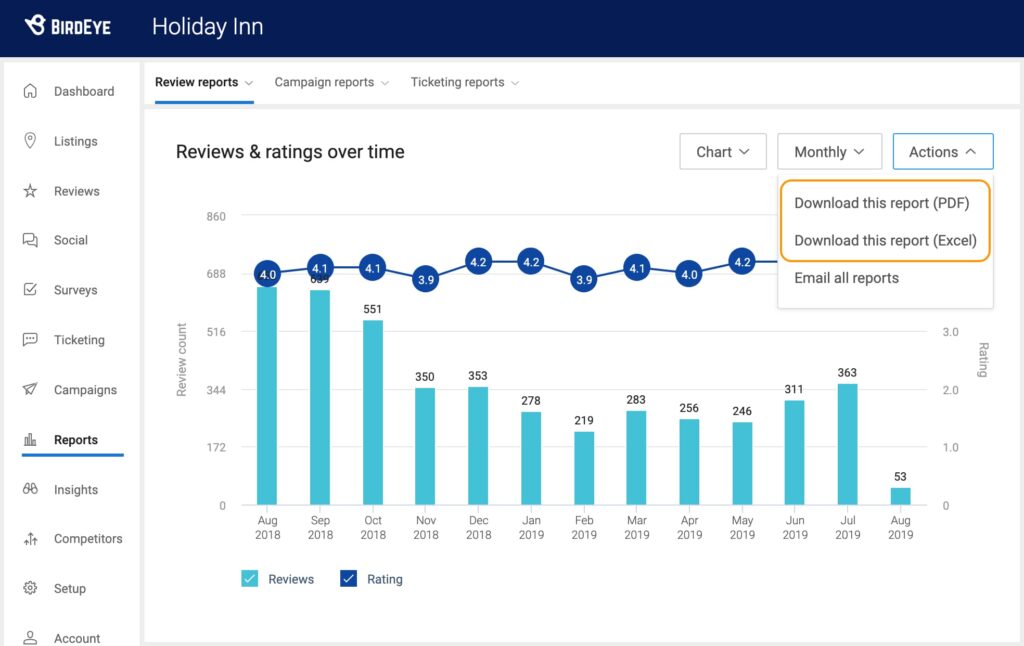
The depth of multi-location infrastructure is where Birdeye separates itself.
Role-based access, tiered approvals, location-level reporting, and HIPAA compliance are built in from the ground up rather than bolted on as enterprise add-ons, which matters for senior living groups operating assisted living, memory care, and skilled nursing under one corporate umbrella.
Key features
- Review Response Agent: Drafts on-brand replies that interpret sentiment, urgency, and even images in reviews, with configurable tone and per-location rules.
- Review Generation Agent: Runs A/B tests across subject lines, templates, sites, and channels to optimize when and where to request reviews.
- Listings AI: Syncs business information across 50+ directories so customers always see accurate hours, addresses, and details for every location.
- Insights AI and Birdeye Score: Combines review, survey, and listing data into sentiment, reputation, and listing scores with location and industry benchmarking.
- Social AI: Creates and schedules location-relevant social posts across Facebook, Instagram, Google Business Profile, and LinkedIn from one workspace.
- Search AI: Tracks how your brand shows up across AI platforms like ChatGPT and Perplexity, then surfaces actions to improve visibility.
Pros & cons
Pros
- Built from the ground up for multi-location complexity, with location-level dashboards and corporate rollups out of the box
- BirdAI is included across plans rather than gated behind premium add-ons
- HIPAA, SOC 2, and GDPR compliance support healthcare-adjacent environments
Cons
- Pricing scales aggressively with location count and isn't published publicly, often requiring a sales conversation
- Some users report a learning curve when navigating the broader feature set across many tools
- Advanced features like surveys, insights, benchmarking, and ticketing can be gated behind higher tiers
- Onboarding typically requires a paid implementation engagement to dial in workflows across many locations
What we like
The Review Response Agent's ability to analyze photos attached to reviews is a useful detail for senior living.
Families sometimes attach photos of common areas, room conditions, or activities when leaving feedback, and an AI agent that can interpret those images alongside the review text generates more relevant replies than one working from text alone.
What users say
Customers consistently call out how Birdeye scales across many locations without losing visibility.
"What I like best about Birdeye is how it brings everything into one place and actually drives results without adding more work.
The automation is the biggest win. Reviews get sent out consistently after move ins and move outs, follow ups happen automatically, and it keeps our locations generating steady feedback without relying on staff to remember."
A recurring piece of feedback centers on pricing relative to smaller operators.
"With each new tool comes a heavy price request. We've been customers for 6 years now and there was no cooperation or meeting in the middle when it came to pricing for a tool that we had interest in."
Pricing
Birdeye doesn’t share its pricing publicly. You’ll need to reach out to the company’s sales team to get a quote.
6. ReviewTrackers
ReviewTrackers is an enterprise reputation management platform built around the idea that reviews are an underused source of customer experience data.
Review sources from major directories funnel into one workspace, AI-generated and Smart Response templates handle replies at scale, and a Natural Language Processing engine surfaces sentiment and trending topics across feedback.
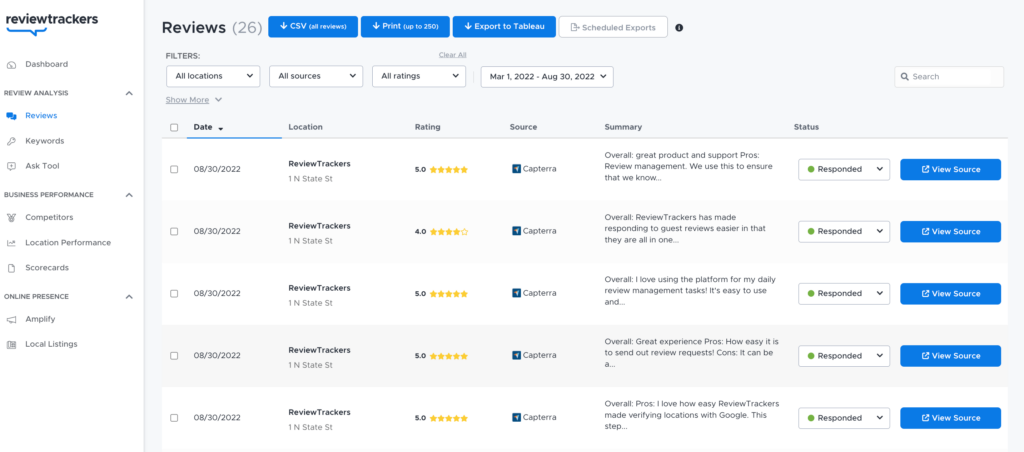
The platform leans heavily into the analytics side of the category.
Competitor benchmarking, location-level scorecards, and structured reporting fit the kind of monthly business reviews executive teams actually run, which makes it a fit for senior care brands managing many locations across assisted living, memory care, or home health.
Key features
- Multi-source review aggregation: Pulls reviews from the top directories that drive revenue into one dashboard with filters for responded versus unresponded feedback.
- AI-generated and Smart Response templates: Combines AI replies with personalized rule-based templates that auto-respond while staying on brand across locations.
- Natural Language Processing engine: Automatically categorizes feedback into themes and surfaces sentiment trends across keywords and phrases at scale.
- Competitor analysis: Benchmarks your review volume, ratings, and sentiment against direct competitors at the local and regional level.
- Local listing management: Keeps business information accurate across directories to support local SEO and ensure families can find current contact details.
- Review widget (Amplify): Displays customer reviews on your website with schema markup to support visibility in local search results.
Pros & cons
Pros
- Natural Language Processing engine is one of the strongest analytics layers in the reputation management category
- Per-location pricing model with a published $89 starting point makes budgeting more predictable than fully custom-quote competitors
- Crisis control and compliance monitoring workflows fit healthcare-adjacent operators that need to escalate issues internally
Cons
- Some review sites like Yelp and TripAdvisor don't support direct response from inside the platform
- Disconnections between ReviewTrackers and source platforms aren't always proactively flagged to users
- Notification timing on certain platforms can lag behind real-time
What we like
The crisis control workflow is the standout for senior care.
ReviewTrackers lets you route flagged feedback to specific internal teams based on review content, which matters when a family member raises a clinical or safety concern that needs to reach a community administrator within hours rather than days.
What users say
Customers consistently call out how cleanly ReviewTrackers aggregates reviews and how fast its response tools are.
"Having aggregated review data saves me a lot of time. Plus, the response generator is a big time-saver. The email portion has helped in getting reviews from customers, too. Overall, the tool is simple but effective.
The price is right, so that helps, too. Other platforms are too cumbersome, but ReviewTrackers is easy to set up and use."
One recurring piece of feedback centers on notifications and broader source coverage.
"Notifications have been a little bit erratic. There seems to be a heavy focus on a smaller selection of resources and the tool would benefit from 'webcrawling' a wider array of sources."
Pricing
Pricing starts at $89/location/month.
How to choose the right senior care reputation management software for you
Picking the right platform comes down to matching the tool to how your senior care business actually operates day to day, not just chasing the longest feature list.
- Review source coverage: Senior care families don't just leave reviews on Google. They use Caring.com, A Place for Mom, SeniorAdvisor, and Healthgrades too, so make sure your platform monitors the specific sites your prospects actually read.
- Workflow fit with your operations: A platform that triggers review invites off your service CRM or EMR will outperform one that relies on manual sends. Map out where customer interactions happen, then choose a tool that hooks into that moment.
- Single location vs multi-location needs: A small home care agency has very different needs than a 40-community senior living group. Lighter platforms work great for single locations, while enterprise tools earn their cost once you're managing many properties.
- Response workflow and AI quality: Look for AI response tools that handle both positive and negative reviews well, with controls for tone and length. Bad AI replies feel worse than no AI replies, since families notice when responses sound robotic.
- Pricing transparency and contract terms: Some platforms publish prices, others require sales calls and annual contracts. If budget predictability matters, prioritize tools with public pricing and month-to-month flexibility.
Spend time in free trials before committing, and focus your testing on the two or three workflows that matter most to your business rather than trying to evaluate every feature at once.