
Local business reviews shape what customers think and whether a business gets found on Google in the first place.
We've spent 200+ hours putting the leading SEO reputation management tools through real-world testing to figure out which ones actually move the needle on rankings, review volume, and customer trust.
Here's our breakdown of the 12 best options for 2026.
Best SEO reputation management tools at a glance
| Software | Starting price | Free trial available? |
| LocalImpact | $19/month | Yes |
| Birdeye | Custom pricing | No |
| Reputation | $80/location/month | No |
| Podium | Custom pricing | No |
| Yext | Custom pricing | No |
| NiceJob | $75/month | Yes |
| GatherUp | $99/month | Yes |
| Reviewshake | $29/month | Yes |
| ReviewTrackers | $89/location/month | No |
| Broadly | $799/month | No |
| TrueReview | $49/month | Yes |
| Grade.us | $124/month | Yes |
How we chose these tools
Across 200+ hours of hands-on evaluation, we focused on the factors that actually matter when you're trying to grow your local search visibility through online reviews:
- Review collection automation: We looked at how each platform handles email and SMS review requests, drip sequences, and CRM integrations, since the heaviest manual lifting in reputation work is getting customers to leave a review in the first place.
- Multi-platform monitoring: Strong tools aggregate reviews from Google, Facebook, Yelp, and industry-specific sites in one inbox, so we evaluated how many sources each platform covers and how quickly new reviews appear.
- Response management and AI replies: Fast, on-brand responses signal active management to both customers and search engines, so we tested response workflows, templates, and AI-generated reply quality.
- Reporting and SEO impact: We dug into the analytics dashboards, sentiment analysis tools, and competitor benchmarking features that help connect reputation work to actual local pack rankings.
- Ease of setup and daily use: Local business owners don't have time for week-long onboarding, so we paid close attention to setup speed, dashboard navigation, and how quickly a non-technical user can get value.
- Pricing transparency and fit: We compared published pricing, plan structures, and per-location costs to identify which tools actually make sense for owner-operators versus enterprise multi-location brands.
1. LocalImpact
LocalImpact is a review management platform built for local businesses and agencies that want to grow their Google and Facebook reviews without the bloat of an enterprise suite.
It pulls reviews from 40+ sources into a single dashboard and pairs that with automated SMS and email outreach to keep new reviews flowing consistently.
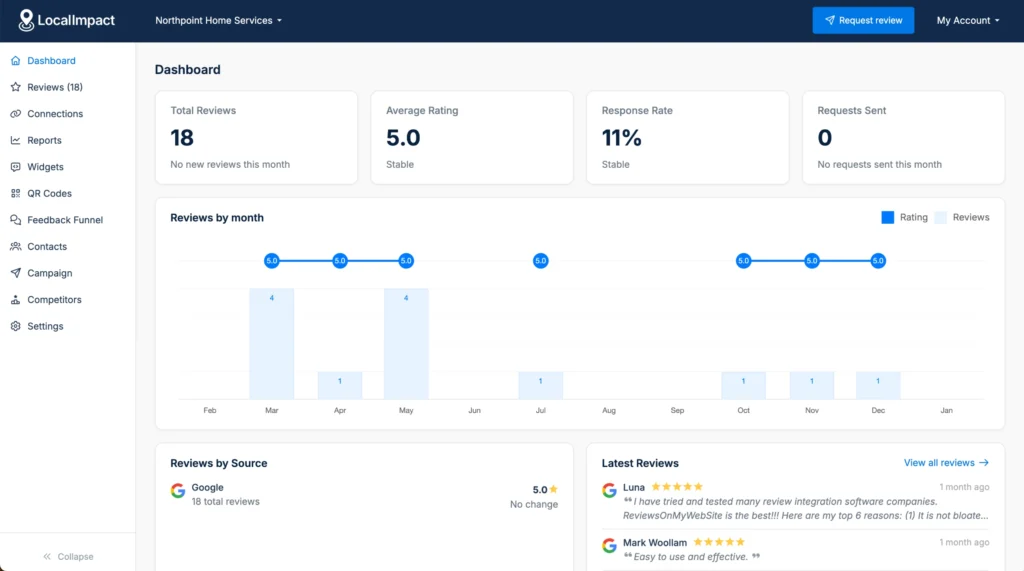
What rounds out the platform is the combination of AI-powered review replies, a customizable review widget, and a white-label option that agencies can sell under their own brand.
Key features
- Automated review requests: Sends personalized SMS and email review invitations with follow-up sequences to keep response rates high without manual chasing.
- AI review replies: Generate context-aware responses to reviews in seconds, with editing tools to adjust tone, length, and clarity before publishing.
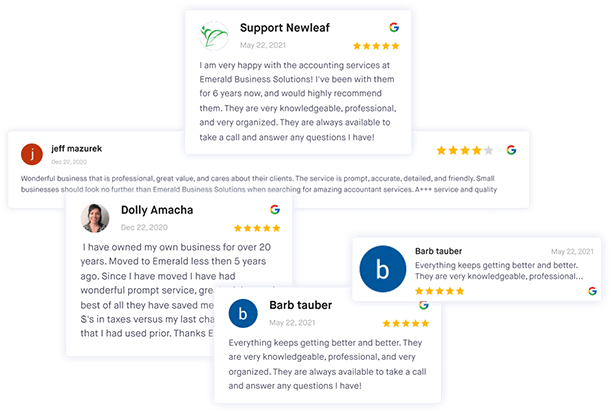
- Review widget: Embeds Google and multi-platform reviews on any website using a copy-paste snippet, with eight display styles including carousel, grid, and rating badge.
- Feedback funnels: Route happy customers toward public review platforms while giving unhappy customers a private channel to share concerns first.
- Social sharing: Turn standout reviews into branded social media graphics in seconds, with customizable templates that match brand colors and fonts.
- White-label dashboard: Lets agencies rebrand the entire platform with a custom logo, favicon, and domain for a fully branded client experience.
What users say
Reviewers consistently highlight how quickly LocalImpact gets set up and how reliably the automation handles review collection in the background, with the responsive customer support team getting frequent mentions.
"The platform is extremely easy to set up and integrate with my existing website. The dashboard is simple to navigate, and the automation tools save me time collecting and displaying reviews.
Customer support is quick to respond and always helpful."
Pricing
LocalImpact offers a 14-day free trial with no credit card required.
Paid plans include:
- Growth ($49/month)
- Pro ($99/month)
- Agency ($149/month)
Manage your online reputation with ease
Monitor, manage, and get more online reviews for your business with LocalImpact.
2. Birdeye
Birdeye positions itself as an agentic marketing platform built specifically for multi-location brands, with AI agents handling review generation, response, listings, social posting, and customer insights across all locations.
Birdeye's AI execution layer goes deeper than most reputation tools, with separate agents configured for each marketing function rather than a single generic AI helper.
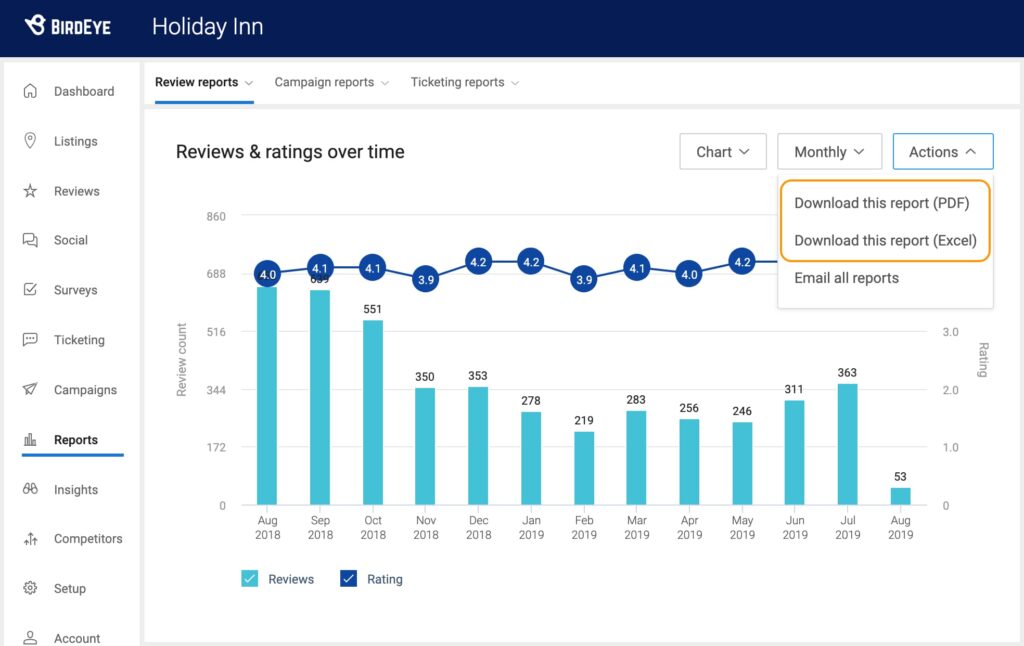
Most relevant for an SEO reputation context, the Reviews AI module pulls reviews from 200+ sites into one dashboard, runs A/B tests on review request templates to lift response rates, and uses sentiment-aware AI to draft on-brand replies.
Key features
- Review Generation Agent: Runs A/B tests across subject lines, templates, sites, and channels to identify the best review request combination, then sends requests at optimal timing.
- Review Response Agent: Generates personalized, on-brand replies by interpreting review sentiment, urgency, and even photos attached to reviews.
- Multi-site monitoring: Tracks 200+ review sites from a single dashboard with location-level filtering and team assignment workflows.
- Reputation Score: Aggregates reviews across all sources and locations to produce a single brand health metric, with location and competitor benchmarking.
- Insights AI: Surfaces sentiment trends by category and location, with quick action buttons to assign tickets or generate responses to negative feedback.
- Review widgets and social sharing: Displays top reviews on websites with AI-summarized highlights, and converts standout reviews into social media posts with one click.
Pros & cons
Pros
- Strong AI agent architecture that automates review generation and response at scale
- Coverage of 200+ review sites with mature integration into 105+ business systems including most major CRMs and PMS platforms
- Location-level reporting that genuinely works for enterprises managing hundreds of locations
- HIPAA, SOC 2, and GDPR compliance out of the box for regulated industries
- Responsive customer support and onboarding teams consistently praised in user reviews
Cons
- Pricing isn't published publicly and skews toward enterprise budgets
- Onboarding takes about a month given the depth of features available
- AI-generated review replies occasionally need manual adjustment to feel less templated
What we like
The Reputation Score and competitive benchmarking work together in a way that goes beyond standard review aggregation.
Seeing how each location performs against direct competitors in the same market makes it much easier to identify which locations need attention and which competitors are actively running review collection campaigns worth responding to.
What users say
Reviewers consistently highlight how Birdeye centralizes review management across many locations, with the AI response automation and unified dashboard getting the most positive mentions from teams managing 50+ locations.
"I've been using Birdeye for about 2 years, and the biggest value is having reviews, customer messages, and location-level feedback all in one place.
The dashboard is easy to check daily, and it saves a lot of time compared to jumping between different review sites. I also like the AI/review insights because it helps spot common customer issues faster."
A common piece of feedback is that the AI-generated responses can occasionally feel templated even after tone adjustments, with users wanting more personalization options.
"I'd really appreciate more personalized AI referral replies. Even when I switch the tone to 'friendly,' the responses still feel robotic and don't sound very natural."
Pricing
Birdeye doesn’t share its pricing publicly. You’ll need to reach out to the company’s sales team to get a quote.
3. Reputation
Reputation positions itself as a "Reputation Performance Engine" built specifically for the AI era, with 15 years of industry-specific development behind the platform.
Spending time in the dashboard, what stands out is how much the platform leans into natural language querying, with the Reputation IQ module letting teams ask questions in plain English instead of building reports.
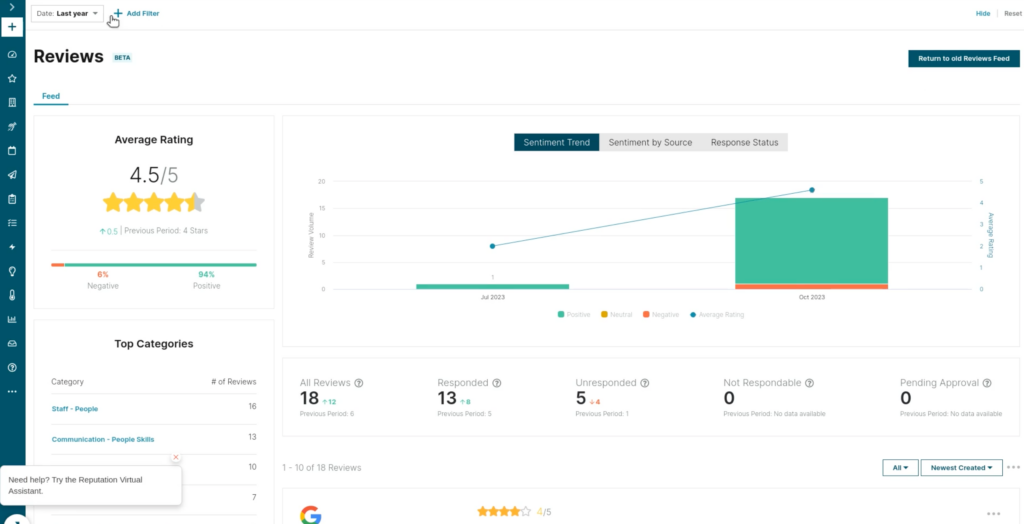
The platform centralizes reviews, listings, surveys, and social into one workflow, with Rep Score functioning as a single brand health metric across nine factors.
Most useful for an SEO reputation context, the AI Response Engine drafts replies matched to brand voice, while the Visibility Scorecard shows how prepared each location's listings and content are for AI-driven discovery and Google's AI Overviews.
Key features
- Reputation IQ (Ask Anything): Type questions in plain English across review data, surveys, and competitive benchmarks and get answers without exports or filtering.
- Reviews & Review Booster: Triggers SMS or email review requests after customer interactions and centralizes feedback from Google, Yelp, Facebook, and industry-specific sites.
- AI Response Engine: Drafts brand-aligned replies for reviews, comments, and surveys with sentiment analysis built in.
- Journey Insight: Maps sentiment across discovery, purchase, service, and follow-up phases to pinpoint where loyalty breaks down.
- Competitive Insights: Benchmarks rating, sentiment, volume, and topics against competitors at both brand and location levels.
- Actions workflows: Converts negative feedback into routed tickets with tracking, SLAs, and escalation paths across locations.
- Visibility Scorecard: Audits how well listings and content are structured for AI-powered search results.
Pros & cons
Pros
- AI-native architecture rather than retrofitted AI features bolted onto older infrastructure
- Reputation IQ removes the analyst bottleneck by letting non-technical users query feedback data directly
- Strong industry-specific tuning for automotive, healthcare, real estate, financial services, and care & living
- Rep Score provides a single, trackable metric across nine factors for executive reporting
- HIPAA and CCPA compliance for regulated verticals
Cons
- Implementation typically takes about 2 months given the depth of configuration
- Reporting customization can feel rigid when teams need granular, custom-merged data views
- Social media tools feel less developed than dedicated social suites
What we like
The combination of Rep Score and Journey Insight gives leadership a single number to track while still letting operations teams drill into exactly where in the customer lifecycle sentiment is dropping.
That pairing makes it easier to connect a falling score to a specific touchpoint and fix it, rather than just watching the metric move without context.
What users say
Reviewers consistently highlight the centralized dashboard and ease of managing reviews across many locations, with the AI response features and Rep Score earning the most positive mentions from enterprise teams.
"I really appreciate how easy Reputation is to use, which makes it a pleasure to manage our customer satisfaction follow-ups and reviews.
Having everything in one place is a significant advantage because it streamlines the process of sending surveys and addressing reviews efficiently."
One area users mention is the reporting section, where navigation and customization could be smoother.
"The look and feel of the reporting section could be improved to be more user-friendly.
For example, adding a search bar to help users quickly find specific reports would be more efficient than having to click through arrows one by one to see what's available in each category."
Pricing
Reputation doesn’t offer a free trial. Plans are priced per location, per month, with optional add-ons and managed services available.
Paid plans include:
- Rep Core ($80/location/month)
- Rep Core + Pulse ($115/location/month)
- Rep Core + Surveys ($150/location/month)
4. Podium
Podium has evolved from a review collection tool into a broader AI communications platform, with its "AI Employee" (branded as Jerry) handling lead response, appointment scheduling, and review requests around the clock.
Podium ties review generation tightly into the broader customer conversation workflow, with review invites triggered automatically after texting, calling, or payment interactions.
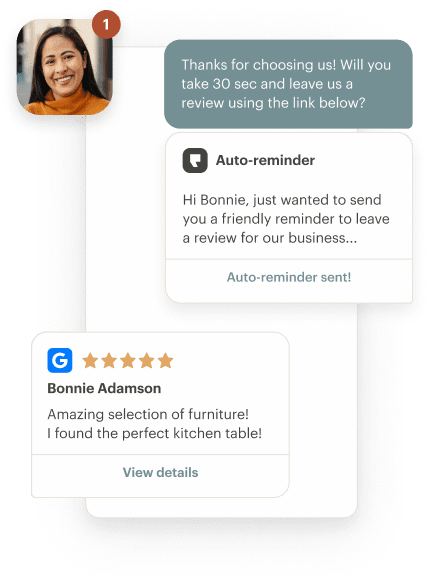
The reviews module specifically focuses on collection volume and Google ranking impact, with the AI Reputation Specialist drafting personalized responses to incoming reviews and chasing customers for review submissions after service interactions.
Key features
- AI Reputation Specialist: Crafts review invites with customizable messaging and generates personalized responses to incoming reviews automatically.
- Review Automations: Triggers SMS-based review invites and reminders so review requests go out consistently after every customer interaction.
- All-in-One Inbox: Consolidates reviews across Google, Facebook, and other platforms with messages, calls, and webchat in a single feed.
- Industry-trained AI Employee: Pre-trained on 10+ years of industry-specific data for automotive, home services, healthcare, and retail verticals.
- DMS/CRM integrations: 200+ integrations including ServiceTitan, HubSpot, Housecall Pro, Salesforce, and most automotive DMS platforms.
- Comprehensive Reporting: Tracks review volume, attribution, and detailed performance metrics with contact profile sync.
Pros & cons
Pros
- Strong SMS-based review request automation that produces noticeable volume lifts
- Tight integration with home services and automotive software like ServiceTitan, Housecall Pro, and major DMS platforms
- AI Employee handles after-hours lead response and appointment booking on top of reviews
- Easy initial setup with implementation typically completed within a month
Cons
- Contract terms include annual auto-renewal that some users find restrictive
- Advanced features sit behind higher-tier plans that smaller businesses may not need
- Review collection captures more star ratings than detailed written feedback in some cases
What we like
The way Podium ties review requests directly to the moment of payment or post-call interaction works well because timing matters for review collection.
Triggering a request via SMS the moment a customer pays an invoice or finishes a service call captures feedback while the experience is fresh, which produces measurably higher response rates than email-based requests sent hours later.
What users say
Reviewers consistently praise the automation around review collection and the unified inbox that ties reviews to broader customer conversations.
"We chose Podium Reviews because of ease. And there was a noticeable bump in reviews when we started the automation."
A common piece of feedback is around pricing, with smaller businesses finding the platform expensive relative to their needs.
"It can be expensive compared to similar tools, especially for small businesses. Some features feel limited unless you upgrade to a higher plan."
Pricing
Podium doesn’t display its pricing publicly. You’ll need to reach out to the company’s sales team to get a quote.
5. Yext
Yext positions itself as an enterprise agentic marketing platform built around the Knowledge Graph, a verified data layer that feeds both traditional search engines and AI models like ChatGPT, Gemini, Perplexity, and Grok.
Yext connects review management tightly to listings and structured brand data, with the same verified location records powering review responses, distribution, and AI citations.
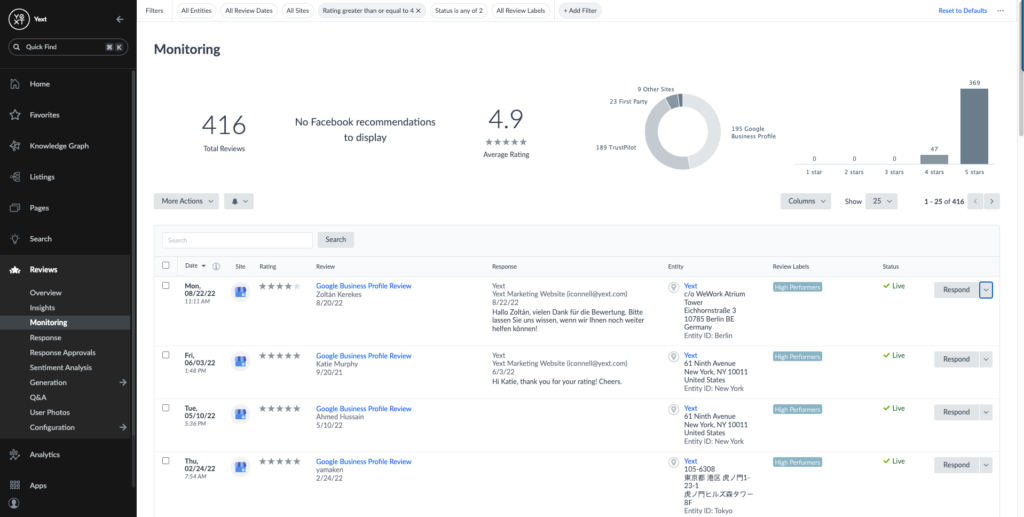
For SEO reputation specifically, the Reviews module pulls feedback from Google, Yelp, Facebook, and dozens of industry sites into one dashboard, with AI-powered response generation and a smart balancing algorithm that routes review requests to the platforms most likely to influence visibility.
Key features
- Multi-site review monitoring: Tracks reviews across Google, Facebook, Yelp, and dozens of industry-specific sites with smart filters and automated alerts.
- Smart review request routing: Yext's balancing algorithm directs review invites to the platforms most likely to lift visibility in both traditional and AI search.
- AI-powered response generation: Drafts personalized, on-brand review replies using templates and rules, with auto-response capability for appropriate situations.
- Review marketing: Embeds reviews on websites, pushes star ratings into Google Ads, and shares positive reviews to social channels in one click.
- Competitive benchmarking: Compares review performance against local competitors using a rolled-up score that factors in count, rating, recency, response time, and response ownership.
- Knowledge Graph integration: Connects verified brand data to review responses, listings, and AI distribution so consistency carries across every customer-facing channel.
- Scout visibility intelligence: Analyzes 10 billion signals across four AI models and 12 million locations to surface 150 visibility metrics against up to 20 competitors.
Pros & cons
Pros
- Knowledge Graph creates a single source of truth that powers both listings and review responses
- Strong analytics and custom reporting, particularly useful for teams managing hundreds or thousands of locations
- Translates well across financial services, healthcare, retail, hospitality, and food verticals
Cons
- Pricing skews high and isn't published publicly, making it harder to evaluate for mid-market budgets
- Implementation typically takes about 2 months and involves a noticeable learning curve
- Reporting interface can feel dense for new users navigating the platform for the first time
What we like
Yext's smart review request balancing is genuinely useful in a way most platforms aren't.
Instead of sending every customer to Google by default, the algorithm looks at where additional reviews will most lift overall visibility and routes requests accordingly.
For a multi-location brand that's already strong on Google but underweight on Yelp or industry-specific sites like DealerRater or Healthgrades, that routing logic produces measurably better distribution than blunt-force Google-only request workflows.
What users say
Reviewers consistently praise the analytics depth, centralized management across many locations, and the customer support team's responsiveness.
"I really like the analytics feature the most. We build our own custom reports instead of using predefined graphs, and I've found nothing nearly as robust as Yext on other platforms."
A common piece of feedback is that the platform has a steeper learning curve than some competitors, with the feature depth requiring time to navigate fully.
"The platform is very feature-rich, which is part of what makes it so effective. However, this comes with a learning curve. It takes time to get fully comfortable with everything Yext offers."
Pricing
Yext's pricing isn't available publicly. You'll need to reach out to the company's sales team to get a custom quote.
Manage your online reputation with ease
Monitor, manage, and get more online reviews for your business with LocalImpact.
6. NiceJob
NiceJob takes a different approach from the enterprise platforms higher up the list, focusing specifically on small and mid-size businesses with a set-and-forget reputation marketing system.
NiceJob streamlines the review collection workflow with automated SMS and email campaigns triggered the moment a job closes in connected systems like Jobber, Housecall Pro, or QuickBooks.
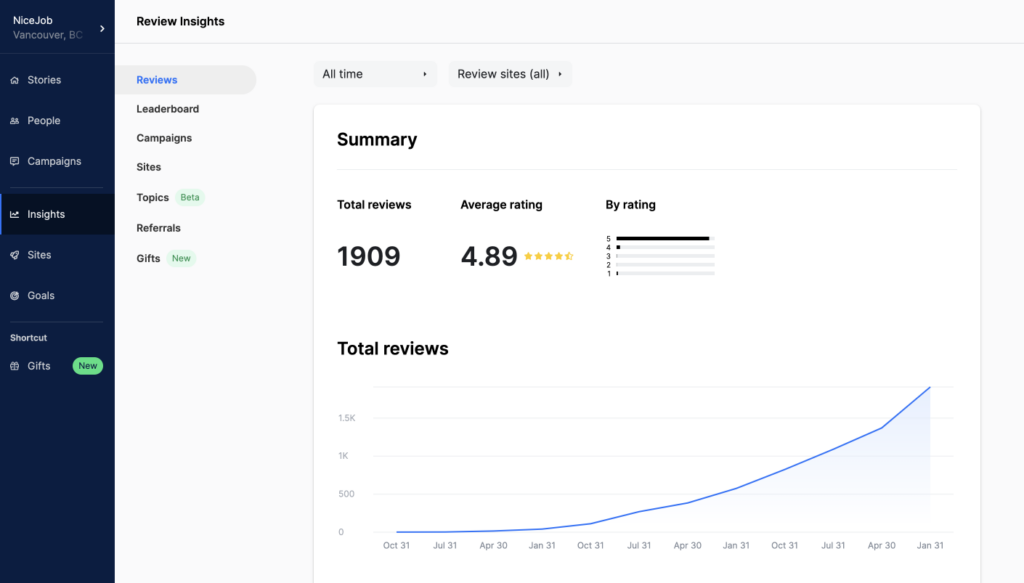
Beyond review collection, NiceJob bundles social proof widgets, AI reply generation, microsites, and referral tools, making it a broader reputation marketing system than pure review software.
Key features
- Automated review campaigns: Pre-built SMS-then-email sequence triggered automatically when jobs close in connected CRMs, with smart reminders to non-responders.
- AI Replies: Generates responses to incoming reviews using customizable tone, voice, and length settings, with rules for which reviews to auto-reply to (e.g., 3-star and above only).
- Social proof widgets: Embeds reviews on websites with trust badges, engage widgets, and microsites that aggregate reviews across Google, Facebook, and other sources.
- Auto social sharing: Turns top reviews into branded social media posts that reportedly drive 3x more engagement than text-only posts.
- Competitor Insights: Tracks competitor review counts, average ratings, customer sentiment, and seasonal trends (available on the Pro plan).
- Campaign analytics: Breaks down which sites drive the most reviews, frequency, volume, and average rating across review, referral, and gift campaigns.
Pros & cons
Pros
- Genuinely fast time-to-value, with most users seeing review volume lifts within the first month
- Strong integrations with home service CRMs including Jobber, Housecall Pro, ServiceTitan, Service Fusion, JobTread, and HoneyBook
Cons
- Integration list is smaller than enterprise competitors, especially for non-home-services CRMs
- Social proof widget customization options are limited for teams wanting tight design control
- AI Replies sits on the higher-tier Pro plan rather than the base Reviews plan
What we like
NiceJob's deep integrations with Jobber, Housecall Pro, ServiceTitan, and QuickBooks make it a natural fit for home service businesses. Review requests fire automatically the moment a job is marked complete in the field service tool, which catches customers at the point of peak satisfaction.
What users say
Reviewers consistently highlight how hands-off the review collection process feels once it's connected to a CRM, with the automation handling follow-ups without manual intervention.
"I really like the automation in NiceJob. It's synced with our CRM and is pretty much hands-off. Review invites are sent out automatically when a work order is completed in our CRM, which is great."
One area users mention is the limited customization on the website widgets that display collected reviews.
"I don't like the widgets and aspects that interact with the website to show reviews. I'd like more customization in terms of the number of reviews displayed, style, font, color, etc."
Pricing
NiceJob offers a 14-day free trial that does not require a credit card.
Paid plans include:
- Reviews ($75/month)
- Pro ($125/month)
- Sites add-on ($99/month + $199 setup fee)
7. GatherUp
GatherUp was built by local SEO practitioners, and that origin shows throughout the platform.
GatherUp's dashboard maps tightly to a Listen, Understand, Engage framework, with each stage matched to specific tools rather than a single sprawling feature set.
The agency-focused positioning is genuine, with full white-label options that let agencies brand the platform as their own and resell it to clients.
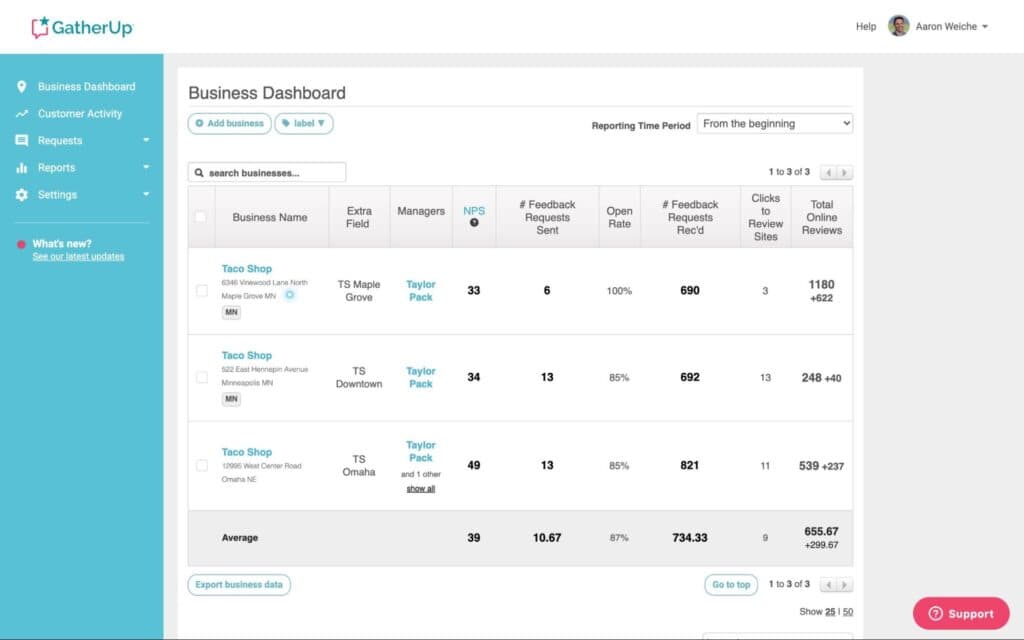
The reviews module pulls feedback from over 100 sites including Google, Facebook, Yelp, Glassdoor, OpenTable, and Indeed, and uniquely monitors Google Q&A alongside standard review monitoring.
The platform combines first-party feedback collection with NPS surveys, sentiment analysis, and review widgets that display 1st and 3rd party reviews on websites with structured data markup.
Key features
- Multi-channel review requests: Sends automated review requests via email and SMS with personalization, segmentation, and scheduling, plus a Web-to-Text widget for converting site visitors into SMS conversations.
- 100+ review site monitoring: Tracks reviews across Google, Facebook, Yelp, Glassdoor, OpenTable, Indeed, and uniquely Google Q&A.
- SmartReply and AutoReply: AI generates personalized, human-sounding responses that match review sentiment, with AutoReply handling positive reviews automatically and Suggested Replies drafting tailored responses for negative feedback.
- Auto-Tagging and Smart Tags: Automatically applies custom tags to keywords in reviews and uses AI to surface the 10 most common themes without manual tag creation.
- Review Defense: Detects and disputes fake reviews automatically across locations, with three plan tiers covering up to 15 local competitors.
- NPS surveys and Performance Reports: Combines NPS scoring with review and request data into weekly or monthly reports per location.
- White-label platform: Lets agencies brand the platform as their own, set their own pricing tiers, and deliver reputation management to clients from 1 location to 100+.
Pros & cons
Pros
- True white-label option with agency-friendly pricing structure that supports healthy margins
- Quick time to implement (under 1 month per G2 data) compared to most enterprise alternatives
- Strong customer support consistently praised across user reviews
- Review Defense is a differentiator for clients worried about fake review attacks
- Integrates with Google Q&A monitoring, which most competitors don't cover
Cons
- Review widgets feel dated compared to newer platforms, with limited modern design options
- No direct Yelp integration for posting reviews
- Customization options can feel limited for agencies needing tight design control
- Smaller integration ecosystem than enterprise competitors like Birdeye or Yext
What we like
The white-label model is the standout. Agencies can build a productized reputation management service under their own brand without needing to develop the underlying platform, which closes a real gap in the market between expensive enterprise platforms and DIY tools.
What users say
Reviewers consistently praise the onboarding experience, customer support, and how naturally the platform fits into agency workflows.
"I've thoroughly enjoyed getting familiar with this product, both for my own business and for clients I serve in my agency. GatherUp is like a missing puzzle piece I'm grateful to have finally found!
Not only is my own review-gathering process more streamlined, but I've got a new productized service I can sell to my clients."
A common piece of feedback is around the review display widgets, where users want more modern design options.
"The review display widgets for use on your company website are a bit dated. Really would love some more modern design options for those."
Pricing
GatherUp offers a 14-day free trial. Paid plans include:
- Single location ($99/month)
- Multi-location ($60/month per location)
- Agency (custom pricing)
8. Reviewshake
Reviewshake takes a hyper-focused approach to reputation management, concentrating on four pillars: managing reviews across 120+ sites, generating new reviews via automated invites, showcasing reviews for social proof, and analyzing review data with competitive benchmarking.
Reviewshake stands out for cost-effectiveness compared to enterprise alternatives while still offering the white-label option that lets agencies resell it under their own brand.
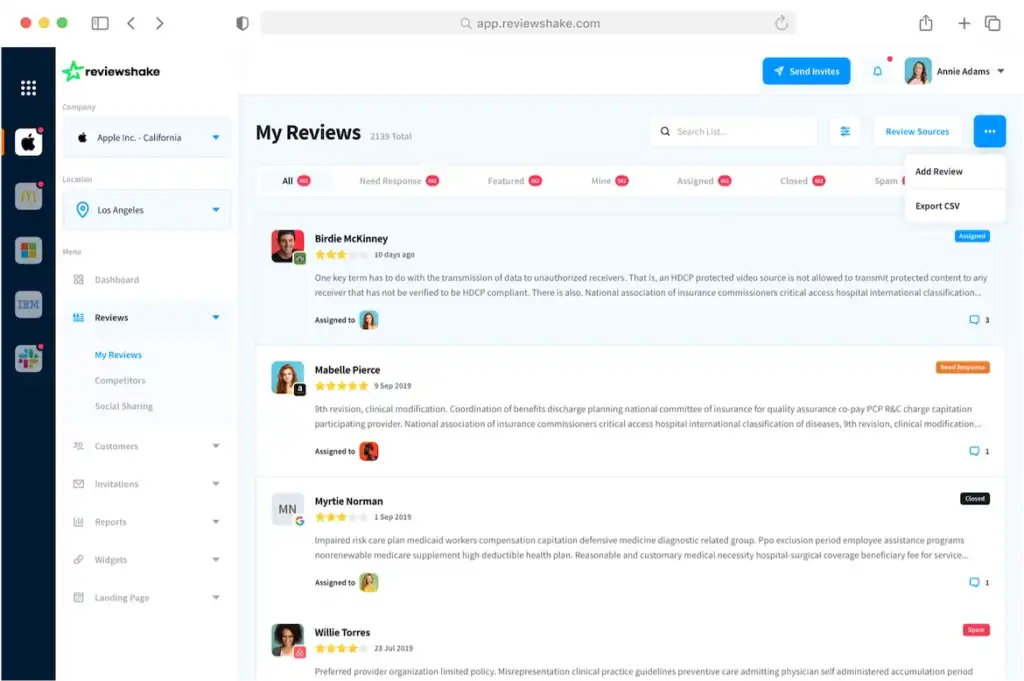
The platform combines multi-channel review requests (SMS, email, QR codes) with AI-powered response suggestions, sentiment analysis, and customizable website widgets that display live reviews from 80+ sources.
Key features
- Multi-channel review generation: Sends review invites via SMS, email, and QR codes with branded templates, automated reminders, and A/B testing on subject lines.
- 120+ site monitoring: Pulls reviews from Google, Facebook, and over 100 other platforms into a centralized inbox with real-time notifications.
- AI-powered reply suggestions: Generates on-brand, sentiment-matched responses that can be approved or edited before sending.
- Sentiment analysis and trends: AI-driven insights identify trends in customer feedback and competitor reviews with keyword tracking.
- Review widgets and Google highlights: Embeds responsive review widgets on websites in carousel, grid, or popup formats, plus pin top reviews to Google Business Profile.
- Auto social sharing: Automatically posts new 5-star reviews to Facebook and Google with branded layouts.
- White-label platform: Lets agencies fully rebrand the platform with their own logo, domain, and pricing tiers.
- Video reviews: A feature most competitors don't offer at this price point, useful for high-trust verticals like healthcare and legal.
Pros & cons
Pros
- Strong white-label option that lets agencies resell at their own margins
- Solid feature parity with more expensive platforms in core review management areas
- Video review capture is a useful differentiator for verticals where written reviews feel impersonal
Cons
- Direct integrations are limited, often requiring Zapier to connect to CRMs, POS systems, and other business tools
- Website widget design feels less polished than newer competitors
- One widget type per account limits flexibility for agencies serving diverse client design needs
- SMS isn't included in lower-tier plans
What we like
Reviewshake's video review capture is a feature most competitors at any price point don't offer.
Written reviews work fine for most local searches, but video testimonials carry significantly more weight in high-trust verticals like healthcare, legal, cosmetic surgery, and home services, where prospects want to see a real person describe their experience.
What users say
Reviewers consistently praise the white-label functionality and the platform's responsiveness to feature requests over time.
"We started using ReviewShake around 3 years ago to replace our old provider, Grade US. We wanted a solution that was more cost-effective with all the same features. ReviewShake gave us this and more.
The feature I like the most is the white labeling. We have now rebranded the platform as our own and a specialized solution to the niche that we serve."
One area users mention is the limited direct integration options, which often require Zapier as a workaround.
"Some downsides would include the need to use zapier instead of having internal integration functionality to bring customer data in without the need for additional software."
Pricing
Reviewshake offers a free trial you can use to test out the software. Paid plans include:
- Starter ($29/month)
- Growth ($59/month)
- Ultimate ($99/month)
9. ReviewTrackers
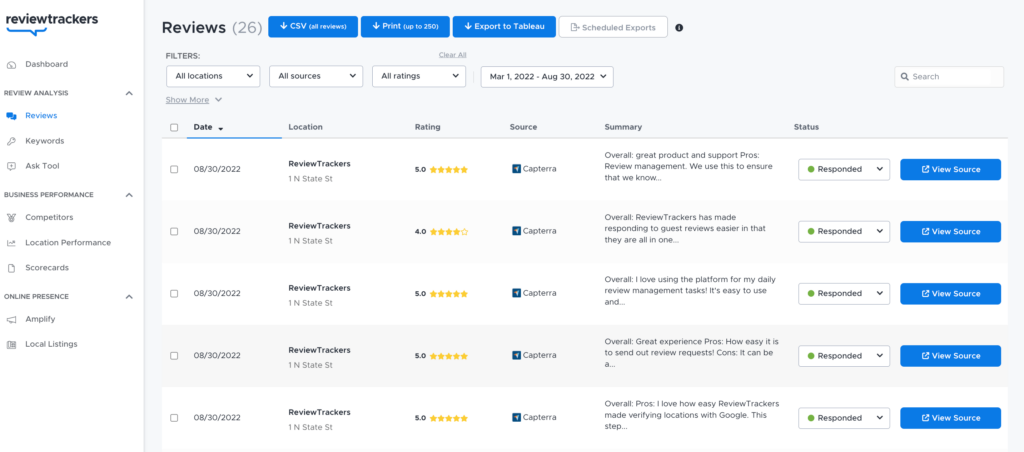
ReviewTrackers takes an analytics-first approach to reputation management, building the platform around customer voice intelligence rather than just review collection mechanics.
ReviewTrackers packs significant depth behind the reporting layer, with sentiment analysis, competitor benchmarking, and local search rank tracking integrated into the same workflow as standard review monitoring and response.
Key features
- Multi-directory review aggregation: Pulls reviews from top directories that drive revenue, including Google, Facebook, Yelp, TripAdvisor, and industry-specific sites.
- Smart Response templates: AI-generated review responses with personalized, on-brand templates that can auto-respond while maintaining brand voice.
- Competitor analysis: Tracks competitor reviews, ratings, and sentiment trends to surface market opportunities at the location level.
- Local search rank tracking: Monitors how locations rank in Google Maps and local search results.
- Local listing management: Maintains consistent business information across directories to support local SEO rankings.
- Hootsuite integration: Combines review monitoring with social media management in a single workflow for cross-functional teams.
- Amplify widget: Displays first-party reviews on websites with structured data markup to support SEO and conversion.
- API and 1,000+ integrations: Connects with CRMs, POS systems, and business intelligence tools to automate review workflows.
Pros & cons
Pros
- Strong analytics and reporting depth compared to most competitors at the same price point
- Mobile app provides genuinely useful on-the-go review management with push notifications
- Aggregation feature works smoothly across many directories and saves real time for multi-location teams
Cons
- Some reviewers note the platform can't always respond directly to certain review platforms like Yelp or TripAdvisor
- Notifications can be inconsistent when review sites disconnect, requiring occasional manual reconnection
What we like
The Hootsuite integration is a useful differentiator that most reputation tools miss entirely.
For brands where reviews and social mentions form two halves of the same conversation, having reviews and social engagement in a single workflow lets cross-functional teams respond cohesively rather than treating each channel as a separate operational silo.
What users say
Reviewers consistently praise the aggregation capability and how the platform makes monitoring many locations from a single dashboard genuinely manageable.
"At my company, reputation and reputation management is key. Review trackers gives us the opportunity to monitor all of our locations in one platform and makes it easy for our team to respond to all reviews.
The platform is easy to use and reporting is key for our leadership and executive team."
A common piece of feedback involves notifications when review sites disconnect, which some users say isn't always immediate.
"Sometimes if one of the review sites disconnect, it doesn't alert us, so it may take us a few weeks to notice."
Pricing
Pricing starts at $89/location/month.
10. Broadly
Broadly takes an AI Workforce approach to reputation management, bundling review automation with AI Receptionist, AI Sales Assistant, and AI Social Media Manager capabilities.
Broadly ties review collection tightly into broader lead conversion workflows, with the same AI assistant handling missed calls, web chat inquiries, and review requests across the customer lifecycle.
Key features
- AI Reputation Specialist: Generates on-brand review responses that match the tone and sentiment of incoming reviews automatically.
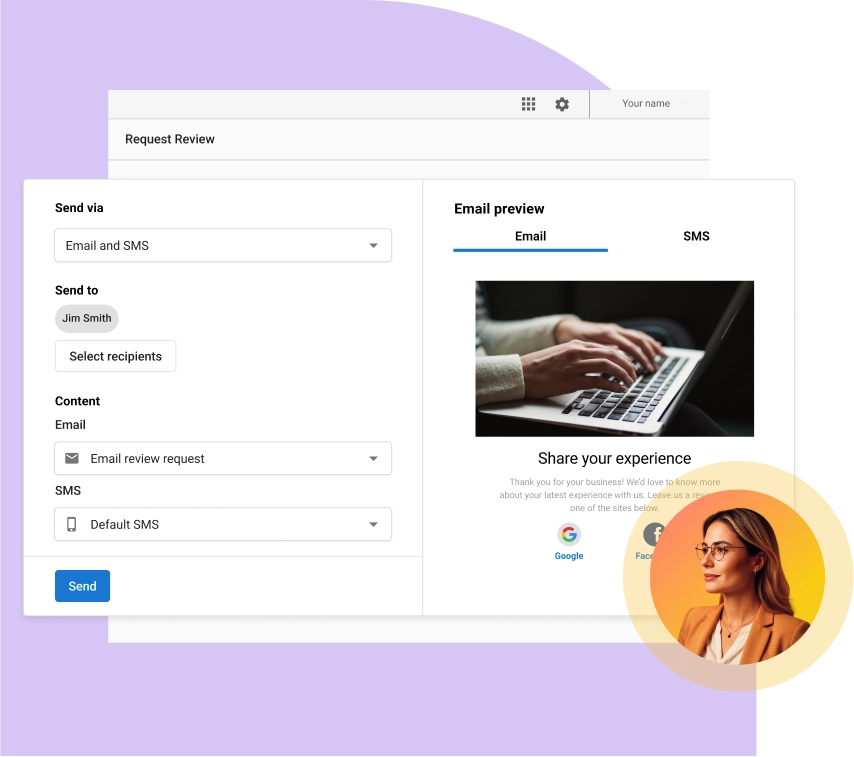
- Multi-channel review requests: Sends review invites via email or SMS after a job or purchase, with automated follow-ups built in.
- NPS surveys: Captures private customer feedback to identify happy customers worth asking for public reviews and surface issues before they become public reviews.
- Consolidated inbox: Brings reviews, SMS, web chat, Facebook, Instagram, and email into one place for centralized response management.
- Web Chat with AI: AI engages site visitors, answers common questions, captures contact info, and transitions conversations to SMS to keep leads engaged off-site.
- Local SEO: Maintains business listings across 40+ directories including Google, Facebook, Amazon Alexa, Foursquare, Yellow Pages, MapQuest, Siri, and CitySearch.
- CRM integrations: Connects with Jobber, QuickBooks, PetExec, ServiceTitan, Shopmonkey, Clio, and other industry-specific tools.
- Mobile payments: Lets local service businesses request and accept payments via SMS alongside review requests.
Pros & cons
Pros
- All-in-one suite that bundles reviews, web chat, payments, and AI assistants for local service businesses
- AI Receptionist handles missed calls and converts them into booked appointments
- Strong CRM integrations for home services, automotive, and pet service verticals
Cons
- Some users report contract terms that lock in for 12 months with auto-renewal
- Connecting multiple Google Business Profile locations sometimes requires separate accounts
- Web Chat doesn't always require email or phone field by default, which can result in unreachable inquiries
- Customer support quality has drawn mixed feedback in more recent reviews
What we like
The integration between AI Receptionist and Reputation AI works in a way that genuinely matters for local service businesses.
A missed call automatically triggers an SMS follow-up that captures the lead, and once the job is complete the same conversation thread triggers an automated review request.
What users say
Reviewers consistently praise how Broadly automates review collection without requiring manual follow-up, with many noting significant lifts in review volume after implementation.
"Broadly has saved me hours of time by completely automating the client review process. Setting up custom forms and following up with clients was very time consuming.
Once we signed up with Broadly our reviews skyrocketed and all we had to do was watch them roll in."
One area users mention is around contract flexibility, with some experiencing friction when trying to cancel or modify plans.
"They have unethical business practices. You are told about an initial 12 month term that you can't get out of."
Pricing
Broadly is priced at $799/month.
Manage your online reputation with ease
Monitor, manage, and get more online reviews for your business with LocalImpact.
11. TrueReview
TrueReview takes a focused approach to review management, concentrating on the mechanics that small businesses care about most: collecting more reviews via SMS and email, generating AI responses, and protecting against fake or policy-violating reviews.
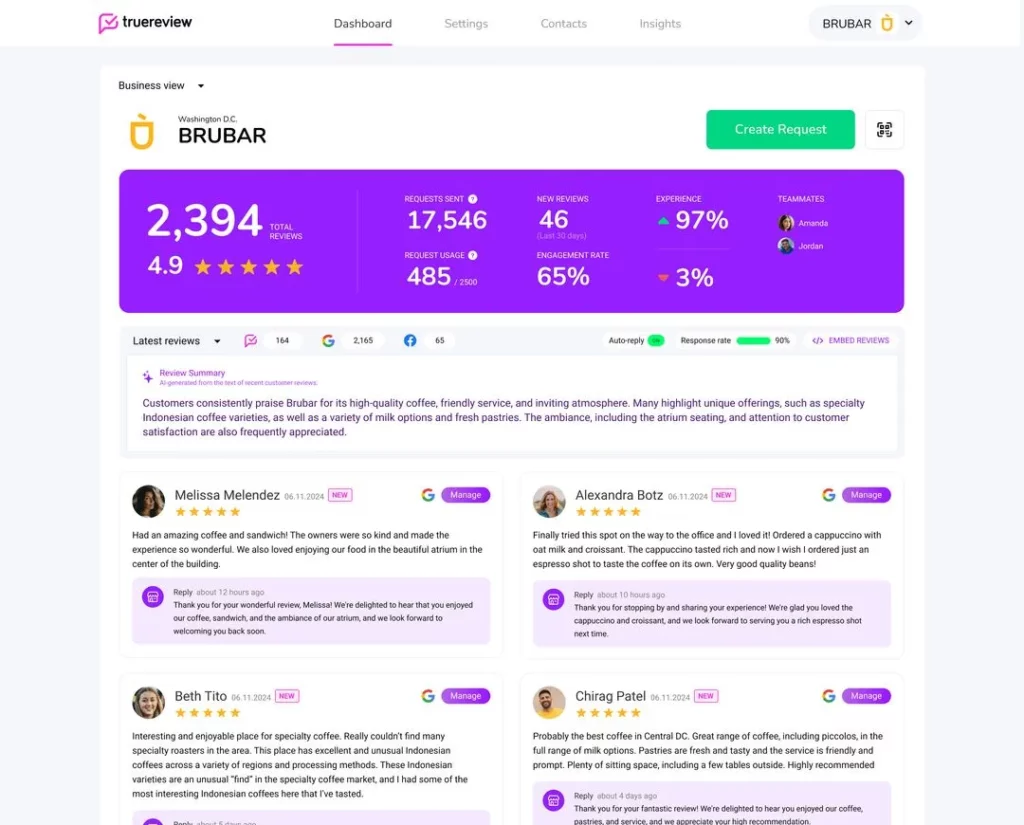
TrueReview's standout feature is Review Radar, an AI-powered tool that scans incoming Google reviews for potential policy violations and guides business owners through the correct reporting process directly to Google.
Key features
- SMS and email review requests: Sends personalized review invites with branded templates, customer name personalization, and automated multi-step follow-up sequences.
- Review Radar: AI-powered detection of potential Google policy violations including bullying, hate speech, spam, and misinformation, with the correct reporting category surfaced for each flagged review.
- AI Review Response Generator: Creates unique, on-brand responses to reviews with selectable tones (professional, friendly, grateful, direct) and automatic language detection.
- Automated review replies: Schedules automatic replies to new Google and TrueReview reviews using AI or templates with rules based on star rating.
- AI auto-tagging: Automatically categorizes incoming reviews by sentiment, services, or key themes for easier filtering and trend identification.
- Customizable embed widgets: Displays reviews from Google, Facebook, Zillow, BBB, and 20+ other platforms on websites in list or column views.
- Drip campaigns: Multi-step SMS and email sequences with custom delays, follow-up timing, and engagement-based logic.
- CRM integrations: Connects with ServiceTitan, Square, Acuity Scheduling, LionDesk, Google Contacts, Mangomint, plus thousands of apps via Zapier or API.
Pros & cons
Pros
- Review Radar is a genuine differentiator for businesses regularly targeted by fake or malicious reviews
- AI Reply tone selector adds genuine personalization that most competitors don't offer at this price point
Cons
- Base Starter plan limits AI response suggestions to 5 per month, which can feel restrictive
- Direct integrations are more limited than enterprise platforms, with Zapier handling most third-party connections
- Multi-location support starts at the Premium tier ($179/month) and adds cost per additional location
- Some users want richer detailed reports earlier in their usage rather than after 30+ review requests
What we like
Review Radar is the standout feature, and it works in a genuinely useful way for small businesses that don't have time to manually scan every incoming review for policy violations.
The AI flags potential issues, explains why each review may violate Google's policies, and surfaces the correct category for reporting.
What users say
Reviewers consistently praise how straightforward the platform is to set up and how quickly review volume increases after implementation.
"I was looking for the right review service and TrueReview came in clutch with easy setup and integration. Also, they have great customer service.
I had a few basic questions and they were all answered promptly.
Everything looks great and goes well with our branding and online presence, which is hard to find."
One area users mention is around viewing detailed reports earlier in their use of the platform.
"It's taking us a while to send 30+ reviews to see all of the insights. I'm curious even with the few we've sent what the response rate is or where we're losing the customer."
Pricing
TrueReview offers a 14-day free trial with up to 250 review requests, no credit card required.
Paid plans include:
- Starter ($49/month)
- Small Business ($99/month)
- Premium ($299/month)
12. Grade.us
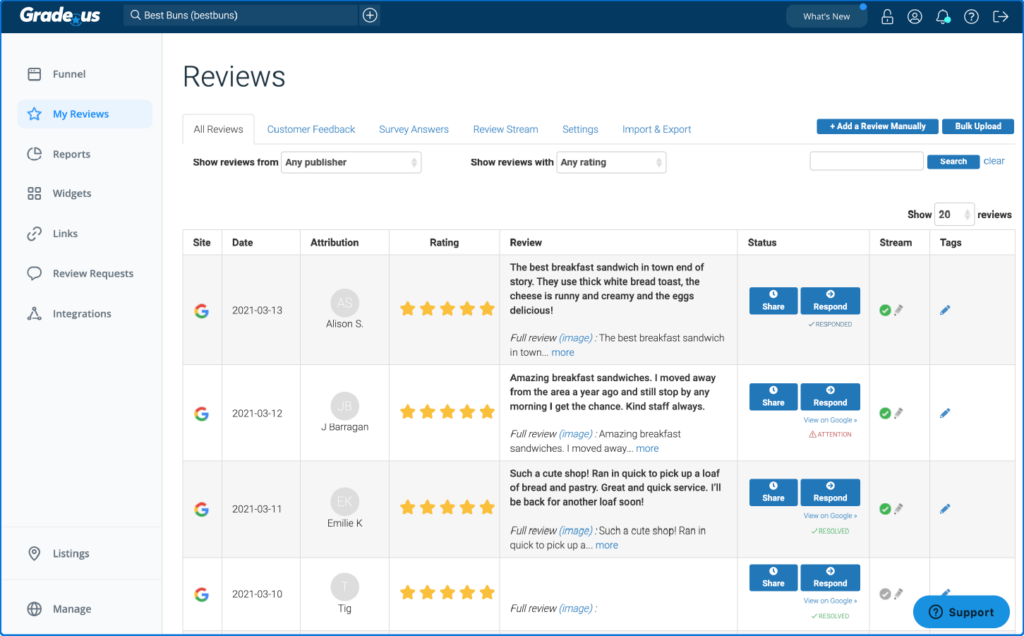
Grade.us takes an agency-first approach to review management, building the platform specifically around the workflows that consultants, SEOs, and marketing agencies need when servicing multiple local business clients.
Grade.us offers deep white-label customization, letting agencies fully rebrand the software with their own logo, custom domain, and color scheme, then resell it to clients at their own margins.
Key features
- Customizable review funnel: A landing page that filters happy customers toward review sites while routing unhappy customers to a private feedback form, reducing the risk of negative public reviews.
- Email and SMS drip campaigns: Multi-step review request sequences with templates, automated follow-ups, and click-through tracking by campaign.
- 100+ site monitoring: Aggregates reviews from Google, Facebook, and 100+ major and industry-specific platforms including legal, healthcare, dental, automotive, real estate, hospitality, and home services directories.
- Full white-label platform: Agencies can customize the look, feel, logo, and custom domain so the platform appears as their own product to clients.
- Schema-friendly review widgets: Embed widgets and a WordPress plugin display reviews on websites with structured data markup that supports rich snippets in search results.
- Automated social sharing: Posts new positive reviews automatically to Facebook with customizable images and content attribution.
- Sentiment analysis and word clouds: Interactive reports surface trends from positive and negative reviews to inform service or product decisions.
- Granular agency reporting: Tracks review funnel conversion rates, campaign open rates, click-throughs, customer recovery from feedback forms, and aggregate ratings across multiple clients or locations.
Pros & cons
Pros
- Strong white-label and multi-client management features purpose-built for agencies
- Schema-friendly widget and WordPress plugin support structured data markup that helps with rich snippets in search results
- Detailed reporting designed specifically for demonstrating ROI to agency clients
Cons
- User interface feels dated compared to newer platforms in the space
- Some users mention limited integration options and want API documentation improvements
- Configuration can be inflexible in places, making certain white-label edge cases harder to handle
What we like
The agency-centric design philosophy comes through clearly in the reporting layer. W
here most platforms treat agency use as a side feature, Grade.us builds the dashboard around multi-client management, with conversion metrics for each client's review funnel, campaign-level click-through data, and customer recovery rates from the private feedback form.
What users say
Reviewers consistently praise the white-label functionality and how it lets agencies onboard new clients quickly while presenting a polished, branded review management service.
"Very easy to use and set up new clients. The onboarding process is less than 10 minutes per client. And the customer support has been great. The few times I've had questions/issues they team has been quick to respond and resolve everything.
You can easily embed the code into websites and also set up email drip campaigns to ask for feedback from recent customers/patients."
A frequent observation involves pricing, with some users noting it can feel high when scaling across many client accounts.
"One downside is that pricing can feel a bit high, especially for smaller teams or when scaling across many clients.
Also, while customization is available, some areas like email templates or campaign flows could be a bit more flexible and modern."
Pricing
Grade.us offers the following pricing plans:
- Small Business ($124/month for one location)
- Multi Location ($75/month/location)
- Agency (custom pricing)
How to choose the right SEO reputation management tool for you
Picking the right reputation management platform comes down to matching the tool's strengths to your actual workflow, not chasing the longest feature list:
- Match the platform to your business size: Single-location owner-operators rarely need enterprise-grade analytics, while multi-location brands need rollup reporting that smaller tools simply can't provide. Pick a platform whose pricing structure and feature depth fit your scale today, with room to grow.
- Check the integrations against your existing stack: Review tools earn their cost back when they fire requests automatically from your CRM, field service software, or POS system. Make sure the platform you choose integrates natively with the tools you already run, or at least has solid Zapier connectivity for the rest.
- Look at total cost, not just the headline price: Add-ons like SMS credits, listings management, and per-location fees can multiply the base price quickly. Map out what features you actually need and price out the realistic monthly cost before signing anything.
- Prioritize review request channels you can actually use: SMS review requests typically convert at much higher rates than email, but only if your customers have opted in and you have valid mobile numbers. Some platforms charge extra for SMS credits, so factor that into your evaluation.
- Test the response workflow before committing: Responding to reviews is where most of the daily work happens, so the response interface, AI suggestion quality, and team assignment workflow matter more than the marketing material suggests. Use the free trial to actually respond to a few reviews before subscribing.
Most of these platforms offer a free trial or demo, so use that window to put the tool through your real-world workflow rather than just clicking around a dashboard. The right pick is the one your team will actually use consistently month after month.